
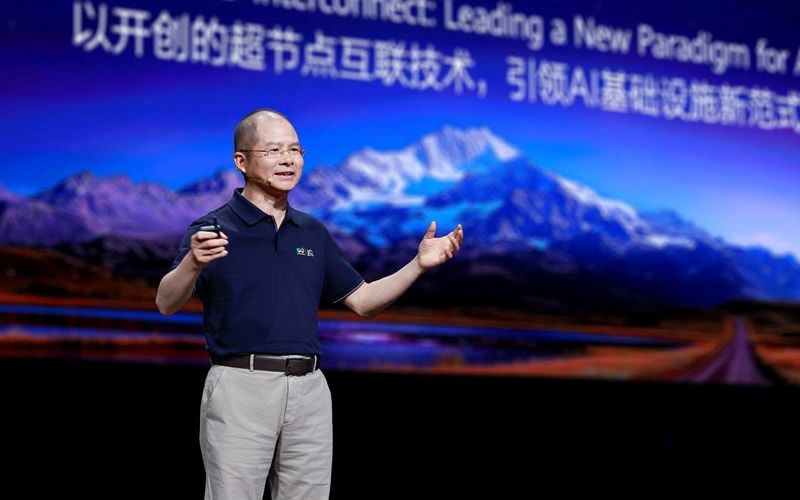
Xu noted: “Computing power is – and will continue to be – key to AI. This is especially true in China.” He reiterated that Huawei’s goal is to sustainably meet long-term computing demand by building superpods and superclusters with the semiconductor manufacturing process nodes that are practically available to the Chinese mainland.
A superpod is a single logical machine, made up of multiple physical machines that can learn, think, and reason as one. Xu unveiled the company’s newest superpod products: the Atlas 950 SuperPoD (with 8,192 Ascend NPUs) and the Atlas 960 SuperPoD (with 15,488 Ascend NPUs). These two superpods will deliver an industry-leading performance across multiple key metrics, including the number of NPUs, total computing power, memory capacity, and interconnect bandwidth.
Based on publicly announced product roadmaps from peers in the industry, these superpods are currently the most powerful superpods in the world, and will remain so for years to come.
Xu also announced the Atlas 950 SuperCluster (with more than 500,000 Ascend NPUs) and Atlas 960 SuperCluster (with more than one million Ascend NPUs), which are large-scale computing clusters comprised of multiple Huawei SuperPoDs. These too are poised to outperform all other computing clusters on the market.
With the world’s most powerful superpods and superclusters, Xu said Huawei has what it takes to provide abundant computing power for ongoing, rapid advancements in AI, both now and in the future.
Xu went on to introduce the TaiShan 950 SuperPoD, the world’s first general-purpose computing superpod. The TaiShan 950 SuperPoD, combined with Huawei’s distributed GaussDB, can serve as a viable alternative to mainframes and mid-range computers, and even Exadata database servers.
To date, a major bottleneck for large-scale AI computing infrastructure is interconnect technology, namely the physical limitations of existing cable technology (both optical and copper) to link up massive numbers of chips and superpods over long distances while maintaining a reliable, high-speed, and low-latency connection. Huawei has honed its connectivity expertise over the past three decades. And by combining this expertise with a number of systems innovations, the company has overcome these challenges.
The result is UnifiedBus, a groundbreaking interconnect protocol for SuperPoDs. Xu also released the technical specifications for UnifiedBus 2.0, in the hopes that industry partners will adopt this protocol to develop more UnifiedBus-based products and components and jointly create an open UnifiedBus ecosystem.
“Superpods and superclusters powered by UnifiedBus are our answer to surging demand for computing, both today and tomorrow,” concluded Xu. “Our goal is to keep pushing advancements in AI to create greater value.”
Themed All Intelligence, HUAWEI CONNECT 2025 will delve into AI across three dimensions: strategy, technology, and ecosystems. At the event, Huawei will deep dive into its latest strategic initiatives and unveil its all-new digital and intelligent infrastructure products, scenario-specific solutions for industries, and development tools.
The event will run from September 18 to 20 at the Shanghai World Expo Exhibition & Convention Center and Shanghai Expo Center.
For more information, please visit HUAWEI CONNECT 2025 online at www.huawei.com/en/events/huaweiconnect
