
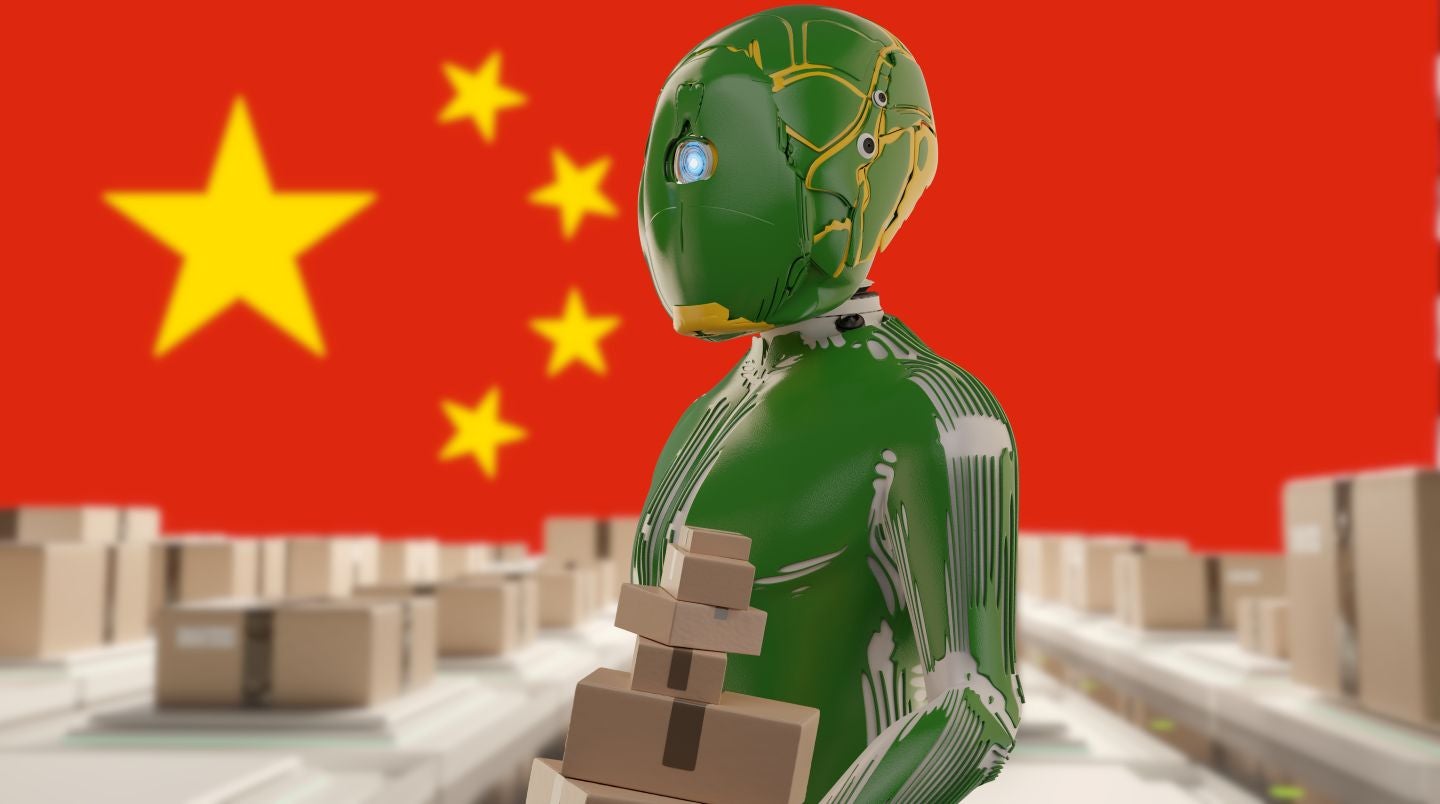
GlobalData defines a humanoid robot as a multi-purpose robot that resembles the human body, typically having a torso, a head, two arms, and two legs. It can perform tasks that mimic human actions, making it suitable for complex interactions in human-centric environments. Humanoid robots can be deployed industrially; however, they are also suitable as service robots and as personal household robots.
China’s ascent to a global robotics leader
China has cultivated its position as a global robotics leader, both humanoid and non-humanoid. Since at least 2014, it has led the world in annual installations of industrial robots, accounting for 54% of global installations in 2024. China also ranks third globally in robot density. As of 2024, 567 robots operate in China per 100,000 workers, behind South Korea (first) and Singapore (second).
Go deeper with GlobalData


Access deeper industry intelligence
Experience unmatched clarity with a single platform that combines unique data, AI, and human expertise.
China has until now relied heavily on foreign suppliers of industrial robots, especially from Japan. However, in 2024, a notable shift occurred. For the first time, Chinese manufacturers sold more robots domestically than foreign suppliers. Their domestic market share jumped to 57% in 2024, up from 47% in 2023.
Driving this transformation is a mix of supportive government policy and consistent innovation in enabling technologies such as AI, sensors, high-precision components, and batteries. At the same time, China has become a global manufacturing hub, particularly for automotive, electronics, solar panels, and batteries. This has accelerated robot adoption as companies rely on automation to scale production and remain cost-competitive.
China is winning the humanoid robot race
It is estimated that a total of 13,250 humanoid robots were shipped in 2025. Unitree and Agibot, both Chinese companies, are the global market leaders, accounting for 81% of humanoid robot shipments in 2025. Taking into account other Chinese humanoid robot manufacturers such as Galbot, UBTech, EngineAI, and Leju Robot, China is likely to have ~90% global market share.
Humanoid robots have quickly caught investor attention in China. In 2025, funding for humanoid robot manufacturers in China surpassed $1bn, with numerous notable funding rounds featuring key investors such as Alibaba, Bosch, CATL, Geely, JD.com, Tencent, and XPeng. Recipients of the funding include Galbot ($453m), Leju Robot ($210m), Robotera ($140bn), and EngineAI ($140m), among others. The year 2026 has already started strongly, with PsiBot raising $280m and Robotera raising another $140bn, both in March.
Unitree and Agibot, the world’s leading humanoid robot manufacturers, are preparing to IPO in 2026. Unitree is targeting a $7bn valuation on Shanghai’s STAR market, and Agibot is aiming for a $6bn valuation on the Hong Kong stock exchange.
US and European humanoid manufacturers are in pursuit
China is not alone in its pursuit of humanoid robots. In the US, Tesla, Boston Dynamics, Figure AI, and 1X are developing humanoid robots. Europe is also home to several humanoid robotics manufacturers, including Neura Robotics (Germany), Hexagon Robotics (Switzerland), and Wandercraft (France).
Tesla has made its Optimus humanoid robots central to its strategy in 2026 as its electric vehicle sales slump. In its Q4 2025 earnings call, Tesla confirmed it will discontinue production of its Model S and Model X vehicles in Q2 2026. The factory space in Fremont, California, which was previously dedicated to manufacturing these vehicle models, will be converted for mass production of Optimus robots.
Despite the global push towards developing humanoid robots, there is scepticism about the necessity of making them closely resemble humans. Some argue that the drive stems more from science-fiction fascination and media-driven expectations than from practical engineering or functional utility.
The primary advantage of humanoid robots is their capacity to integrate into environments built for humans, such as confined spaces and stairs, as well as dexterously holding utensils and tools. Moreover, human-like forms will be more engaging. Humanoids can offer psychological comfort and more intuitive interaction, especially in caregiving, education, and customer-facing services where body language, facial expression, and voice cues are essential. However, achieving convincing human likeness adds layers of mechanical and engineering complexity, and these trade-offs may negate the benefits when simpler, task-specific robots would suffice.