
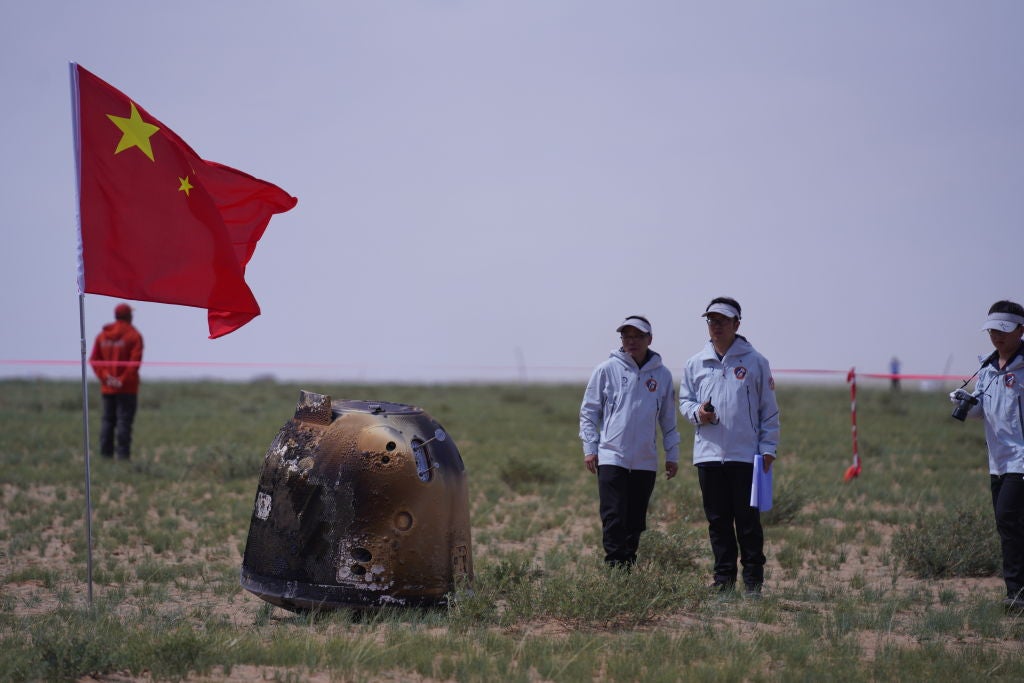
On Tuesday (25 June), China’s space mission Chang’e-6 returned to Earth with rare lunar samples from the Moon’s unexplored far side, after a 53-day mission.
According to GlobalData’s thematic intelligence report on the space economy, the scarcity of certain natural resources on Earth has encouraged greater research of the moon, as scientists focus on developing new means of obtaining resources.
Go deeper with GlobalData


Access deeper industry intelligence
Experience unmatched clarity with a single platform that combines unique data, AI, and human expertise.
The Chang’e-6 probe used a drill and an AI-generated robotic arm to collect rock and soil samples weighing approximately 4.4 pounds.
Scientists are hopeful that these samples may contain traces of ice, which can be used to extract water, oxygen, and hydrogen, according to the BBC.
Starting with the USSR’s Luna 16 robotic probe, there have been nine lunar missions that have retried samples from the Moon’s near side.
However, the China National Space Administration is the first space agency to successfully land on the far side of the Moon and retrieve samples.
China’s President Xi Jinping hopes that China can continue to “reach new heights in unravelling the mysteries of the universe”.
To compete with private US companies, the Chinese government is supercharging its patent effort and has begun to open its space economy to commercial companies, according to GlobalData. By 2021, Chinese companies Space Pioneer and iSpace raised over $300m each in funding.
The BBC reports that analysts anticipate the next chapter in the space race to be centred around which global superpower will dominate lunar resources.
GlobalData forecasts that the space economy will be worth between $760bn and $1trn in 2030, growing at a compound annual growth rate of between six percent and 10% between 2020 and 2030.