

From the number of teams, to the distances between them, and the variety of disciplines that must agree on design decisions, the complexities involved in modern car design are huge. Today’s vehicles pull together mechanical packaging, electronics, software, safety requirements, manufacturability and service access. Each area brings its own specialists, suppliers and standards.
These complexities mean traditional review processes struggle under that weight. The most consequential discussions continue frequently take place around monitors – a design team can struggled to get a true sense of scale for a new product. Unidentified design flaws can cause major issues further on in workflows; teams may discover a physical prototype has an awkward fastener, sub-optimal arrangement or an overlooked maintenance operation.
Additionally, new autonomous and electric vehicles are overhauling what cars look like on the inside: batteries, power electronics and software-defined features add new interfaces, but also new points of failure. Different regional regulations and the standards they must meet piles on complexity.
What is missing is a shared sense of presence around these complex digital twins. The ability for a global design team to look at the same product iteration, at true scale, in real-time, and to be able to capture key design decisions is critical.
The answer: Integrated design processes
Immersive Engineering is pushing the boundaries of what is possible in product design, heralding a new era in automotive collaboration. Engineers can open a vehicle’s digital twin and step into an immersive workspace based on extended reality (XR) – the family of technologies that includes virtual, mixed and augmented reality. There is no elaborate export or dataset duplication; every immersive environment runs on the same Designcenter NX™ software session.
The first advantage is scale. At 1:1, a participant can stand beside the front assembly or lean towards the wheel arch to understand immediately what a service technician will face. Navigation is simple; the out-of-the-box Ring and Pointing controller are there to intuitively move through the space, point to objects and select parts. Additionally, compatible controllers (think a PS5 controller) can also be used to navigate around the scene.
Next, orientation. An integrated assembly view lets reviewers highlight components of the model. The Section tool cuts cleanly through the car, exposing internal components previously unseen meaning clearances, routing and possible interference risks become visible to everyone.
When something needs closer inspection, the Transform tool lets users pick up, reposition and examine components in context. When a review is required on an intricate, deeply embedded car part – for example a gearbox, engine component or brake callipers – the ability to isolate and closely inspect it is invaluable. Doing so can show how a proposed fix may create a new problem elsewhere and eliminate issues before they arise.
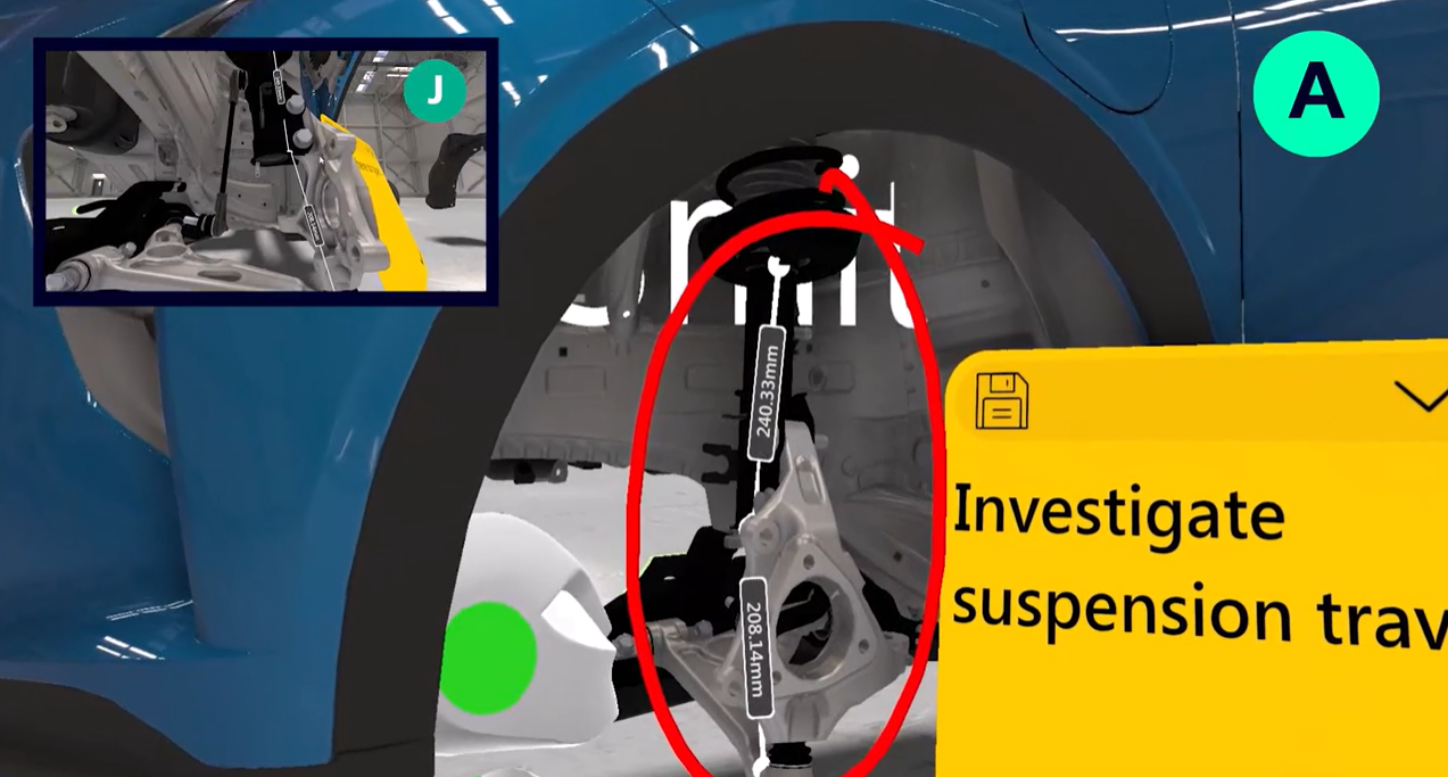
A range of tools in the immersive environment help keep designs on track. The use of accurate measurements mean reviewers can add dimensions to features, referencing exact points and surfaces and tracking changes down to the millimetre. Mark-up tools allow users to highlight areas that require attention, then capture viewpoints as a common reference that any participant can return to – whether they are in the headset or joining from desktop. Comments can be attached as simple notes against specific locations, adding further context to design changes.
All the tools a designer could need are present within Immersive Engineering. A virtual monitor can be placed, resized and positioned based on the users preference. On that monitor sits Designcenter NX, where engineers can make changes directly in the native CAD environment with the model still visible.
Some participants will prefer headsets for spatial judgement. Others may join without one, using a conventional screen. Critically, wherever a stakeholder is based and whatever their role, they can access the immersive environment in a way that works for them. It represents a neutral ground where expertise is shared and decisions are recorded.
The power of Immersive Collaborator
Siemens’ Immersive Collaborator stand outs for its ability to bridge geographical divides and bring teams, sites and regions together. By integrating live updates and design changes into meetings, it allows participants to observe and interact with ongoing modifications. Its reach is truly global; it can connect design leads in Europe and engineering teams in India and North America.
Immersive Collaborator supports a shared virtual environment where stakeholders gain and act on insights by reviewing colleagues’ design decisions and merging disparate workflows. This integration of Immersive Engineering accelerates design productivity and fosters innovation, connecting people and departments to make instant decisions based on a single source of truth.
Partnerships driving a collaborative future
Siemens Immersive Engineering is an immersive environment designed for detailed engineering review, connected to a core CAD dataset. A single shared design room for dispersed teams, suppliers and internal groups can meet in a collaborative environment, examine products at scale and capture design intent.
The benefits for automotive manufacturers are wide-ranging. Automotive development can stumble at the handover points: design to manufacturing, engineering to supplier, concept to detailed packaging. Immersive Engineering reduces friction by making avoidable misunderstandings a thing of the past. By slashing errors and decision times, and bringing teams from across the globe together, it offers a blueprint for adapting to the next generation of car design. Early adopters are poised to lead the industry into the future and you could be one of them. Fill in your details now to learn more.
