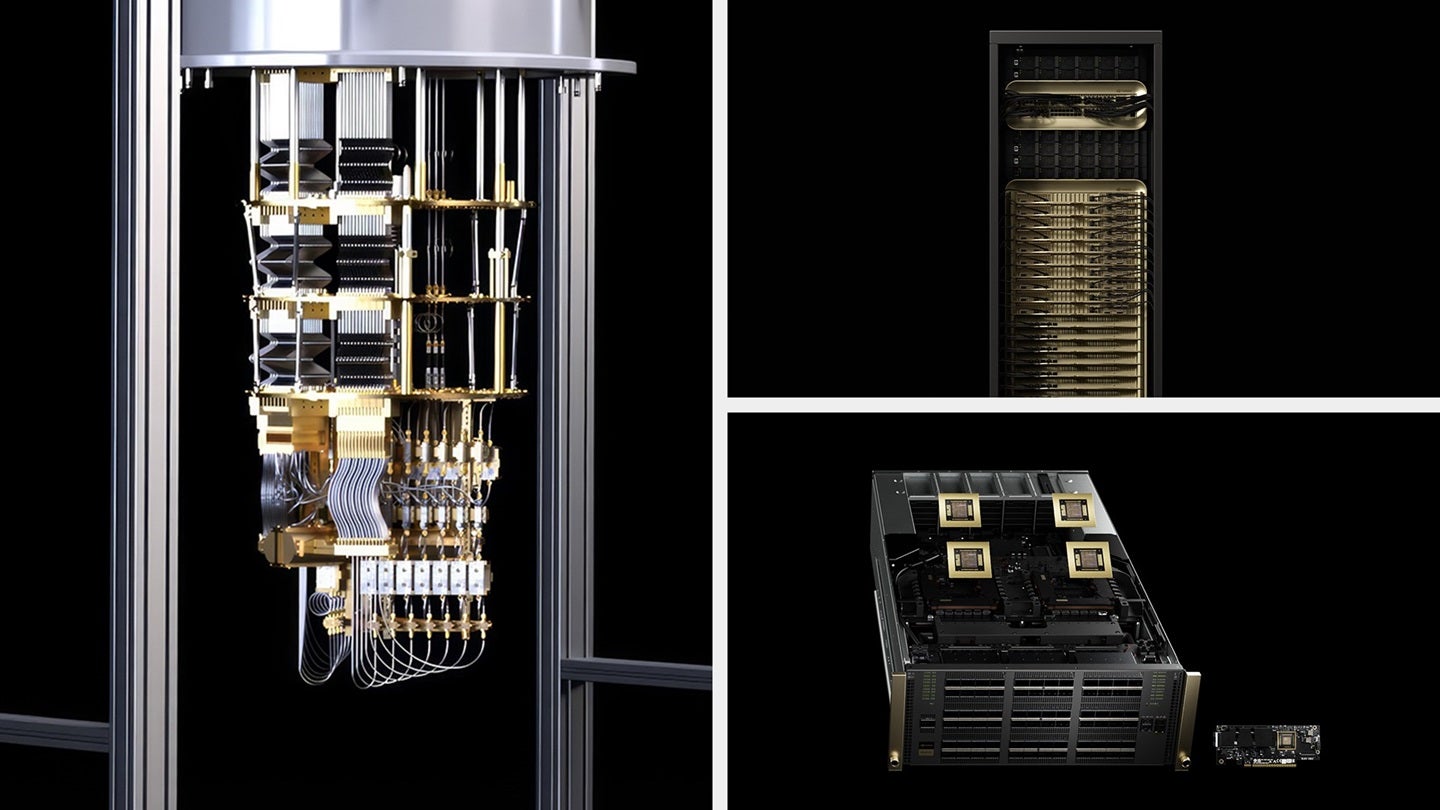
Japanese research institute RIKEN is set to integrate Nvidia GB200 NVL4 systems into its two new supercomputers for scientific AI research and quantum computing.
The AI-dedicated system will utilise 1,600 Nvidia Blackwell graphics processing units (GPUs) and will be connected using Nvidia Quantum-X800 InfiniBand networking.
Go deeper with GlobalData


Access deeper industry intelligence
Experience unmatched clarity with a single platform that combines unique data, AI, and human expertise.
It aims to support research across life sciences, materials science, climate and weather forecasting, manufacturing, and laboratory automation.
The quantum computing system will incorporate 540 Nvidia Blackwell GPUs, also on the GB200 NVL4 platform and linked by Quantum-X800 InfiniBand networking.
Researchers are expected to use this infrastructure for work on quantum algorithms, hybrid simulation, and methods that combine quantum and classical computing.
These developments build on a collaboration announced in August 2025, between Fujitsu and Nvidia to codesign a new flagship supercomputer under the development code name FugakuNEXT, which will succeed the existing Fugaku supercomputer.
The two GPU-accelerated supercomputers at RIKEN will serve as proxy machines for hardware, software, and application development relating to FugakuNEXT.
Operational launch of the two new supercomputers is scheduled for spring 2026, while FugakuNEXT is targeted for deployment by 2030.
FugakuNEXT is planned to feature FUJITSU-MONAKA-X CPUs paired with Nvidia technologies through Nvidia NVLink Fusion, a newly introduced silicon for high-bandwidth connectivity between Fujitsu CPUs and Nvidia GPU architecture.
Nvidia noted that FugakuNEXT is projected to deliver a hundredfold increase in application performance compared to current CPU-based or other existing systems, with plans to integrate production-level quantum computers in the future.
Nvidia hyperscale and high-performance computing (HPC) vice president Ian Buck said: “RIKEN has long been one of the world’s great scientific institutions, and today it stands at the forefront of a new era in computing.
“Together, we’re helping Japan build the foundation for sovereign innovation that will drive breakthroughs to solve the world’s most complex scientific and industrial challenges.”
The combined use of MONAKA-X CPUs and Nvidia’s latest GPUs is intended to facilitate advancements across high-performance computing (HPC), AI, quantum research, and their intersections.
The initiative represents ongoing collaboration between RIKEN and Nvidia, with the companies also working together on floating point emulation software designed to leverage Nvidia Tensor Core GPU performance for traditional scientific computing.
This approach is intended to enable applications to fully utilise GPU power for AI and HPC at RIKEN as well as other supercomputing centres globally.
RIKEN Centre for Computational Science director Satoshi Matsuoka said: “Integrating the Nvidia GB200 NVL4 accelerated computing platform with our next-generation supercomputers represents a pivotal advancement for Japan’s science infrastructure.”
RIKEN is also set to adopt Nvidia CUDA-X, which includes over 400 libraries, microservices, and tools optimised for GPU acceleration.
Recently, Japan-based SoftBank Group sold all of its shares in Nvidia, generating $5.83bn from the transaction.