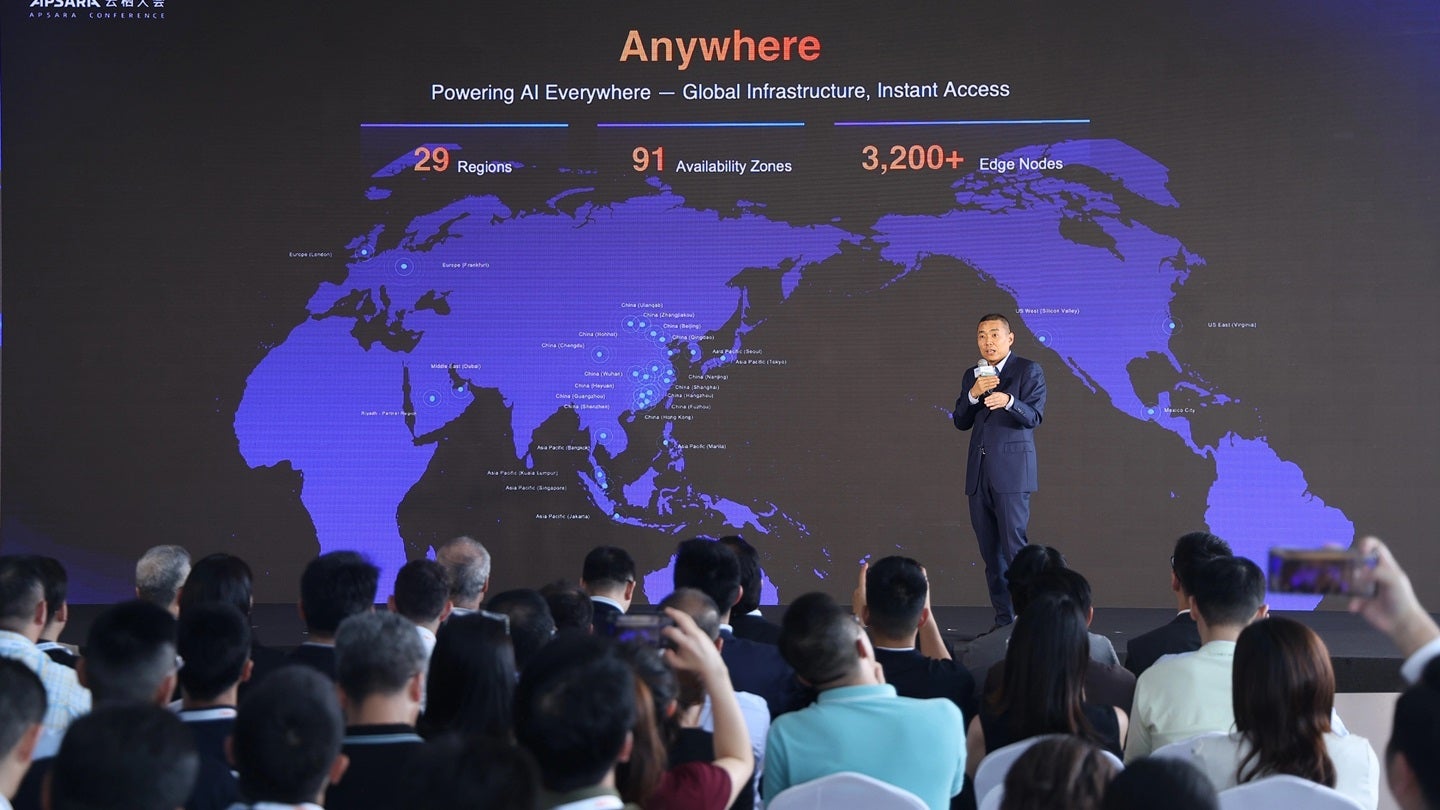
Alibaba Group’s digital technology arm Alibaba Cloud is set to launch new data centres in Brazil, France and the Netherlands as part of its expansion strategy.
An announcement in this regard was made at the company’s Apsara Conference 2025 in Hangzhou, China.
Go deeper with GlobalData


Access deeper industry intelligence
Experience unmatched clarity with a single platform that combines unique data, AI, and human expertise.
Alibaba Cloud also plans to establish new data centres in Mexico, Japan, South Korea, Malaysia and Dubai, which are scheduled for rollout over the coming year.
In addition, the company intends to open regional service centres in Indonesia and Germany to deliver continuous multilingual support.
Currently, Alibaba Cloud operates 91 availability zones across 29 global regions.
In parallel with infrastructure expansion, Alibaba Cloud has introduced the ‘AI Catalyst Program’, which is structured to facilitate the growth of AI companies worldwide.
Selected participants for this programme will have access to expert guidance, AI development tools, go-to-market resources, up to two billion complimentary Model Studio tokens for generative AI development. They will also receive up to $120,000 in Alibaba Cloud credits.
Alibaba Cloud intelligence group senior vice president and international business president Dr Feifei Li said: “AI is revolutionising not only technology, but also the very foundation of how enterprises deliver business value and drive growth.
“Our strategic expansion of global infrastructure is designed to cater for the accelerating demand from forward-thinking customers.”
Alibaba Cloud is collaborating with international enterprises to advance AI deployments across sectors including sports, automotive, biopharmaceuticals, marketing, and technology.
Its Platform for AI (PAI) has now integrated the full suite of Nvidia Physical AI software stack to provide developers with a unified cloud-native environment for research in humanoid robotics and physical AI systems.
This partnership is intended to offer tools for accelerated progress in robotics and related fields.
Focusing on the sports industry, Alibaba Cloud has partnered with the International Skating Union (ISU) and ThinkSport to launch the Sports Data Hack Challenge.
The initiative is an AI hackathon aimed at engaging Europe’s sports innovation community between October and December 2025.
The programme targets startups, developers, academic teams and industry stakeholders to prototype solutions addressing current business challenges in sports with the aim of commercial deployment.
In life sciences, AstraZeneca China has adopted Alibaba Cloud’s LLM Qwen and Model Studio: Exclusive solution to construct an adverse event reporting tool.
This system assists human analysts in identifying relevant literature and generating reports on pharmaceutical safety incidents.
AstraZeneca is also deploying enterprise intelligent agents and AI-driven chatbots within its organisational operations.
Alibaba Cloud has supported AstraZeneca in developing a vertical medical model trained on a large corpus of medical literature complemented by domain-specific annotated datasets.
AstraZeneca China commercial IT head Xin Zhong said: “Working closely with Alibaba Cloud, we managed to harness the benefits of the Qwen LLM and Model Studio: Exclusive, which vastly improved the efficiency of generating adverse event reports from huge amounts of medical literature.”
In digital marketing, GladCube has worked with Alibaba Cloud to co-develop AI applications tailored for Japan’s marketing sector.
Using Alibaba’s Wan visual generation model within GladCube’s “Dra Vis” platform facilitates streamlined video production workflows for marketing teams.
GladCube will also introduce “AvaTwin”, combining Wan-enabled avatars and AI-generated narration for use in corporate settings.
Tokyo-based FLUX has produced “FLUX-Japanese-Qwen”, a 32-billion-parameter Japanese large language model developed using Pinpoint-tuning methodology in collaboration with Alibaba Tongyi Lab.
This approach targets only neural circuits specific to Japanese language processing, resulting in improved performance on benchmarks without loss of original model integrity.
FLUX has further specialised this approach for financial sector applications by training on domain-relevant Japanese datasets.
Alibaba Cloud also revealed that Turbo AI continues to use its infrastructure to build out full-stack AI solutions covering research, deployment and management from lightweight models through extensive infrastructure projects.