
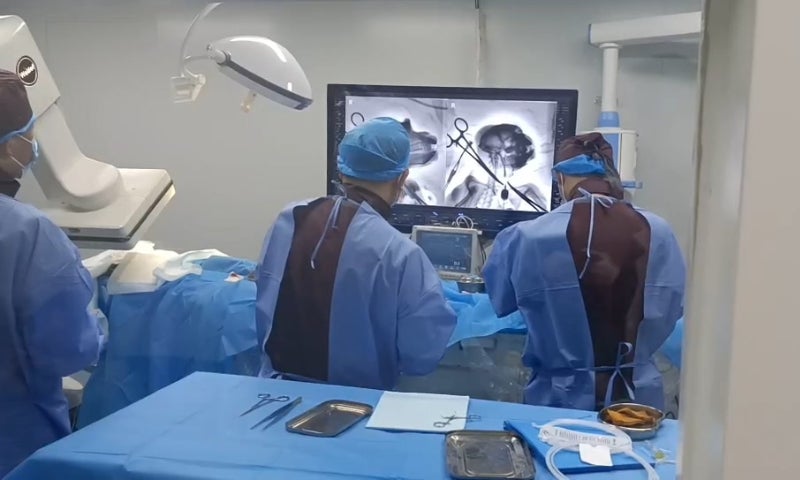
A group of researchers from China claims that they have conducted a successful experiment in which a monkey moved a robotic arm using its brain, reported Global Times, citing Beijing Daily.
The experiment, which was conducted at Nankai University, marks a significant progress in neuroscience.
Go deeper with GlobalData


Access deeper industry intelligence
Experience unmatched clarity with a single platform that combines unique data, AI, and human expertise.
It could lead to future advancements that may aid individuals with physical impairments to communicate with external devices and enhance their overall well-being, they said.
According to the South China Morning Post’s report, the research is yet to be peer-reviewed and the claims were published on the university’s website.
The researchers employed brain-computer interface technology (BCI), which allows people to use their brain’s electrical signals to operate computers or other external devices.
The technology functions by detecting and recording brain signals, and then transforming them into commands that can operate the external devices.
During the experiment, the monkey could control the robotic arm to catch food while being held in a container.
The team lead, professor Duan Feng from Nankai University’s College of artificial intelligence, explained that they implanted a stent into the monkey’s jugular vein that travelled to the brain’s motor cortex, which controls body movement.
An electroencephalogram (EEG) sensor was placed on the stent to record brain activity.
The sensor sent electrical signals to a transmitter placed near the neck, which connected to external devices and enabled control of the robotic arm.
While Feng’s team led the research, it was jointly completed by the Chinese People’s Liberation Army General Hospital and Shanghai HeartCare Medical Technology Company.
The researchers claim that this was the first interventional BCI experiment on non-human primates in the world.