

Industrial equipment design needs a new kind of workshop. It must be bespoke enough to fit a customer’s process, standardised enough to support builds at scale and futureproof enough to run for years against a changing economic and technological backdrop. The pressure on manufacturers has risen as plants chase higher output, tighter tolerances and faster changeovers. The machines that deliver those gains are more complex, more automated and interconnected.
This means a greater emphasis on digital-twin creation. Digital twins are already playing an important role in allowing manufacturing companies to stay ahead of the competition.
According to GlobalData forecasts, the market for digital twins will grow rapidly this decade, from $5bn in 2019 to $154bn by 2030 – a compound annual growth rate of 36%. That growth reflects a left shift of production before products are physically manufactured.
Yet, for many companies, design teams are often siloed when it comes to collaboration. A designer sees one view, the controls engineer sees another, the customer sees a simplified rendering and the commissioning team sees the real machine only when it arrives on site. That fragmentation is extremely costly in machinery, where collision issues are identified too late. The knock-on consequences may include late, hurried and expensive fixes.
Digital twins, real results
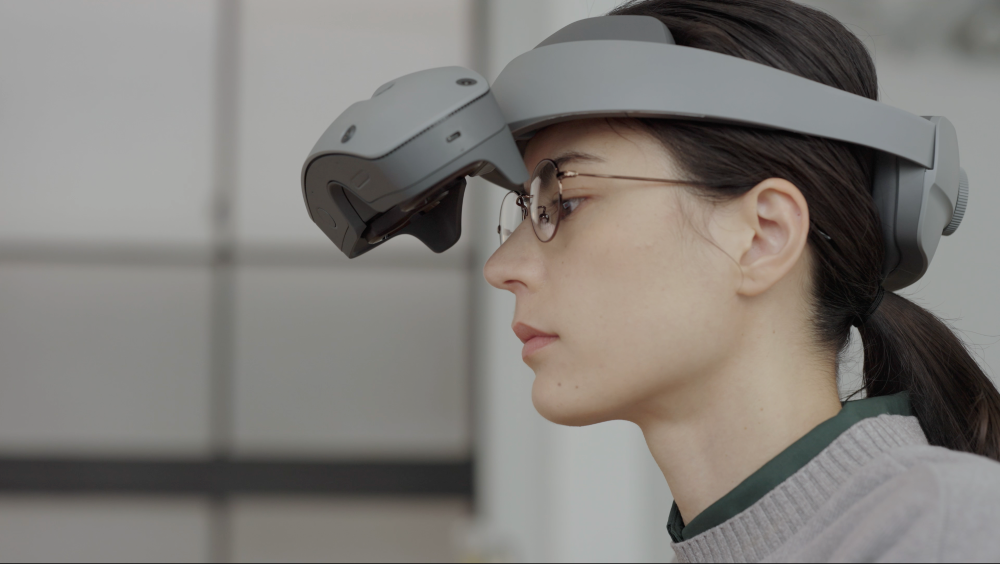
Integrated Immersive Engineering is bringing digital twins to life, by allowing teams to validate products designs at 1:1 scale. The same model used for detailed review on a traditional monitor becomes the object everyone gathers around in a 3D environment.
Scale gives designers instinctive control. At 1:1, the digital twin feels as real and interactive as a physical prototype. Navigation is designed to be simple; out-of-the box controllers, or compatible controllers (think a PS5 controller) can be used.
Then comes the heart of machinery design. Changing buyer behaviour means machines are becoming increasingly complex. This is the key driver behind industrial design needing a refresh. Immersive sessions do just this. The team can bring in kinematic behaviour – how arms, slides, cams and carriers move relative to one another, meaning the discussion is grounded in real-motion. A mechatronics simulation can be shown on a virtual monitor inside the workspace. The monitor can be placed and resized; – putting a screen on a stand in a workshop bay is one example. With that in view, stakeholders can watch a full kinematic simulation play out for intricate mechanisms and processes, then step closer to the exact point where there may be a collision.
In a conventional review, interference checks are treated as static reports, produced by one person and consumed by others after the fact. In an immersive environment, engineers can watch the sequence and examine the mechanism in real-time. That makes it easier to diagnose root causes like timing issues interfering with routing or safety cushions that are too optimistic.
Integrated Immersive Engineering enables complete collaboration, allowing all key stakeholders to join a design review and shifting left the design cycle.
Manufacturing engineers can join and judge whether access for assembly tools is plausible. Maintenance specialists can assess reach and visibility. A customer’s process expert can confirm that the intended motion matches the reality of how parts will be presented and handled. Participants can join from different sites as if in the same room.
Decisions still need to be captured. Integrated tools that let participants leave notes against the digital twin solve that. A reviewer can drop a sticky note at the exact location of a concern, annotate a feature in place, and highlight what must be checked next. The result is a set of tasks tied to geometry and context; busy immersive sessions lead to concrete follow-ups.
The overall takeaway is earlier certainty. Collisions can be identified before production lines are assembled and shipped. Motion can be validated before commissioning becomes a scramble. Decisions can be recorded in a form that survives handovers between disciplines and sites. It’s a place where a team agrees what the machine will do, how it will be built and how it will be used.
Tools and partnerships making collaboration routine
Immersive technology is now an integrated part of many leading manufacturers’ design pipelines.
Consider the integrated Immersive Engineering approach offered within Siemens Designcenter. The goal is to let engineering teams step into the digital twin without data preparation and capture outcomes that the rest of the organisation can use right away. The result is fewer surprises during build, fewer compromises on site and fewer urgent changes after acceptance tests begin.
Partnerships make the difference between a capability and a habit. Equipment makers need dependable workflows, compatible devices, and support that fits their engineering processes. Suppliers and customers need an easy way to participate without specialist training. The most useful immersive room is the one that all stakeholders can join: designers, controls engineers, commissioning leads, operators and decision-makers. And Designcenter NX™ software, bastioned by Immersive Engineering, offers just this.
Integrated Immersive Engineering is the endpoint of a design revolution that will change the way products are created. For industrial machinery firms trying to reduce commissioning risk as designs become more complex, Immersive Engineering is carving a new path into the future.
Interested? Arrange a hands-on demo by filling in your details on this page to learn more.
