

In the heyday of the Victorian era, Silvertown was a booming industrial hub dominated by rubber production, flour mills, and sugar factories. Over the years, the area was strengthened by the opening of the Royal Docks, transforming it into London’s major trade hub for the best part of the 20th century. Things were going from better to better, but two world wars took their toll on Silvertown. In 1917, a large TNT explosion at a munitions factory caused extensive damage and casualties in the area, and the district continued to suffer during WWII bombings. When the historic Royal Docks were closed in 1981, Silvertown fell to dereliction and disuse.
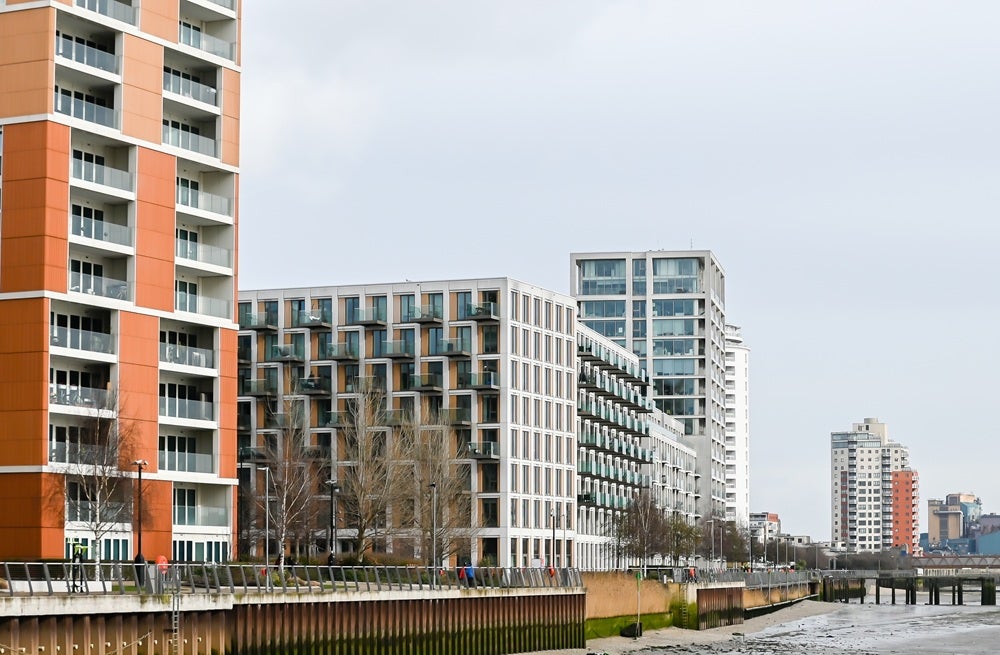
But while Silvertown was abandoned for decades, its story is far from over. Today, it is being revived into an attractive waterside location. In a £3.5 billion development, more than 6,000 residential units and 400,000m2 of mixed-use space are being built by Lendlease and Starwood Capital between 2023 and 2038, with the first homes nearing completion in Autumn 2025. These homes will offer accommodation through shared ownership, providing a more affordable route onto the property ladder. A new town centre will follow in one of the later phases, presenting a vibrant hub for residents to shop, dine, and enjoy.
The best part? Sustainability is at the heart of the entire project at Silvertown. Several historic landmarks are being restored and repurposed as relics of the area’s rich heritage, while new constructions are targeting best practice green building certifications, featuring green roofs and photovoltaic panels. Silvertown is also pioneering a highly innovative zero-carbon heating and cooling system called ectogrid which relies on small-scale decentralised heat pumps and chillers placed in each building.
Circular energy at Silvertown
“Silvertown’s sustainability ambitions are driven by a commitment to zero-carbon heating and cooling, enabled by ectogrid’s circular energy principles,” says John Hatton, Senior Sales Manager for Energy Infrastructure Solutions at E.ON UK, the company behind the technology. “It is designed to avoid fossil fuels entirely. The technology works by connecting multiple buildings with differing energy profiles to a shared network, allowing waste energy to be exchanged and reused efficiently.”
Heat pumps, plantrooms, AI and ectocloud controls – all key components of the ectogrid solution – are integrated to optimise energy flows that the technology can dynamically adapt to match customer behaviour and weather patterns. The waste heat from local industrial partners, such as data centres, flows into the network while cooling is returned as a byproduct. This approach reduces installation costs, operational costs, and carbon emissions, making it attractive for both the housing developers and the data centres: the former need cost-effective heating while the latter can reduce the electricity and water required to meet their cooling needs. In this way, the system can reduce expenses while increasing long-term sustainability and resilience.
This is the first ectogrid deployment in the UK, marking Silvertown as a flagship for sustainable urban energy infrastructure. Over the first 15 years of operation, the project aims for 88% CO2 savings compared to traditional gas boilers, saving over 4,000 tonnes of CO2 per year.
The special role of data centres
According to Hatton, data centres are “integral” to the circular energy vision, and there are several large ones planned in Silvertown’s vicinity. Most notable is Ada Infrastructure’s redevelopment of a former paint factory into the largest planned data centre campus in London. The campus will comprise three separate data centre buildings, the first of which is anticipated to be ready in 2027.
The 210 MW campus will be the first of its kind to achieve both BREEAM and WELL certifications in England thanks to its sustainable design. Meanwhile, its use of renewable energy sources and integration into E.ON’s ectogrid network will further enhance its sustainability credentials.
Data centre construction is currently booming in London, but the industry is being scrutinised for its energy inefficiency, producing vast amounts of thermal energy as a byproduct of its IT equipment and cooling infrastructure. This heat is currently vented to the atmosphere and lost instead of being recovered and used to heat homes and businesses. With ectogrid, E.ON is on a mission to change this.
“Data centres are integral to the ectogrid network,” says Hatton. “Their waste heat will be captured and reused to supply heating for residential and commercial buildings, dramatically improving energy efficiency and reducing emissions. Data centres will also benefit from advanced cooling solutions and flexible energy infrastructure, supporting both operational needs and sustainability goals.”
This symbiotic relationship is a model for how digital infrastructure can support urban decarbonisation. Overall, district heating projects offer data centres the chance to become active contributors to local energy systems, rather than isolated consumers. By participating in ectogrid-powered developments like Silvertown, these businesses can monetise waste heat, reduce operational costs, and enhance their sustainability profile.
Grid benefits
In London and other major cities worldwide, rapid urban and economic growth is driving a surge in demand not just for housing but also ever-larger data centres – and as the rate of global warming accelerates alongside these demands, the question of how to balance such developments with sustainability is critical.
As we transition to electric heating, a similar shift is also occurring in transportation: from internal combustion engines to electric vehicles. This combination places significant pressure on the power grid which, although undergoing rapid expansion, is struggling to meet the pace of demand.
Studies of the London energy system suggest that waste heat flows could supply up to 38% of all homes. Capturing waste heat requires less power for heating, which in turn eases grid capacity upgrade requirements and potentially onward supply chain constraints, enabling the grid to support other needs.
Overall, Silvertown demonstrates how large-scale urban regeneration can balance growth and environmental responsibility, championing collaboration between developers, technology providers like E.ON, and local stakeholders. For data centres, developments like Silvertown represent a golden opportunity to become leaders in energy efficiency, rewriting their role in the future of urban energy systems.
