

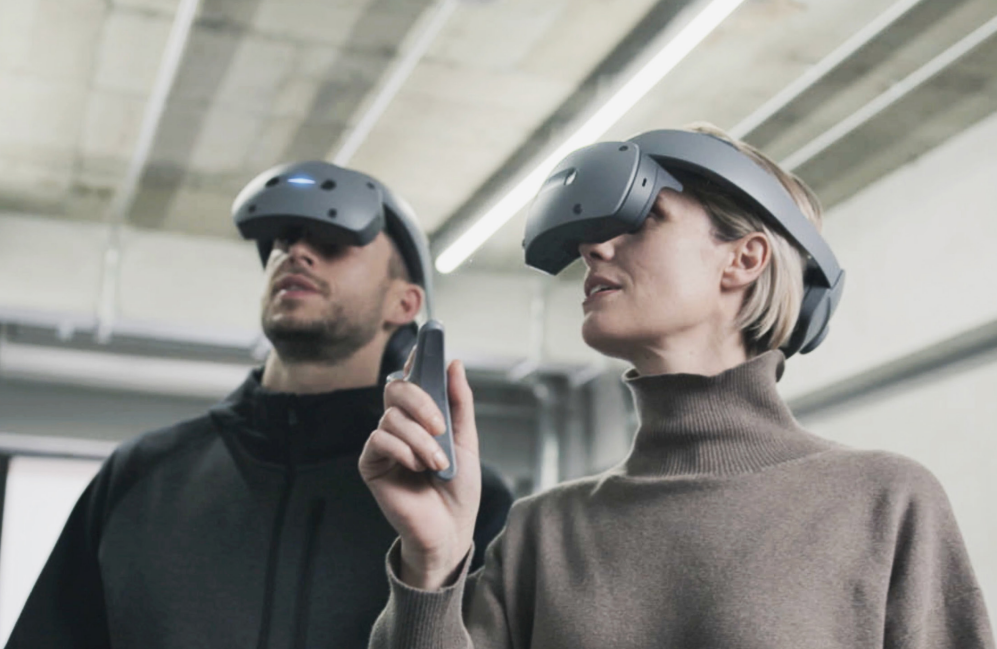
Major manufacturing industries are under increasing pressure to innovate quickly, cut costs, and collaborate across global teams – challenges that traditional, physical-based workflows struggle to meet. However, Immersive Engineering is revolutionising product design by enabling teams to work together in mixed reality environments and inspect digital prototypes in real-time.
XR technologies, which include both Augmented Reality (AR) and Virtual Reality (VR), are gaining traction in enterprise applications. They are increasingly being used in industry to provide immersive training experiences, prototyping, and improved operational efficiency. According to GlobalData, the AR market is projected to reach $100 billion by 2030, driven primarily by software.[i] And the VR market is expected to grow to $57 billion over the same period, indicating significant expansion in both sectors.[ii] Immersive Engineering incorporates both; the implications for industrial design are profound.
With nearly a quarter of XR usage now in engineering and industry, we could see XR adding $1.5 trillion to global GDP by 2030[iii]. Immersive Engineering has staked its claim as a foundational part of the industrial sector worldwide. Companies that have not yet embraced it risk falling behind as it streamlines design cycles and reduces innovation costs for competitors.
Disconnect between siloed teams
The disconnect between product design teams and shopfloor operators is a major challenge in industrial innovation. This often arises from a lack of effective communication and collaboration tools that can effectively bridge the gap between these two critical components. Design teams are typically focused on creating innovative products, while shopfloor operators are responsible for the manufacturing of these designs.
As product designs grow more complex, misunderstandings can arise – especially if the shopfloor teams do not have access to the same level of detailed information or understanding as the design teams. And when there is a lack of understanding or miscommunication between these groups, it can lead to significant issues such as costly rework and inefficiencies.
Immersive technologies enable users to experience CAD models in life-sized, real-world contexts. This enhances visualisation, spatial awareness and the ability to inspect intricate details from multiple perspectives. Clients and stakeholders can better understand and engage with designs, streamlining feedback before physical prototyping.
XR technology also eliminates geographical and departmental barriers, enabling teams from around the world to work together in shared immersive environments. This approach allows for simultaneous input from engineers, technicians, and other stakeholders, fostering early and comprehensive engagement that was previously difficult to achieve.
By enabling early detection of design issues and reducing errors before production, immersive CAD technologies improve design quality and minimise costly rework. Ultimately, these advantages help companies innovate, differentiate themselves in the market and bring products to market faster. All of this offers a significant competitive edge.
Visualising next-generation aircraft
By identifying potential issues early in the design process, and facilitating faster consensus, Immersive Engineering enhances design accuracy and significantly boosts productivity. Siemens estimates gains of up to 30% are possible through reduced rework and more efficient collaboration.[iv]
Natilus, founded in 2016, is an aerospace startup specialising in next-generation cargo aircraft, with a goal of doubling cargo capacity, reducing emissions, and incorporating autonomous flight capabilities. The company’s team of engineers use Siemens Designcenter NX CAD software and Siemens Immersive Engineering technology to visualise and refine aircraft designs at scale. This immersive approach enhances collaboration, stakeholder engagement and early identification of manufacturing challenges. This enables more efficient and cost-effective product development and allows team members to experience and interact with the aircraft design together, whatever their background.
Aleksey Matyushev, CEO of Natilus, explained the impact of Immersive Engineering in a recent podcast: “When we put on the headset, the wow factor was huge. It was the first time we ever saw the scale of what we’re building [and] as we passed the headset around through the different disciplines, I think it was very eye opening for some of our engineers.”[v]
“For the first time ever, it started to put all the pieces together in a meaningful way. And we are a very close-knit team. But imagine doing this in a team of 5000 engineers, or even larger. I think there’s huge opportunities for the technology, especially as folks are more decentralised right now, to be able to understand what each discipline is working on and put the pieces together in a more meaningful, cohesive way.”
Accelerating product creation in the automotive sector
Consider BAC, a firm designing and building road-legal, single seater cars. Siemens’ Immersive Engineering solution enables BAC’s teams to visualise 3D parts in real space and conduct immersive customer reviews and seat fitting, all while involving stakeholders in design reviews using digital twins.
Today, Immersive Engineering is allowing designers all over the world to refine their products in virtual and mixed reality environments, accelerating innovation and improving collaboration across different teams throughout the product development process. Immersive environments accelerate this potential to enhance both collaboration and efficiency in industrial settings. They make 3D models accessible to non-designers, and enable intuitive exploration, feedback, and validation – directly from the shop floor.
Firms on the cutting edge of the industrial landscape are benefitting from Immersive Engineering – and you can too, drawing on Siemens’ unparalleled expertise and experience in the field. To find out more, download the whitepaper on this page.
[i] GlobalData: Augmented Reality in Media, March, 2024
[ii] GlobalData: Virtual Reality, October, 2024
[iii] https://www.pwc.com/id/en/media-centre/press-release/2020/english/virtual-and-augmented-reality-could-deliver-a-p1-4trillion-boost.html
[iv] https://webinars.sw.siemens.com/en-US/teamcenter-and-ai/
[v] https://open.spotify.com/episode/4bzYjThhYqSYxVRmbWfNQR
