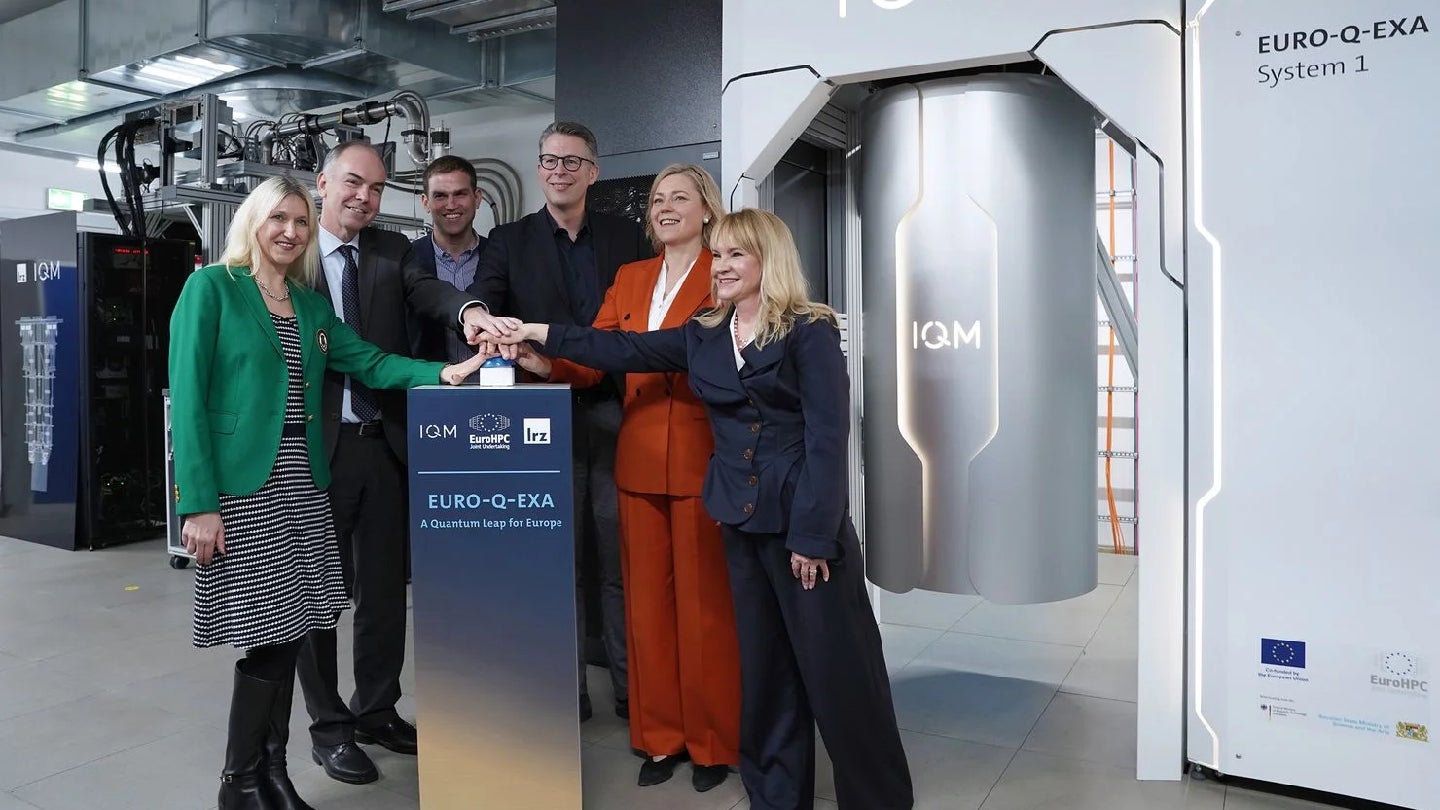
The EuroHPC Joint Undertaking (EuroHPC JU) has inaugurated Euro-Q-Exa, a EuroHPC quantum computer being installed at the Leibniz Supercomputing Centre (LRZ) in Garching near Munich, Germany.
Euro-Q-Exa is based on IQM Quantum Computers’ ‘Radiance’ platform and provides 54 superconducting qubits. The installation roadmap includes adding a second quantum computer with more than 150 qubits by the end of 2026.
Go deeper with GlobalData


Access deeper industry intelligence
Experience unmatched clarity with a single platform that combines unique data, AI, and human expertise.
LRZ has connected the system to its supercomputer to support hybrid quantum-classical workflows.
EuroHPC JU owns the system and said the total acquisition cost is €25m. Of this, €10m was funded by EuroHPC JU, while the remaining €15m was provided by the Federal Ministry of Research, Technology and Space (BMFTR) and the Bavarian State Ministry of Science and the Arts.
EuroHPC JU executive director Anders Jensen said: “The inauguration of Euro-Q-Exa represents another milestone in our journey towards a world-class European quantum computing infrastructure. This new EuroHPC quantum system reinforces our commitment to providing researchers, industry, and the public sector with cutting-edge computational resources, fostering innovation and technological sovereignty across Europe.”
Euro-Q-Exa is one of six quantum systems that EuroHPC JU plans to integrate into European supercomputers. The programme aims to provide access for European researchers and to support technical independence in quantum computing, according to the announcement.
LRZ will host and operate Euro-Q-Exa at its Garching site. The centre has previously integrated multiple quantum technologies into supercomputers and runs them for research users.
Euro-Q-Exa is the second hybrid quantum computer that LRZ has installed with IQM Quantum Computers and made available via the Munich Quantum Portal (MQP). LRZ said having two hybrid systems improves continuity of access when one machine undergoes maintenance.
On the hardware side, the system targets low-latency integration into an HPC environment.
LRZ said the system uses tunable couplers and high-fidelity gates to support a lattice topology, and that a cryostat cools the processor to below −273°C to keep the superconducting circuits stable during operation.
According to the research institute, simulating quantum processors (QPUs) with up to 50 qubits remains feasible on a supercomputer. However, moving to 54 qubits makes full-state simulation difficult or forces the computation to run in stages, because each additional qubit doubles the size of the state space and drives up RAM requirements.
Euro-Q-Exa will be accessible to German and European researchers through the MQP and the EuroHPC JU portal. Users can run the QPU standalone or in conjunction with LRZ’s SuperMUC-NG, and later with Blue Lion, described as LRZ’s next supercomputer.
The software environment includes multiple programming languages and common quantum software packages such as Qiskit and PennyLane, delivered via the Munich Quantum Software Stack (MQSS) developed at Munich Quantum Valley with universities, research institutes and companies. MQSS supports hybrid algorithms, workloads and interfaces to additional tools.
LRZ board of directors chairman Dieter Kranzlmüller said: “With Euro-Q-Exa, we are combining the strengths of quantum and supercomputing. This gives researchers the opportunity to test new approaches and implement groundbreaking calculations, opening up new scientific dimensions using European technology.”