

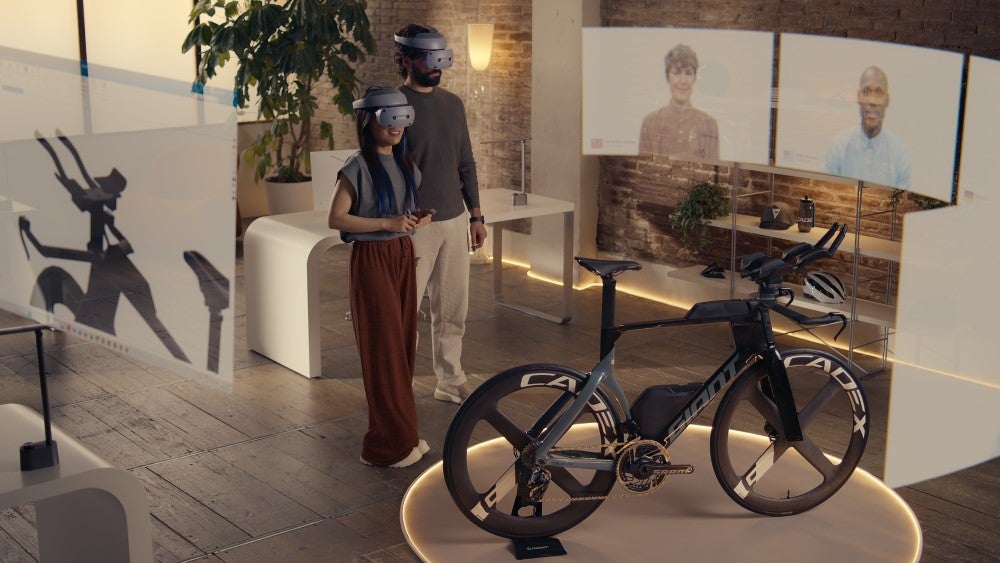
Consumer goods industries are under increasing pressure to innovate quickly. With rising expectations around design and user experience, increased product complexity, and the move toward experience-driven differentiation, integrated Immersive Engineering is shaping product design – facilitating a consumer-centric approach during the design phase, and getting higher first-time-right rates demanded by discerning consumers.
Analysis from Siemens suggests teams using such platforms are seeing productivity gains of up to 30% compared with previous benchmarks.
Furthermore, with increasing calls for personalization to reflect personality, values, and lifestyle, product development companies must have the tools to be able to model and view multiple iterations of the same product during an immersive design review to ensure that the product meets consumer expectations when it launches.
Extended reality (XR), utilising augmented reality (AR), mixed reality (MR), and virtual reality (VR), leverages digital twins and are emerging as new technologies that offer major benefits by reducing physical prototypes, slashing development costs and time, and streamlining workflows – resulting in higher productivity while drastically compressing time to market.
Virtual moves
Integrated Immersive Engineering creates a virtual environment, with real-world space and scale, where stakeholders can simulate consumer interactions and assemble or disassemble a product before it is physically built – testing different design iterations at each stage. This is further supported by visualizing designs through kinematic simulations, which emulates how the different components move (or clash) in relation to each other as they would in the real world.
This early-stage foresight to detect and correct component mechanics and dynamics over traditional methods enables the resolution of ergonomic issues before production begins.
Cross-functional alignment from day 1
The use of digital twins provides a dynamic, high-fidelity 3D model of new products, integrating CAD data, engineering specs, and manufacturing constraints. Consequently, a product in development can be continuously updated and synced with input from real-time data and product designers, engineers, manufacturers, and suppliers.
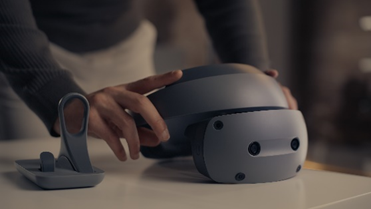
Combined with the Sony HMD headset, the beauty of Integrated Immersive Engineering is that teams experience objects at 1:1 scale, providing a real-world physical perception and enabling stakeholders to interact with new products and view it at every angle – evaluating aesthetics, usability, and ergonomics.
XR-driven collaboration also helps break down the traditional silo structures associated with traditional workshops. With early detection of clashes of spatial fit, aided by digital spaces for functionality and aesthetics, and assembly sequence issues quickly addressed, all parties can view, comment and input on a product’s development, resulting in full-scale product reviews.
With real-time feedback, annotation, and decision recording, a major benefit is stakeholder communication, aided by in-scene sticky notes and live annotations within an immersive session that capture discussions and findings.
This captures “virtual” validation at each stage – delivering direction on assembly intent, accessibility, material choices, and overall product feel – more certainty regarding engineering feasibility and manufacturability before any costly cutting of physical prototypes or tooling. Furthermore, with greater stakeholder alignment through detailed digital trails and tracking, compliance and traceability are more transparent, preventing fewer disputes further down the line.
A significant benefit in the post-Covid era is that stakeholders can be located anywhere in the world, viewing a design in real-time and providing input remotely. This removes the bottlenecks associated with traditional design and production methods. The outcome is faster, more decisive revisions – reducing cycle times and error rates and thereby increasing productivity.
Unconstrained engineering
In partnership with Sony, Siemens is at the forefront of this disruptive and productive technology – with Immersive Engineering software that allows designers and engineers to engage with high-resolution digital twins using advanced VR tools for precision product design.
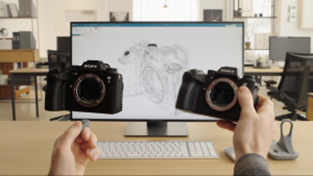
Designcenter NXTM software enables one-click-go immersive without data preparation – and with no limit to monitor size, design details can be viewed using mixed reality mode (MR) at 1:1 scale. Whether the product is a pair of glasses or a mobile phone, styling and form change can be completed, providing clear product aesthetic design validation.
Using the out-of-the-box controllers, or a compatible hand-held controller, this is achieved by navigating around and into the virtual object, visualizing see-through materials to showcase internal components through a virtual monitor.
Using a fully integrated kinematic simulation, virtual prototypes can be assembled at 1:1 scale, with components intuitively picked up, inspected and positioned manually. After that, an ergonomic test fit can be undertaken with a virtual human.
Designcenter NX also enables full access to modelling applications, with any changes made instantly updated in the virtual space and viewable by any stakeholder anywhere, making smart decisions faster. With the ability to test colorways with realistic materials and aesthetics in different lighting environments, the design can be interrogated and refined accordingly.
Left shift forward
Integrated Immersive Engineering is “left shifting” the design timeline and emerging as the new technology in a highly competitive consumer market space that demands new products are in sync with rapidly changing consumer preferences.
With real-time collaboration on a single design source, Siemens’ Designcenter NX is enabling refinement of consumer products with early issue detection and resolution – integrating feedback and fast iteration in real time.
The resulting quicker, clearer decision-making helps streamline design-to-production processes and gets products to consumers quicker. The customer benefits from products that are better tested for usability, more tailored through market feedback, and rigorously validated for manufacturability and serviceability, resulting in higher satisfaction levels and fewer recalls or warranty claims.
To learn more about how Siemens Immersive Engineering could turn your product vision into a reality, fill in your details on this page.
