
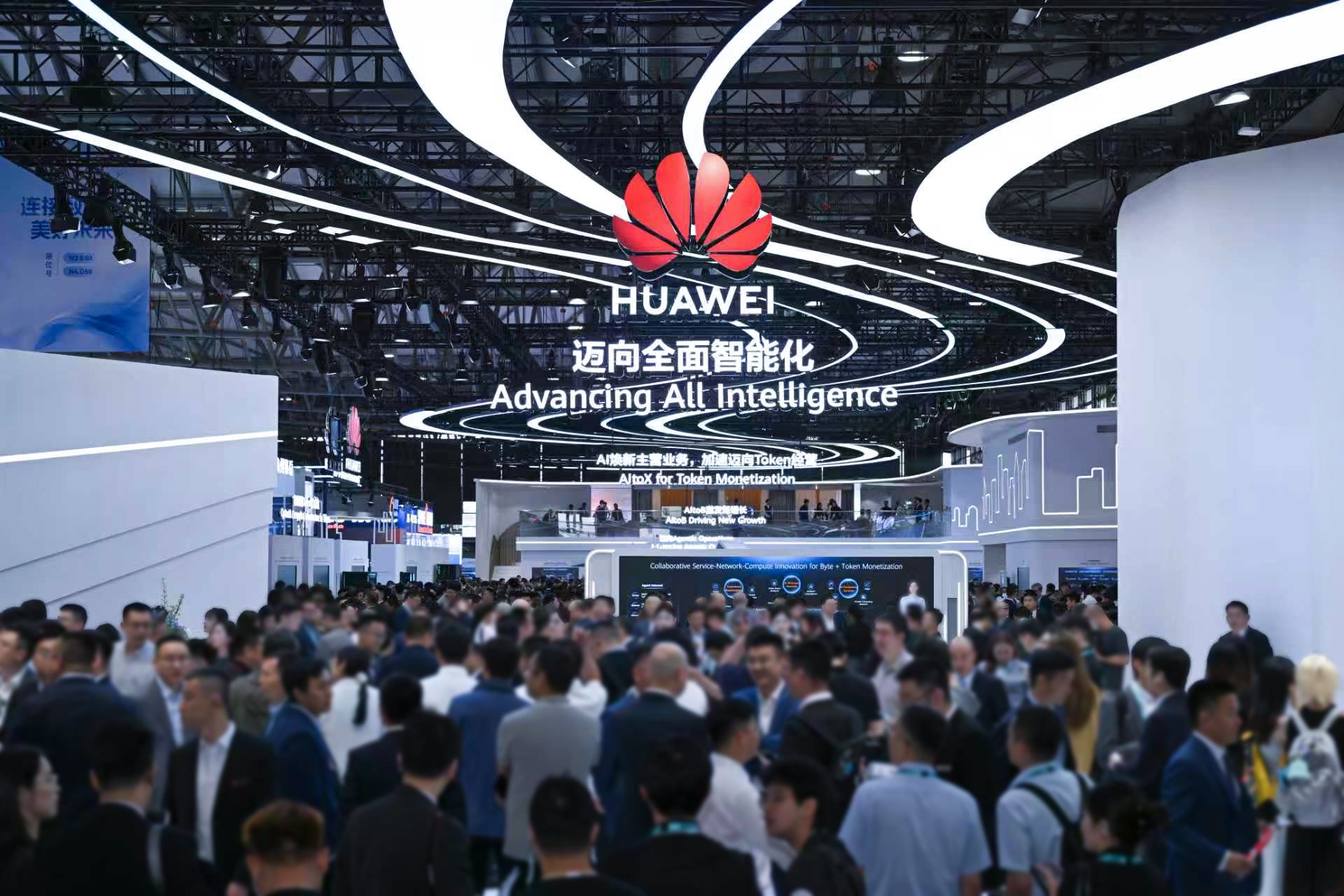
According to the official website[i], around a third of visitors to this year’s MWC Shanghai 2026 were senior executives, with many coming from outside the traditional telecoms world – a statistic that reflects how questions about networks, cloud and AI are now on the agenda far beyond operators and equipment makers. Indeed, coverage from the show reached around one million views across official and partner channels, while government and policy stakeholders were also strongly represented.
I’m attending MWC to explore how Huawei is finding new ways to connect its services, mobile networks and computing power. Under its Advancing All Intelligence theme, the company is working with global carriers, partners and industry experts to look at faster, more reliable networks, stronger upload speeds on 5G‑A, and practical ways to turn better connectivity and AI tools into new business and revenue.
On stage, David Wang, Huawei’s Deputy Chairman of the Board and Rotating Chairman, reminds the audience how the industry got here. For the past four decades, each new generation of mobile has “pushed the limits of spectral efficiency and performance,” opening the door to new services that helped carriers turn technical capability into real business. Now, as he put it, mobile is entering a new “age of intelligence.”
Huawei sets out a clear message to telecom operators: the next wave of growth will not come from selling more mobile data alone. As AI models and agents spread through everyday life and business, they consume ‘tokens’ each time they process text, images or voice. Huawei wants carriers to see that activity as a new revenue stream in its own right.
A bigger revenue base
Mobile operators have traditionally focused on data use, or bytes, such as the traffic generated when people stream video, browse the web or use apps. However, Huawei is encouraging them to also consider tokens, which are used when AI systems translate, answer questions or analyse images. The argument is that if networks are designed with AI in mind, operators could potentially generate revenue both from the data they carry and from the AI activity running over their networks.
To support this shift, Huawei is promoting what it calls an AI-centric target network with three main layers:
- The basic communications network: Instead of simply pushing as much traffic as possible, it is designed for real-time interaction. That means strong upload and download speeds, along with mechanisms to guarantee quality, so AI-powered services can respond quickly and reliably.
- The computing network: Here, the network is treated as a way to distribute processing power, not just data, making it easier to run AI workloads close to the user.
- The AI computing infrastructure: This focuses on high performance and energy efficiency, while remaining open enough for partners and developers to build their own applications and services. Huawei is keen to stress support for open ecosystems so that operators are not locked into a closed stack.
Why 5G-A and uplink performance matter
Huawei’s strategy leans heavily on 5G Advanced (5G‑A), which it says is already serving more than 100 million users worldwide. This is because a key point is uplink performance. Many AI use cases depend on sending a steady stream of data from the user to the cloud or edge, not just downloading content. For example, AI glasses – used for translation or augmented tours – require around 20 Mbps of upload speed to deliver smooth, real-time experiences.
To meet such demand, operators are starting to experiment with offers that promise specific uplink speeds, latency and consistency, tailored to AI scenarios. For Huawei, this is where token monetisation becomes tangible: the better the uplink and responsiveness, the more AI tasks users can run, the more tokens are consumed, and the more scope operators have to charge for guaranteed performance.
In addition, Huawei and its partners are positioning the upper 6 GHz band as a key resource for AI-focused mobile networks, noting that more than 20 countries plan to use it for mobile from 2026, in ways that could shape how well their networks support AI services over the next decade.
New services built around AI
On the consumer side, Huawei is trying to show how all this infrastructure work can translate into services people will actually use. In China, it plans to work with carriers in provinces such as Guangdong, Shanghai and Hebei to redesign mobile and home offers around AI. The examples it highlights include smart home assistants that manage appliances and media, personal communication assistants that help handle calls and messages, and bundles that link mobile plans with home connectivity and services. In each case, user interactions quietly trigger AI processing in the background. That activity consumes tokens, which in turn can be counted, priced and monetised by the operator.
For business customers, Huawei also outlines a model where operators offer AI computing through their own networks so enterprises can run some workloads on carrier infrastructure rather than only in public clouds. This combines connectivity and computation into one service with potential gains in performance, security and data locality, while giving operators a larger share of AI-related value.
In practical terms, increasingly complex networks will need much higher levels of automation, and Huawei says it is investing in AI systems that can handle tasks such as maintenance, optimisation, energy management and user experience with minimal human input, including specialised versions for environments like rail lines, stadiums and campuses.
View from the floor
Stepping back from the noise of MWC’s show floor, Huawei’s message came across as a forward-looking one: the centre of gravity is moving from simply delivering faster connections to building networks that are ready for AI. For operators, that opens up the chance to design networks and business models where the intelligence running over their infrastructure sits at the heart of their plans, and Huawei appears determined to play a central role in that shift.
From consumer assistants in the home to more automated operations in the background, the pitches on stage and the conversations I heard in meetings and demos all pointed in the same direction: AI activity in telecom networks is no longer just another stream of traffic, but a foundation on which operators can build new services, partnerships and long-term growth.
[i] https://www.mwcshanghai.com/
