
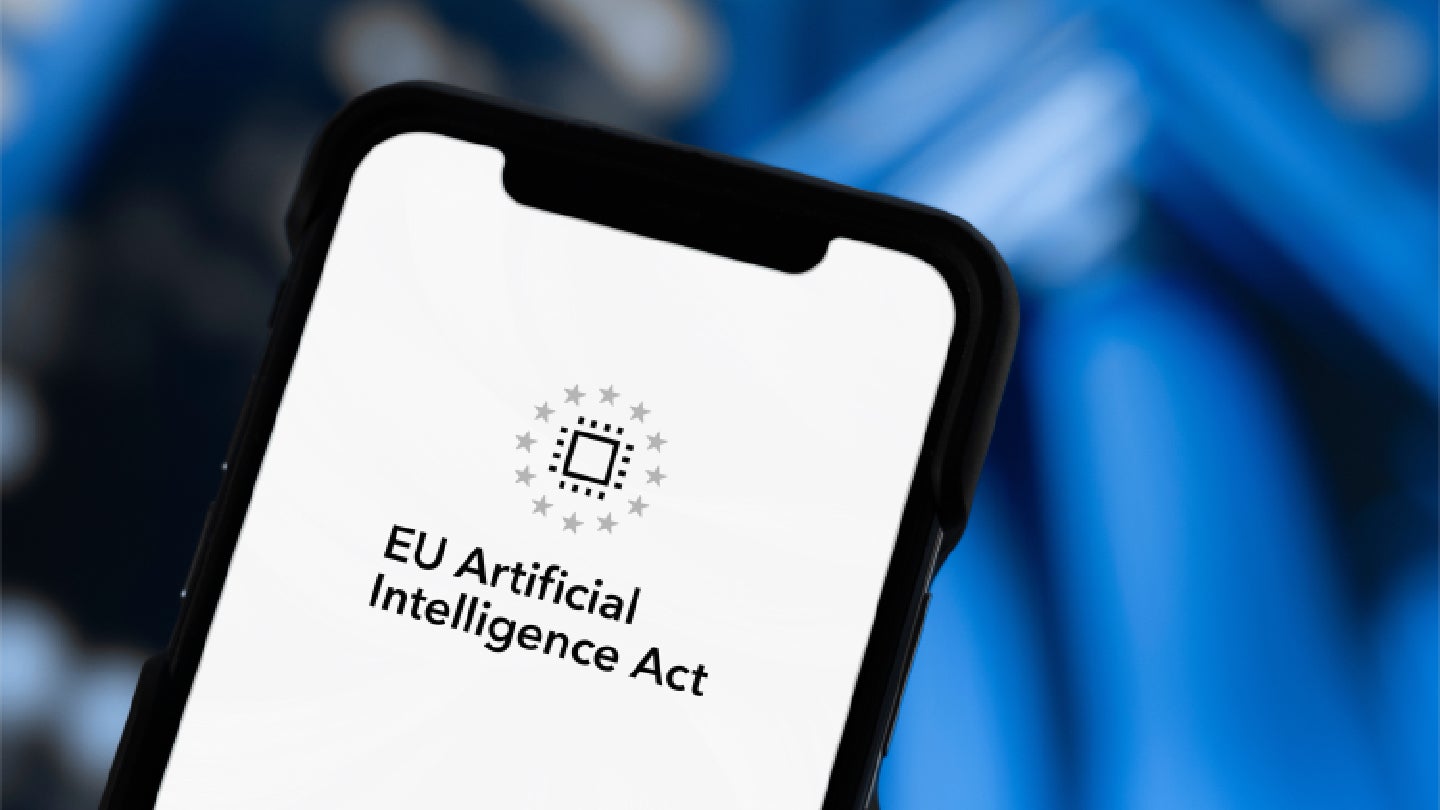
The European Commission’s (EC) AI Office, in collaboration with national authorities, has begun enforcement of the AI Act.
The move brings new transparency requirements into effect, mandating that certain AI systems inform users when they are interacting with AI or when content has been AI generated or modified.
Go deeper with GlobalData

Access deeper industry intelligence
Experience unmatched clarity with a single platform that combines unique data, AI, and human expertise.
Under the new framework, chatbots and similar AI-driven interactive tools must disclose their non-human nature to users.
The regulations also require that deepfakes, audio, images, or video content created or altered using AI, are clearly labelled.
AI-generated or edited material must be marked in a machine-readable format, enabling easier identification by both users and automated systems.
The EC stated that these measures aim to reduce the risk of deception and manipulation, help individuals make informed decisions, and clarify obligations for businesses.
The Commission has also published an initial list of over 180 organisations that have committed to the Code of Practice on transparency of AI-generated content, which operationalises these new requirements.
EC Tech Sovereignty, Security and Democracy Executive Vice-President Henna Virkkunen said: “AI is a transformative technology that can bring extraordinary benefits to our people and businesses. But we are also seeing that harms can occur if AI is not properly designed and used and the most advanced models create risks on an entirely new scale.
“Europe anticipated this development. With the AI Act, we established a clear, risk-based and durable framework for trustworthy AI—one that gives innovators legal certainty while protecting the public interest.
“As enforcement begins, we are taking an important step towards AI that people and businesses can understand and trust, and whose benefits are shared widely across our society.”
The enforcement allows the EC AI Office to oversee compliance by providers of general-purpose AI (GPAI) models.
These models, used in a wide array of applications including AI agents, must meet documentation and copyright policy requirements and must publish a comprehensive summary of training content.
Additionally, the law targets advanced GPAI models presenting systemic risks, demanding further risk management regarding issues such as large-scale harm or misuse in cyber, biological, chemical, radiological, or nuclear contexts.
Responsibility for implementing the Act’s transparency standards and prohibitions on harmful AI practices is distributed between the AI Office, national authorities, and the European Data Protection Supervisor, depending on the AI system in question and its area of operation.
Member States are expected to ensure national bodies are appropriately designated and resourced for enforcement.
The AI Office and national authorities are supported by a new Scientific Panel of 60 independent experts. Professor Alessandro Abate of the University of Oxford’s Department of Computer Science has been named Lead Scientific Adviser.
Instruments to facilitate compliance and report suspected breaches, including a Complaint Tool and a Whistleblower Tool, have also been introduced, with confidentiality measures in place for all submissions.
Some key aspects of the AI Act, such as rules on high-risk AI systems, will not be applied until later dates, 2 December 2027 for most high-risk systems and 2 August 2028 for those integrated into regulated products.
New prohibitions, including those covering non-consensual sexually explicit content generated by AI and child sexual abuse material, are set to apply from 2 December 2026.