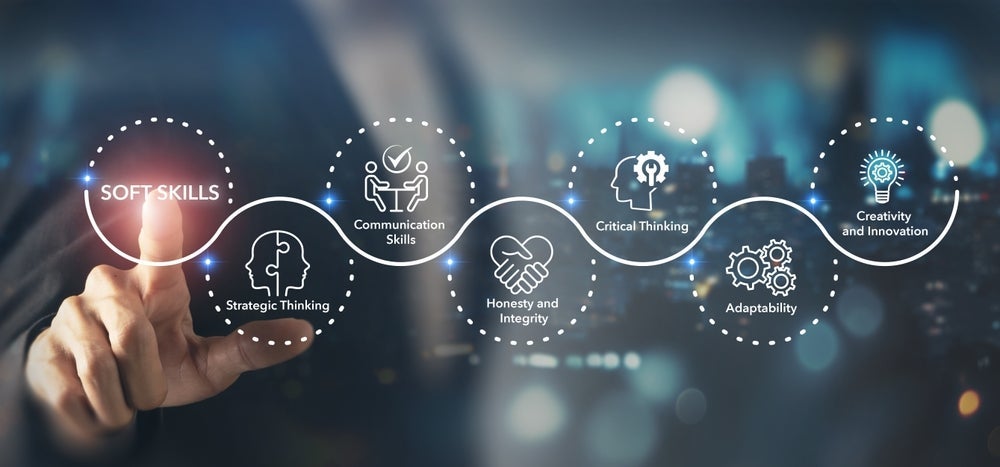
Corporate human resources departments started using personality tests like Myers-Briggs Type Indicator in the 1970s before a universal shift towards more evidence-based methods. And while people management decisions have become progressively more data-led, measuring soft skills remains highly unscientific.
Furthermore, as workplace tasks become increasingly automated, human attributes are fast becoming an important differentiator for employers and employees alike.
Go deeper with GlobalData


Access deeper industry intelligence
Experience unmatched clarity with a single platform that combines unique data, AI, and human expertise.
This is why UK startup Lumenai’s CEO and founder Antonia Manoochehri is planning on disrupting the people management space with ambitions to create an entirely new enterprise data layer based on a scientific method of measuring and indexing the very capabilities that make us human in the AI age.
Many years of deep research have gone into Lumenai’s platform which is essentially a method of recording human behaviours, values, and decision making and processing them into structured, robust data that can be processed by AI driven analytics.
Presently, companies Manoochehri declines to mention by name are “scraping a lot of data on human behaviours” which is problematic on two levels. Firstly, Manoochehri advocates a data sharing protocol where the data belongs to the human user, “without having data scraped and used it without consent”.
Secondly, data scraping is an ineffective method for accurately assessing human capability as it simply draws inferences rather than collecting robust and defensible data.
And people analytics and insights formally collected within corporate and business environments tends to be gathered through methods such as surveys, 360 evaluations, and employee opinion polls are also problematic. “It’s full of bias,” says Manoochehri, adding: “It’s not robust or standardised data so you can’t create a data bank that can be modelled repeatedly in different ways against many different decisions. There is literally no quality data based on standardised protocols on human values, behaviours, and decisions.”
The key to Manoocherhi’s ambition is the ability to structure what has hitherto been unstructured human behavioural data because, only then, can it be AI enabled. Only then does the aim to eventually measure, develop and deploy human capability at scale become viable.
What is human capability indexing?
At the core of Manoocherhri’s Lumenai platform lies a proprietary assessment methodology that, in about 90 minutes, collects around 48 structured data points. The methodology is built on Manoochehri’s 25 years experience with the processes and practices of academic assessment. The innovation is applying it to soft skills.
From this data, Lumenai produces a data “passport” for each individual—high quality, standardised data that can be modeled like numerical data which is owned by the individual themselves. Data collection is app-based, providing a real-world mechanism for seamlessly building profiles.
Data collection needs to be legal and defensible, says Manoochehri, especially when it comes to people data. “It needs structured protocols around it. We need robust data that’s opted in, and that gives results. Then AI enablement can actually give you trusted insights,” she says.
With sovereignty over their own data, users have the ability to choose which organisations, including their employer, can access their data passport. The passport can be particularly useful in a university or careers service environment. In fact, Lumenai has a trial running with three universities later in the year.
Manoochehri hopes that Lumenai will demonstrate the need for a whole new layer in the enterprise technology stack—a data layer for managing people in an AI-enabled workplace. Her research experience in the education sector working on qualitative assessment for companies including Pearson, and the proprietary methodology that she has developed is the basis for her claims that this human data is defensible and useful. She says that by building Lumenai, she has essentially built this missing data layer.
But like every nascent idea, Lumenai needs funding and stewardship.
Lumenai’s investment from UK based scientific frontier research platform Corpora.ai is an important milestone in the company’s evolution from Oxford University spin out to pre-seed startup. Beyond the funding, Corpora.ai will support Lumenai by lending access to its deep research knowledge ecosystems as well as mentorship from one of the UK’s leading tech investors, Corpora.ai’s founder and CEO Mel Morris CBE.
Lumenai is building out the last of its user experience for release in beta in October. The assessment engine is market-ready and fully tested, and feedback has been good, says Manoochehri.
“Imagine a 40-year-old or 50-year-old CEO that now knows more about themselves than they ever knew in their 30-year career in whatever industry. And then the flip side, where you’ve got a university grad that now understands more about what path they need to go down, rather than just choosing a path because they’re going to take whatever they can,” she says, adding: “When we understand their skill sets we can actually divert and navigate them into a career trajectory they’re brilliant at. That changes the future of work.”