

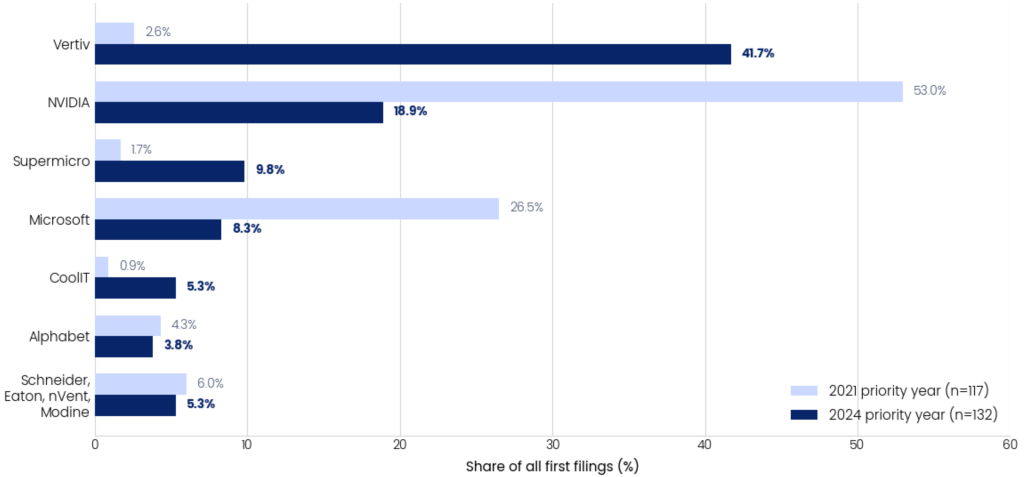
GlobalData analyzed 2,486 patent publications from 17 companies across five liquid-cooling classifications, de-duplicated into first filings and dated by earliest priority. A first filing is the original application behind an invention, counted once however many countries it is later published in. The 2024 priority year holds 132, an 11-year high and 12.8% above the 117 recorded for 2021. Volume is not what changed. Ownership is.
In the 2021 priority year, NVIDIA Corp (NASDAQ: NVDA) opened 62 of those 117 first filings and Microsoft Corp (NASDAQ: MSFT) 31, a combined 79.5% of the field. Vertiv Holdings Co (NYSE: VRT), which sells thermal management into exactly this market, opened three. By 2024, the positions had swapped: Vertiv 55, NVIDIA 25, Microsoft 11. On this evidence, the inventive work now sits with the company that builds the cooling rather than with the companies buying AI compute.
Vertiv gained 39 points of share. Its peer group gained nothing
Vertiv’s climb was steady: seven first filings in 2022, then 22 in 2023, out of 88 and 74 filed across all 17 companies. None of its rivals did the same. In 2024, Schneider Electric SE (EPA: SU) filed two, Eaton Corp plc (NYSE: ETN) four, and nVent Electric plc (NYSE: NVT) one. Modine Manufacturing Co (NYSE: MOD) filed none. Between them, those four filed seven in 2021 and seven again in 2024. Their share of the field fell from 6.0% to 5.3%, because the field grew and they did not. Vertiv is moving on its own, so what it does here says little about the rest of the sector.
Figure 1. Vertiv moved from 2.6% to 41.7% of first filings while its listed peer group stayed flat
Source: GlobalData Patent Analytics
Two mechanical objections have to clear first. Jurisdictional double counting inflates raw publication counts for companies that file widely; de-duplicating cuts the raw total by roughly two thirds and reorders the field. Publication lag then varies by filer. Every Vertiv first filing from the 2018 to 2022 priority years was published within 21 months of its priority date, against 63% for NVIDIA, 61% for Microsoft, 54% for Alphabet Inc (NASDAQ: GOOGL), and 25% for Amazon.com Inc (NASDAQ: AMZN), because provisional-then-convert strategies delay first publication. Recent priority years therefore understate the US-first filers. Adjusting 2024 by each company’s own historical rate narrows Vertiv’s lead over NVIDIA without closing it.
The concentration is not an offshore artifact either. Vertiv’s US parent entity accounts for 85% of its 2024 first filings.
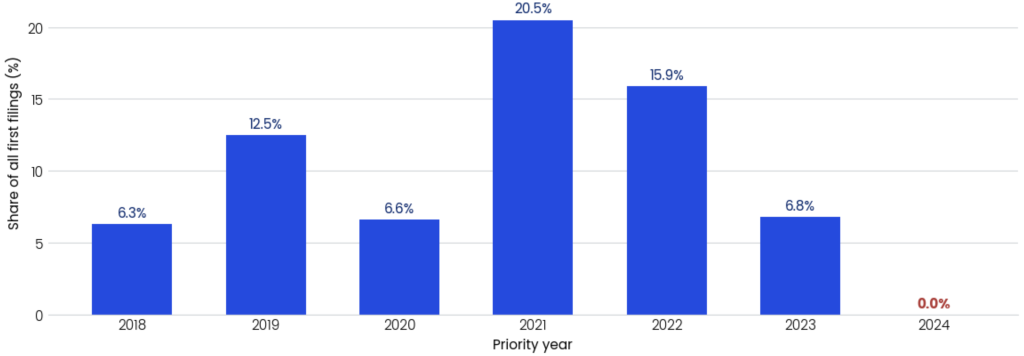
Immersion cooling went from 21% of filings to zero
Filings referencing immersion cooling, in which whole servers sit in dielectric fluid, peaked at 24 first filings in 2021, 20.5% of that cohort, with Microsoft accounting for 16. The count fell to 14 in 2022, five in 2023, and none in 2024. Microsoft has filed nothing on immersion since its 2022 cohort, over a period in which it kept filing steadily in this field. This is a title-level classification, so read the exact counts as indicative. The direction is not ambiguous.
Figure 2. Immersion cooling filings fell to zero in the 2024 priority year
Source: GlobalData Patent Analytics.
Cohort size by priority year: 2018 n=63, 2019 n=56, 2020 n=121, 2021 n=117, 2022 n=88, 2023 n=74, 2024 n=132.
The reasonable interpretation is that an architectural question closed rather than that a market cooled. Before 2022, no vendor sold a validated product for racks above 100kW, so the buyers of AI compute did the architectural work themselves and patented it, immersion included. Once the industry converged on direct liquid cooling to cold plates, the inventive work moved to whoever builds, plumbs, monitors, and services the result. External context fits the timing: Vertiv codeveloped power and cooling reference architectures for NVIDIA’s GB200 NVL72 platform, announced in October 2024, in the same window as its 2024 priority filings. The patent evidence cannot establish the two are connected, but the sequence is consistent with NVIDIA specifying and suppliers engineering.
Where the field is contested and where it is not
The control layer is contested, not captured. Filings covering control, monitoring, and thermal management logic rather than mechanical hardware account for 15 of Vertiv’s 55 first filings in 2024, or 27%, the same share NVIDIA ran at during its own 2020 to 2021 peak, 32 of 118. Both build in the same place, and no operator holds a dominant position in the software-adjacent layer that carries service attachment.
Two entrants matter more than their counts suggest. Super Micro Computer Inc (NASDAQ: SMCI), which filed nothing here before 2021, opened 13 first filings in 2024. CoolIT Systems (private) opened seven, against one or two a year previously. Server OEMs are bringing rack-level cooling in-house while specialists push harder. Motivair (private; Schneider Electric completed its 75% acquisition in February 2025) sharpens the point: it appears in this dataset with a single first filing, dated 2020. A cooling acquisition does not necessarily carry a patent position within this scope.
What the filings do not establish
Patent activity is not revenue and it is not commercialisation. Vertiv’s 2024 cohort will not convert to grants in volume for another one to three years; among filers with enough history in this scope to measure, grant conversion has run between 70% and 93%. A falling hyperscaler count is likewise not evidence of disengagement: if NVIDIA publishes reference designs that its supply chain implements, inventive work shifts to suppliers by design, and that looks identical to retreat in patent data.
Three signals will resolve it: grant conversion on Vertiv’s 2023 and 2024 cohorts, which turns filing volume into a defensible position; whether Schneider Electric, Eaton, or nVent move off single digits, which separates a company story from a sector one; and whether immersion stays at zero through the 2025 cohort, publishing from mid-2026. The interval between these patent signals and their appearance in product launches and earnings guidance is where the commercial consequence becomes visible.
Companies identified as innovation leaders through patent indicators show 1.4x higher 24-month forward consensus revenue growth than the broader market.
Extracting Innovation Alpha using Patents reports 5% to 7% annualised alpha over the S&P 500 and 6% to 9% against specialist innovation benchmarks, across seven years, with portfolios outperforming 85% of the time. Explore the full analysis, including the 40+ proprietary patent indicators and how each is constructed, Brinson attribution isolating stock selection from sector allocation, 24-month forward revenue, profit, and margin profiles for top-ranked against bottom-ranked portfolios, decile and holding-period robustness tests, and sector case studies covering defense, healthcare, green innovation, and generative AI.
The filings above are one dataset over one technology. The study tests whether signals of this kind hold systematically. Download now below.
