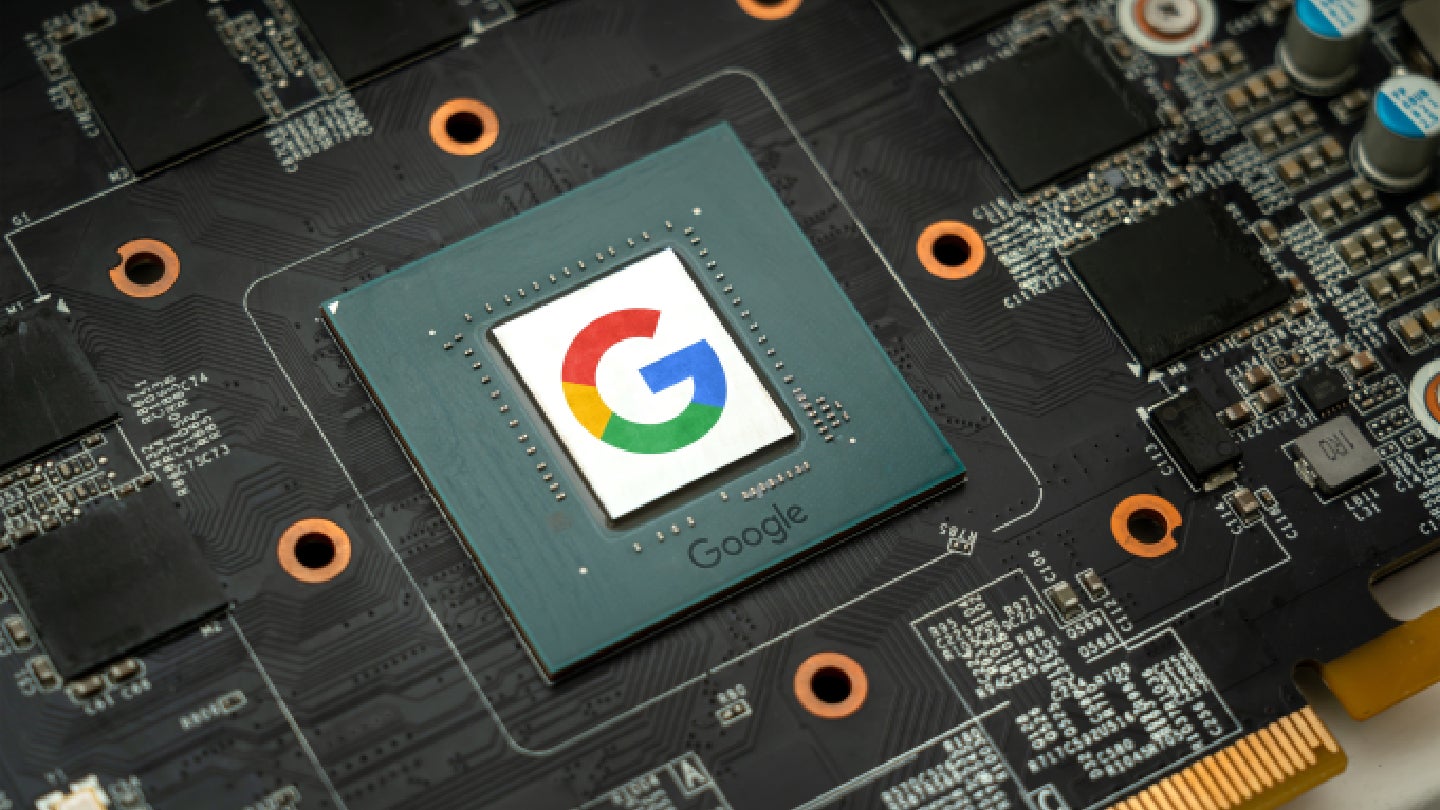
Alphabet’s Google has expanded its eighth-generation tensor processing unit (TPU) portfolio with TPU 8tx and TPU 8i Max.
According to an official blog post by Google’s AI and Infrastructure senior vice president and chief technologist Amin Vahdat, the new systems are aimed at addressing rising demand for AI acceleration both from Google’s own operations and from external organisations seeking specialised AI compute capabilities.
Go deeper with GlobalData

Access deeper industry intelligence
Experience unmatched clarity with a single platform that combines unique data, AI, and human expertise.
The TPU 8tx is designed to support secure and confidential inference, a feature aimed at regulated enterprises and government customers working with sensitive data and proprietary AI models, stated the blog post.
The hardware integrates security functions directly at the silicon level, allowing data and model weights to remain protected during active use.
Vahdat stated that the 8tx system also offers up to two times lower latency than the existing TPU 8t, with what it describes as a near-zero performance penalty.
The second new system, TPU 8i Max, is built to address memory bottlenecks that arise during high-context AI workloads involving large numbers of autonomous agents, such as those processing extensive codebases or video streams.
The 8i Max combines two low-latency TPU 8i chips into one package, reportedly doubling compute capability, on-chip memory, and memory bandwidth compared to the TPU 8i.
This configuration allows data centres to achieve higher compute density per rack and per watt, suiting workloads requiring expansive context windows.
These additions follow the earlier launch of TPU 8t and TPU 8i in April, which are systems intended for large-scale AI training and real-time inference.
The combined four-system line-up marks the first time Google has released so many variations within a single year.
Vahdat noted that Google’s TPU business is growing and now serves nearly 100 customers, including research labs, trading companies, retailers, and universities.
He wrote: “Shipping four TPU systems and a unified, open software stack in a single year only happens when silicon architects, networking engineers, compiler teams, and Google DeepMind researchers build side-by-side.”
Google first designed TPUs over a decade ago for internal workloads like voice recognition and translation. The company now offers eighth-generation TPUs to Google Cloud clients as well as for deployment within customer data centres.