Huawei has launched an upgraded version of its Stellar AI Network infrastructure at the HUAWEI CONNECT 2026 conference in Shanghai.
The upgraded architecture encompasses three core domains, namely AI Fabric, AI WAN and AI Campus. The Chinese telecommunications vendor said that the release is intended to support enterprise networking demands following a 260-fold increase in daily AI token consumption over the past year.
Go deeper with GlobalData

Access deeper industry intelligence
Experience unmatched clarity with a single platform that combines unique data, AI, and human expertise.
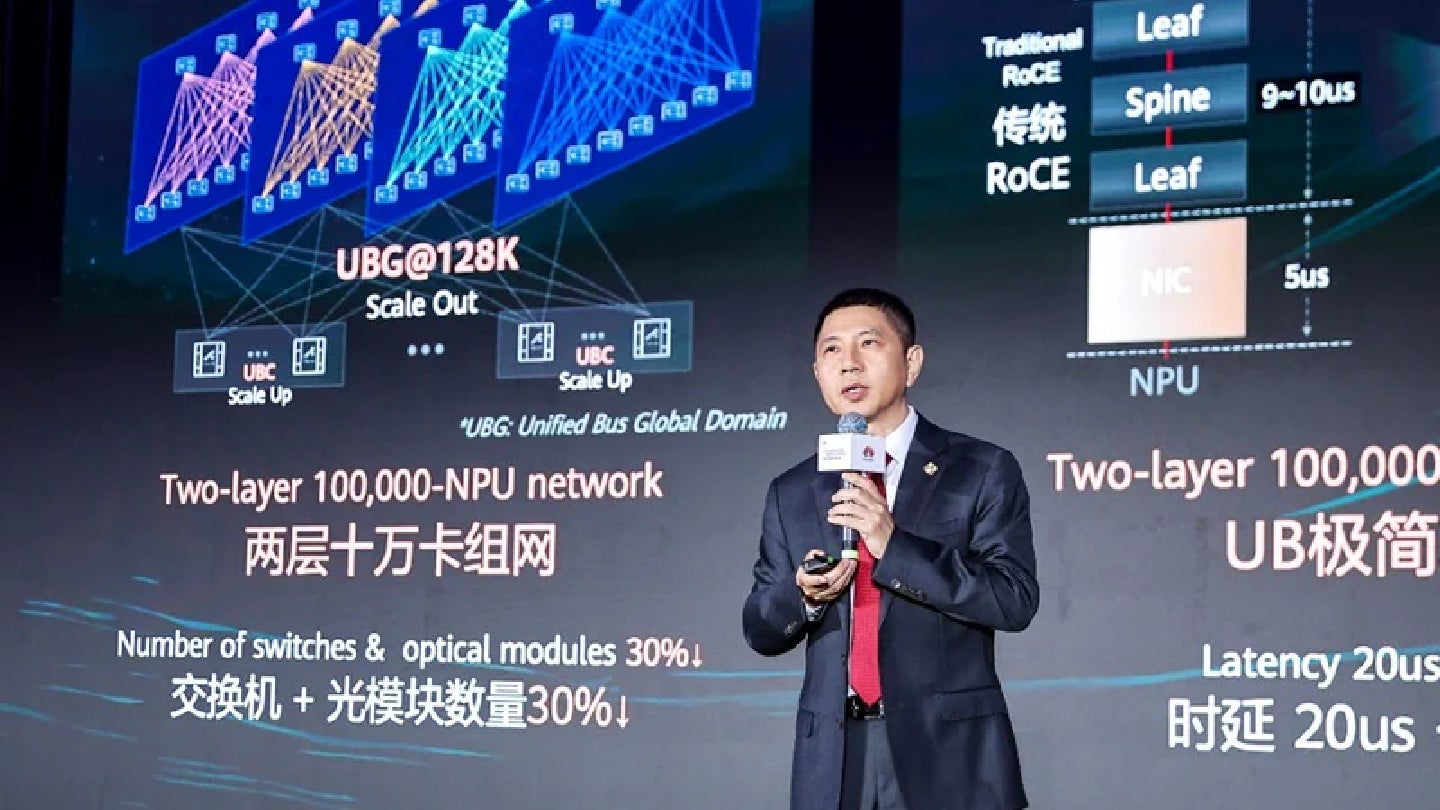
Within the AI Fabric 2.0 segment, Huawei introduced the SF9300 series unified bus gateway (UBG) switch.
Designed to pair with the company’s Ascend A5 and A6 processors in an integrated computing-network deployment, the switch employs a two-layer multi-plane design that eliminates the core network layer. This architecture reduces infrastructure deployment costs by 30% and lowers end-to-end latency from 20 microseconds to 11 microseconds.
The system also incorporates link-layer retransmission technology to eliminate data loss during link flaps, cutting annual cluster service downtime by an estimated 100 hours.
Huawei also unveiled its proprietary CloudEngine XH9300-EN series of near-packaged optics switches.
The hardware features a centralised light source that reduces interconnect power usage from 1,000 watts to 600 watts. Its near-packaged layout reduces optical-electrical conversion latency by 180 nanoseconds, improving single-node latency by 26%.
A modular snap-fit design allows on-site replacements to reduce fault recovery times from days to hours.
For wide-area connections, the Stellar AI WAN system enables computing delivery across spans exceeding 1,000km. The configuration uses a proprietary Starnet lossless algorithm to maintain remote processing efficiency above 95%.
By using a layerwise model partitioning algorithm on local appliances, initial and terminal computing layers run on-premises so that only high-dimensional vectors travel across public networks. Huawei stated that this structure protects raw data locally, cuts remote branch processor expenses fourfold and reduces required network bandwidth fivefold.
The campus networking platform incorporates telemetry sampling across more than 25 data categories every 100 milliseconds. Paired with a deep causal pruning algorithm that reduces model inference errors by more than 20%, the system lowers mean time to repair for network faults to under five minutes.
Security across the portfolio includes a three-layer guardrail that monitors cryptojacking, prompt injection and host vulnerabilities, having detected 415 high-risk flaws and 322 threat events during an initial week-long customer trial.
Campus switches also embed AI micro-models to lower endpoint threat detection from five minutes to under ten seconds. In addition, the WAN architecture integrates quantum key distribution over distances of up to 80km.