

For martensitic chromium steels, a blade’s performance is set during heat treatment, when controlled microstructural changes turn relatively soft strip steel into a hard, corrosion-resistant blade.
Before hardening, martensitic chromium knife steel has a predominantly ferritic microstructure. Much of its chromium is bound in chromium carbides, so the material lacks the hardness and corrosion resistance expected of the finished blade. During austenitising, the steel is heated so that ferrite transforms into austenite and carbides begin to dissolve. This releases carbon and chromium into the metallic matrix. Carbon contributes to the hardness that can subsequently be achieved, while chromium available in the matrix is central to corrosion resistance.
The process depends heavily on temperature and time. If the hardening temperature is too low or the holding time too short, insufficient carbon and chromium are introduced. The result can be reduced hardness and corrosion resistance, with some of the initial ferritic structure remaining. Excessive temperature or holding time can cause excessive carbide dissolution, which can encourage grain growth and increase retained austenite, a softer phase that can lower final hardness.
After heating, quenching rapidly cools the steel, transforming austenite into martensite, the phase responsible for much of the blade’s hardness and strength. High-carbon grades can also undergo deep cryogenic treatment to further reduce retained austenite and increase hardness.
Finally, tempering relieves internal stresses in the newly formed martensite and promotes the precipitation of fine carbides, trading a small amount of hardness for greater toughness. Temperatures that are too low can leave the blade extremely hard but brittle. Excessively high temperatures can encourage the precipitation of chromium-rich carbides, reducing corrosion resistance and potentially compromising hardness and toughness.
Understanding alloy selection
Carbon is essential for martensitic hardness and carbide formation. Increasing carbon content can increase hardness and wear resistance, but the size and distribution of carbides should also be considered. Larger carbides can improve resistance to abrasive wear but may reduce the stability of fine edges.
Chromium provides corrosion resistance, provided sufficient amounts remain in the matrix and are not tied up in chromium carbides. Nitrogen can contribute to both hardness and corrosion resistance, making it particularly useful in grades designed to offer a more balanced set of properties.
Molybdenum can improve corrosion resistance and toughness while contributing to solid-solution strengthening and the formation of alloy carbides. Vanadium, meanwhile, can form particularly hard carbides that help increase resistance to abrasive wear.
These factors are why the working environment should lead the material-selection process. An industrial blade cutting abrasive synthetic fibres has very different requirements from a fishing knife exposed to salt water or a chef’s knife expected to combine sharpness, corrosion resistance, and straightforward maintenance.
Matching Alleima knife steel grades to the application
For highly abrasive cutting applications, Alleima 19C27 uses its high carbon content and relatively coarse carbide structure to deliver strong wear resistance and a micro-serrated cutting effect. Alleima 10C16Mo3V1 adds vanadium-containing carbides for applications such as gardening tools and harvesting knives, where wear resistance and toughness are important.
At the other end of the spectrum, Alleima 13C26 combines high carbon content with finely dispersed carbides, supporting the sharpness, hardness and edge stability required for razor and surgical blades.
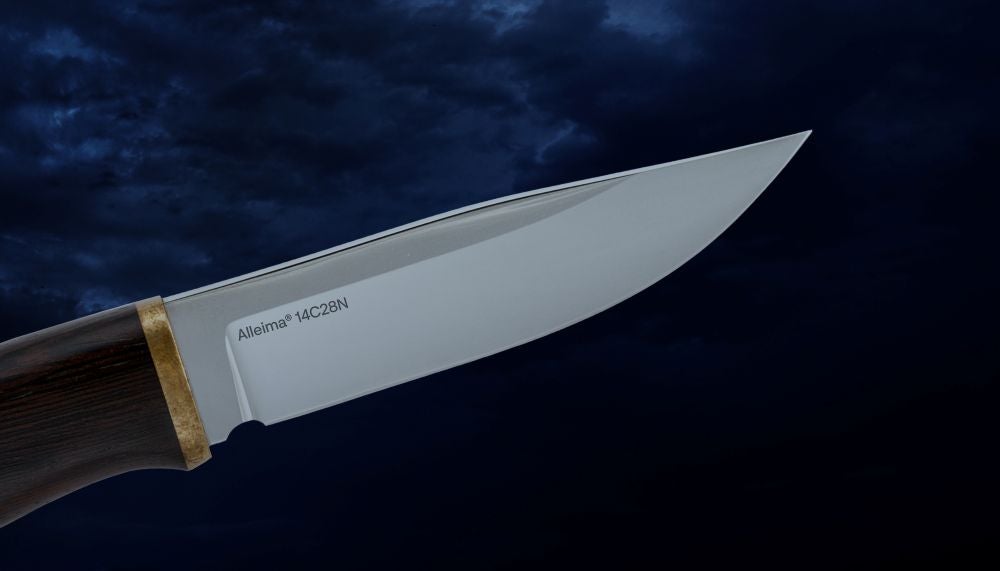
Applications requiring a broader balance can draw on grades such as Alleima 14C28N, where nitrogen supports hardness without sacrificing corrosion resistance to the same extent as a simple increase in carbon. Typical uses include folding knives, chef’s knives and fishing knives.
Where corrosion exposure dominates, Alleima 7C27Mo2 is designed for high corrosion resistance, toughness and easy resharpening, making it suitable for fishing and hunting knives used in marine environments.
Alleima also produces Damax, its Damascus steel, by combining 19C27 with 7C27Mo2. The steel combines the former’s high wear resistance with the latter’s corrosion resistance and toughness, while delivering the patterned appearance expected of a premium Damascus product.
From metallurgy to predictable blade quality
For product developers, the combination of grade selection, production control and correctly optimised heat treatment provides a more reliable route to achieving blade performance. The chemistry establishes what a steel can achieve, while the manufacturing and heat-treatment processes determine how successfully that potential is realised.
Explore the metallurgical changes behind hardening and tempering in greater depth, alongside a guide to matching individual knife steel grades with specific applications. Download the free report to find out more.
