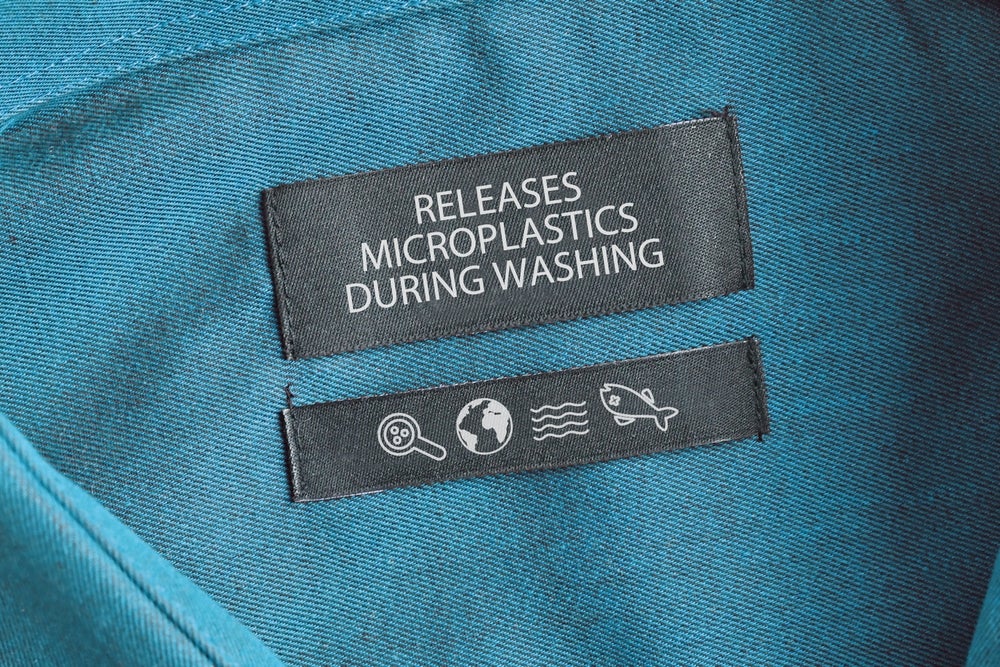
Microplastics are a serious issue, taking thousands of years to break down and being increasingly linked to many health problems.
They are even now found inside human bodies and in very remote parts of the planet.
Go deeper with GlobalData


Access deeper industry intelligence
Experience unmatched clarity with a single platform that combines unique data, AI, and human expertise.
Laundry is an important but often overlooked source of microplastics. In Germany, washing machines release about 500 tons of tiny plastic fibres into wastewater every year. Wastewater treatment plants remove most of them (about 91%), but some still end up in rivers and soil.
Special filters for washing machines could increase removal to about 96%, but they are costly and would make doing laundry noticeably more expensive. Because of this, filters should be seen as just one option alongside other ways to cut microplastic pollution, for example, from road traffic.
How fish-inspired filters work
According to University of Bonn biologist and study co-author Leandra Hamann, current washing machine filters do not solve the problem.
“Some of them quickly become clogged, others do not offer adequate filtration,” she said.
US Tariffs are shifting - will you react or anticipate?
Don’t let policy changes catch you off guard. Stay proactive with real-time data and expert analysis.
By GlobalDataHamann believes new filter designs could greatly cut the amount of microplastics released by washing machines. Instead of relying on complex engineering, she and her team turned to evolution for ideas.
Fish such as sardines, anchovies, and mackerel have funnel-shaped gill arch systems that work like cross-flow filters. As water flows through their mouths and toward their throats, comb-like structures with tiny tooth-like elements form a flexible mesh that traps particles. This gill system both filters the water and helps the fish catch food.
“During feeding, water flows through the permeable funnel wall, is filtered, and the clean water is released back into the environment via the gills,” explained co-author and biologist Alexander Blanke. “Plankton, however, is too large to pass through the natural sieve. It is held back by the filter, and thanks to the funnel shape, it rolls toward the gullet, where it is collected until the fish swallows, which empties and cleans the system.”
Because the trapped particles roll toward the throat instead of staying in the filter area, the system is much less likely to clog.
The researchers tested different mesh sizes and funnel angles before finding a design that worked extremely well.
“We have thus found a combination of parameters that enable our filter to separate more than 99 percent of the microplastics out of the water but not become blocked,” Hamann said.
From lab design to real-world use
Despite its promise, there are several challenges to putting this fish-inspired filter into everyday use. Washing machine designs might need to be modified, which could raise production costs or slow adoption by manufacturers. The filter materials must be durable enough to withstand years of hot water, detergents, and friction from clothes without losing efficiency.
Users would also have to remember to maintain and empty the system correctly, or its performance could drop over time. Finally, there needs to be clear guidance on how to handle and dispose of the collected plastic pellets so they do not simply re-enter the environment in another way.
In their setup, once the microplastics are caught, they are gathered in a filter outlet and then sucked out several times a minute. With a few changes to standard washing machines, the team suggests that the appliance could then compress the collected plastic to remove water and shape it into a small pellet.
After several dozen wash cycles, the user could simply remove this solid plastic block and throw it away with normal household trash. The researchers say their filter design is cheap to produce and doesn’t need complicated mechanical parts. They have applied for a patent and hope washing machine companies will refine the system further and build it into their future products.