
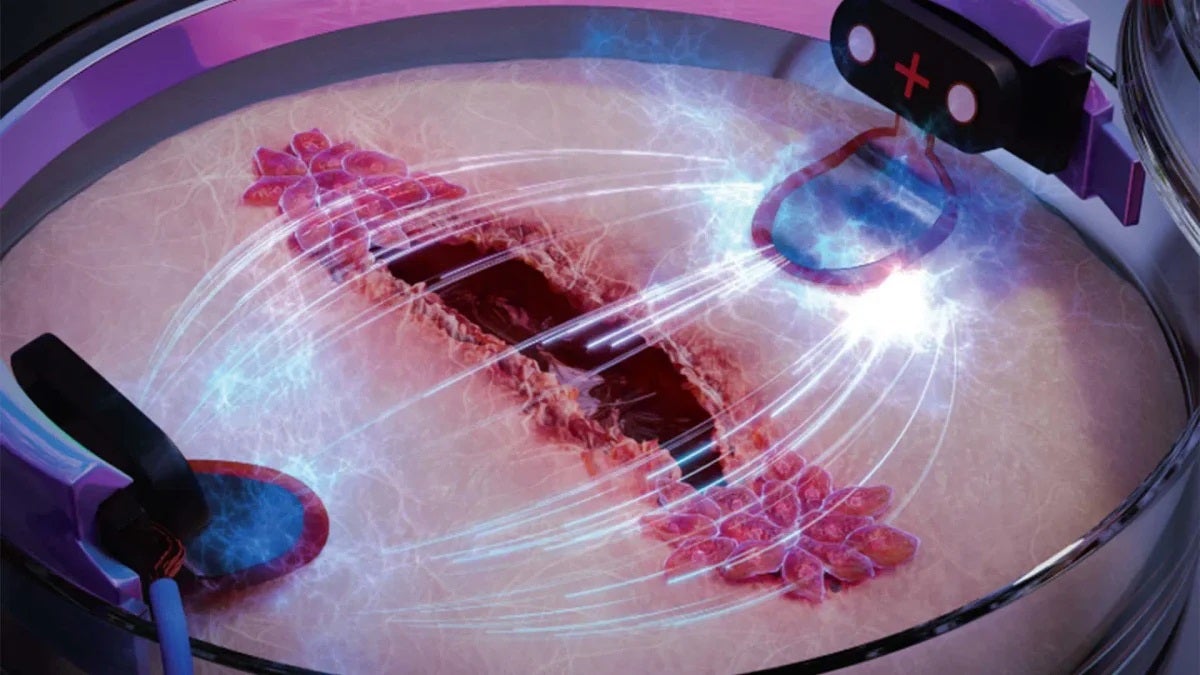
Researchers have developed a method to accelerate the healing process of chronic wounds by three times using electric stimulation.
The process was developed by researchers at the Chalmers University of Technology, Sweden, and the University of Freiburg, Germany.
Go deeper with GlobalData


Access deeper industry intelligence
Experience unmatched clarity with a single platform that combines unique data, AI, and human expertise.
Chalmers University of Technology associate professor of Bioelectronics and head of research on the project Maria Asplund said: “Chronic wounds are a huge societal problem that we do not hear a lot about.
“Our discovery of a method that may heal wounds up to three times faster can be a game changer for diabetic and elderly people, among others, who often suffer greatly from wounds that will not heal.”
The hypotheses for the research were based on the idea that skin cells are electrotactic.
This property allows skin cells to ‘migrate’ directionally when placed in an electric field.
Meaning, if an electric field is applied to skin cells in a petri dish, the cells cease moving randomly and begin migrating in one direction.
To accelerate the healing of wounds, the researchers looked at how this principle may be utilised to electrically direct the cells.
The researchers compared the healing of two artificial skin wounds by stimulating one with electricity and leaving the other to heal on its own.
Asplund added: “In order to study exactly how this works for wounds, we developed a kind of biochip on which we cultured skin cells, which we then made tiny wounds in. Then we stimulated one wound with an electric field, which clearly led to it healing three times as fast as the wound that healed without electric stimulation.”
The study also examined the relationship between diabetes and wound healing.
According to the World Health Organisation (WHO) and the International Diabetes Federation, one in 11 adults has some kind of diabetes today.
“We saw that when we mimic diabetes in the cells, the wounds on the chip heal very slowly. However, with electric stimulation we can increase the speed of healing so that the diabetes-affected cells almost correspond to healthy skin cells,” Asplund noted.