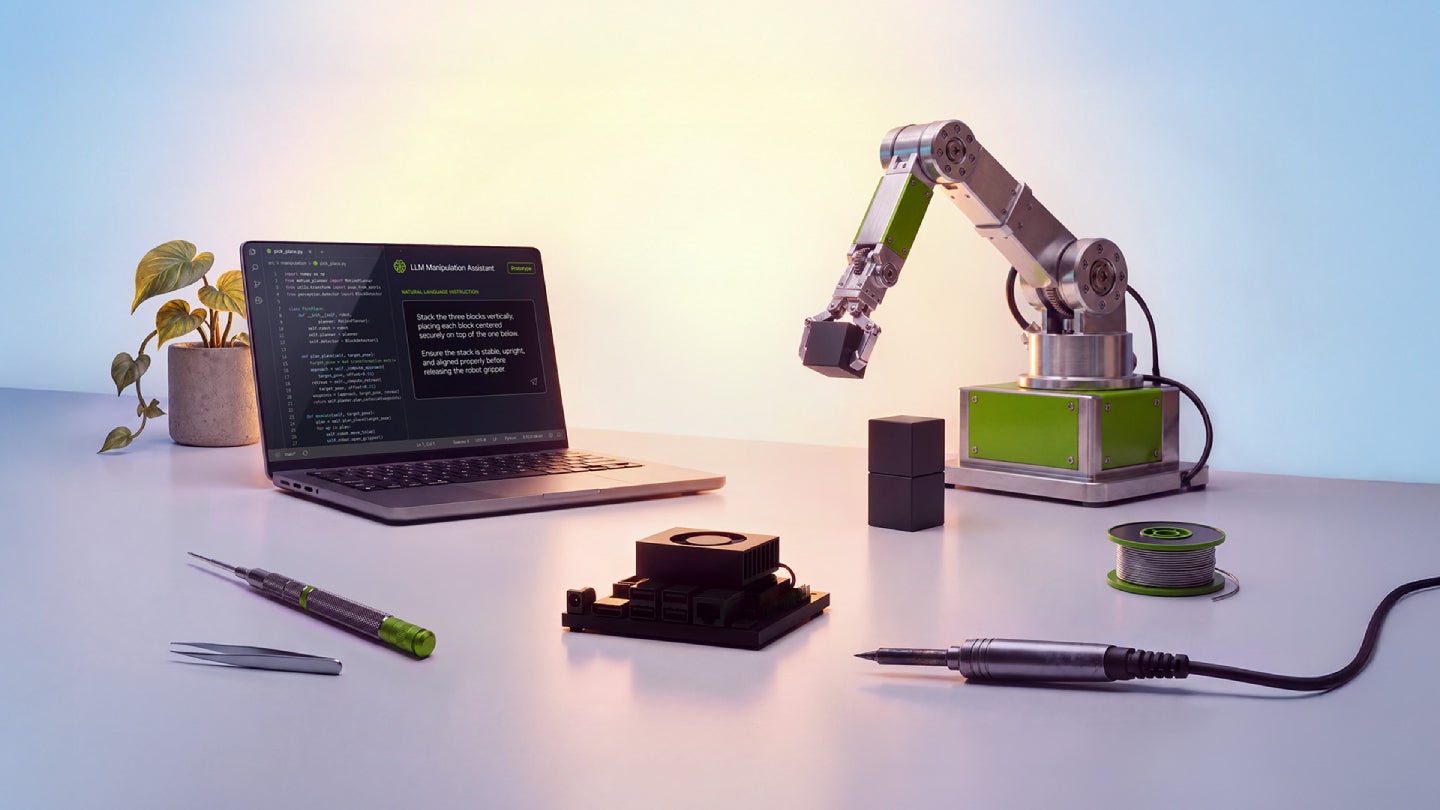
Nvidia has announced the Jetson Orin Nano 2, a new robotics computer for entry-level edge AI, with the module and developer kit expected to be available in the first half of 2027.
The Jetson Orin Nano 2 delivers 78 trillion operations per second (TOPS) of AI compute and features 8GB of memory and an 8-core Arm CPU. It is designed to provide improved AI and video-processing performance in a cost-effective, power-efficient system.
Go deeper with GlobalData


Access deeper industry intelligence
Experience unmatched clarity with a single platform that combines unique data, AI, and human expertise.
According to Nvidia, the Jetson Orin Nano 2 achieves twice the inference performance of the Jetson Orin Nano Super through enhanced Tensor Cores and higher memory bandwidth, while maintaining the same compact form factor. In 15-watt mode, it uses 40% less power than the previous module to produce equivalent performance, the company said.
Nvidia robotics and edge AI vice president Deepu Talla said: “Today’s small and medium frontier models have reached the accuracy of last year’s largest frontier models, unlocking real-time intelligence for edge devices.
“The Jetson Orin Nano 2 computer puts that breakthrough within reach of millions of developers, delivering the performance and energy efficiency needed for real-time reasoning at the edge.”
The Jetson Orin Nano 2 is powered by Nvidia’s open software stack. It includes Jetson agent skills, and is part of an AI ecosystem that enables developers to run the latest large language and vision language models optimised for memory-efficient edge inference.
Supported open models include Nvidia Cosmos, Nvidia Nemotron, Gemma 4 and Qwen 3. These capabilities are intended to support rapid development of advanced AI applications for edge devices.
Cognex, Doosan Bobcat and Matic are among the first companies to adopt and explore Jetson Orin Nano 2.
Nvidia reports that more than three million developers build on its robotics stack.
Partners including Advantech, RidgeRun, Chuanglebo, RS, ADLINK, Seeed Studio, Plink, JWIPC, Antmicro, Aetina, Auvidea, AAEON, Twowin, Aptiv, Tauro Tech, Realtimes, AVerMedia, Connect Tech, Neurealm, TZTEK, YUAN and ForeCR are developing carrier boards, hardware systems, customised AI software and reference solutions intended to help customers accelerate time to market.
Wing, a drone delivery company and subsidiary of Alphabet, is using Jetson Orin Nano Super and the Nvidia software stack in its fleet of delivery drones. It plans to evaluate Jetson Orin Nano 2 to advance real-time AI perception and reasoning for faster, safer delivery.
Matic Robots is adopting Jetson Orin Nano 2 in its home cleaning robots. Its aim is to enable conversational AI, gesture detection, deeper contextual understanding of the home, precision mapping, semantic understanding, and autonomous cleaning.
Last month, Nvidia introduced the Jetson T3000 and Jetson T2000 modules, which are designed to expand mainstream robotics and edge AI systems. These modules are based on the Nvidia Thor architecture and are intended for compact, high-performance, efficient AI processing at the edge.
Jetson T3000 provides 865 FP4 teraflops of AI compute, features an Nvidia Blackwell GPU, an eight-core Neoverse Arm CPU, 32GB of LPDDR5X memory, 273GB/s memory bandwidth, and 25 GbE connectivity.
Jetson T2000 extends the Thor architecture to additional use cases outside high-end robotics, offering 400 FP4 teraflops of compute and 16GB of memory.