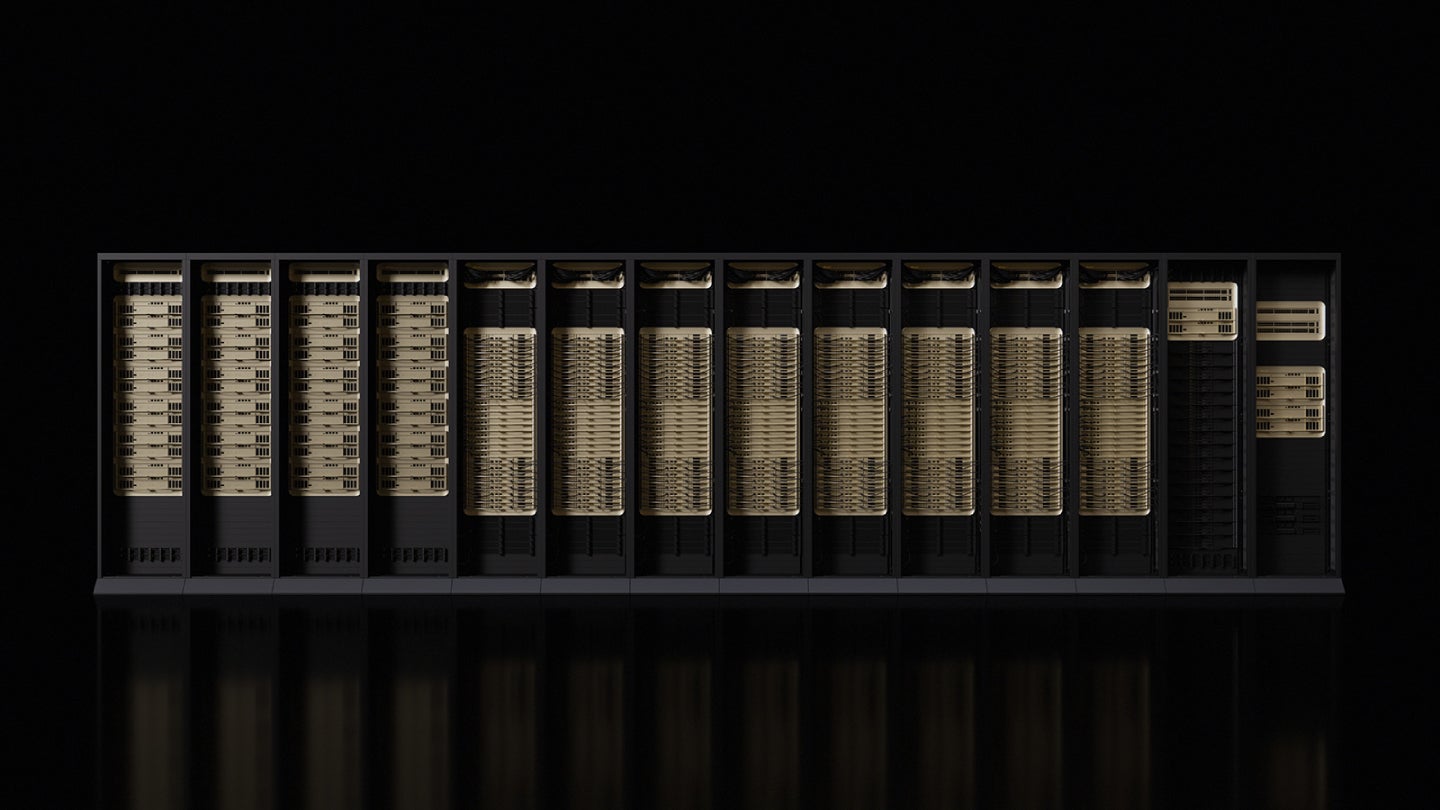
Nvidia has unveiled the Rubin platform, a new suite of six chips designed to support AI supercomputing infrastructure at scale.
The platform consists of the Vera CPU, Rubin GPU, ConnectX-9, NVLink 6 Switch, SuperNIC, BlueField-4 DPU and Spectrum-6 Ethernet Switch.
Go deeper with GlobalData


Access deeper industry intelligence
Experience unmatched clarity with a single platform that combines unique data, AI, and human expertise.
Nvidia plans to deploy the platform in the second half of 2026, with hyperscalers including AWS, Google Cloud, Microsoft and Oracle Cloud all announcing plans to integrate Rubin-based systems.
Microsoft will adopt the Vera Rubin NVL72 rack-scale systems for its next-generation Fairwater AI data centres.
Rubin’s architecture is based on close codesign between compute, networking and storage hardware.
According to Nvidia, this approach reduces token generation costs up to tenfold, and cuts the number of GPUs required for mixture-of-experts model training by a factor of four compared with its predecessor, Blackwell.
The company has named the platform after astronomer Vera Florence Cooper Rubin.
Two main system configurations are detailed: the Vera Rubin NVL72, containing 72 GPUs and 36 CPUs per rack, and the HGX Rubin NVL8 server board with eight interconnected GPUs for x86-based generative AI.
The Rubin GPU includes a third-generation Transformer Engine with hardware-accelerated adaptive compression and delivers up to 50 petaflops of NVFP4 compute for inference workloads.
Nvidia’s sixth-generation NVLink offers 3.6TB/s bandwidth per GPU and 260TB/s at rack scale, enabling high-throughput communication for large models.
The Vera CPU features 88 custom cores with Armv9.2 compatibility and direct NVLink-C2C connectivity.
Security and reliability are strengthened with third-generation Confidential Computing, deployed at rack scale on Vera Rubin NVL72 systems, to keep data protected across all processing domains.
The platform implements real-time health checks and fault tolerance through a second-generation RAS engine.
BlueField-4 DPU introduces Advanced Secure Trusted Resource Architecture (ASTRA) for provisioning large-scale AI environments.
Networking advances include the Spectrum-6 Ethernet Switch built on 200G SerDes technology with co-packaged optics optimised for AI workloads.
Spectrum-X Ethernet Photonics increases reliability and power efficiency while supporting long-range distributed operations as a single AI environment.
Early adopters such as CoreWeave plan to deploy Rubin-based infrastructure starting in late 2026.
Server vendors Cisco, HPE, Lenovo, Dell Technologies, and Supermicro will offer Rubin-compatible systems.
Research labs including Anthropic, OpenAI, Meta, and Mistral AI intend to use the platform for larger models and lower latency.
OpenAI CEO Sam Altman said: “Intelligence scales with compute. When we add more compute, models get more capable, solve harder problems and make a bigger impact for people. The Nvidia Rubin platform helps us keep scaling this progress so advanced intelligence benefits everyone.”
Red Hat has extended its collaboration with Nvidia to provide an optimised software stack covering Red Hat Enterprise Linux, OpenShift and Red Hat AI products for Rubin deployments.