
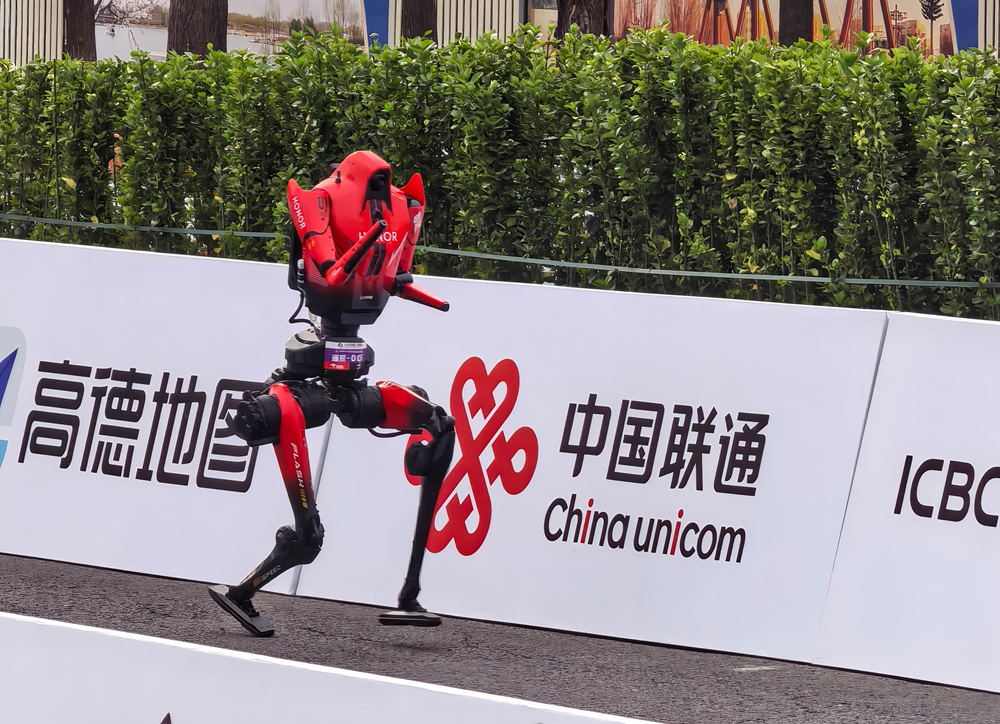
On April 19th 2026, at Tongming Lake Park and Nanhaizi Park, Beijing, a humanoid robot completed a half marathon faster than any human in history. Lightning – a running robot created by Chinese company Honor – covered the 21km course in Beijing in just 50 minutes and 26 seconds, more than six minutes quicker than the human world record. Standing 169cm tall and swinging its short forearms for balance, the bright-red robot powered through the race, crossing the finish line in record time.
While humanoid robots don’t feel fatigue, lose will-power, or ‘hit the wall’ as human marathon runners are apt to do, they do face other extreme demands. With the robots reaching the impressive speed of 10 metres per second, far exceeding the average human, they require exceptional stability, reliability, and endurance. To meet these challenges, Huawei and China Unicom Beijing jointly provided stable, high-speed 5G-A coverage to enable the robots’ high-precision positioning and fully autonomous navigation throughout the race.
What was the role of 5G-A technology?
The Beijing E-Town Half-Marathon and its world-first Humanoid Robot Half-Marathon did more than put robots on the starting line – they turned the race into a live demonstration of next-generation connectivity. A 5G-A network and high-speed uplink capabilities provided seamless communication between the robots and their control systems, enabling real-time data transmission, essential for precise navigation and optimal performance.
The E-Town half-marathon featured both human and robot runners competing simultaneously, with the robots divided into separate autonomous navigation and remote-control groups, running on the same course. Each robot requires approximately 10 Mbps uplink for video uploads, environment sensing, gait control, and autonomous navigation. Using uplink slices ensured sub-decimetre positioning accuracy and an average end-to-end latency below 30ms across the entire course, providing robust support for the robots’ video uploads, obstacle avoidance, cornering, and sprinting.
By combining intelligent base stations and dedicated uplink slices, the partners delivered field-tested uplink peaks of 677 Mbps and maintained >99.6% fulfilment at 20 Mbps. This technical framework also enabled a smooth and seamless experience for video livestreams and instant media workflows as well as precise robot perception, positioning, and motion control.
The high-uplink 5G-A network used for this event was supported by multiple core technologies, including:
- Innovative ELAA technology to deliver optimal network coverage and user experience
- 5G-A network featuring 3.5 GHz and 2.1 GHz bands, and 3CC aggregation, with single-user uplink speeds of up to 677 Mbps.
- Smart-board-powered 5G-A elastic network to intelligently allocate network resources based on service requirements and applied to key services, such as livestreaming uplink, voice and video calls, and short videos.
How do robots run?
The robots were equipped with advanced sensors and processors that allowed them to perceive their environment and make decisions in real-time. These sensors included LIDAR and cameras, which provided a comprehensive view of the surroundings, enabling the robots to detect obstacles and navigate the course efficiently.
Sophisticated AI and machine learning algorithms interpreted this data to execute complex manoeuvres, adapt to changing conditions, and improve performance with each lap. Combined with high-precision positioning and dynamic obstacle avoidance, these systems enabled accurate, stable, high-speed running. This deep integration of AI and robotics in sport not only boosts robot performance today but also points to a future where increasingly capable humanoid robots feature in a wide range of sporting events.
Broader implications
The implications of the successful robot marathon reach far beyond sport. As robots become more advanced, they are poised to evolve from simple tools into partners across sectors such as healthcare, manufacturing, and logistics – working alongside people, augmenting human abilities, and driving new levels of efficiency.
What unfolded on the streets of Beijing was a live testbed for the next generation of intelligent infrastructure, where connectivity, AI, and robotics operate as one. As these technologies mature, humanoid robots will move from showcasing their running prowess to become true collaborators across industry.
