Since school closures and remote learning became ubiquitous during the Covid-19 pandemic in 2020, school attendance in the UK has declined drastically.
The road to the return of in-person learning has proved to be less than smooth. A 2024 report published by the Education Policy Institute found that up to 400,000 children may be missing from education entirely, representing a 50% increase from pre-pandemic levels.
Reportedly, it is students who suffer from social, emotional, or mental health difficulties who are most likely to miss periods of mainstream education. The problem that schools face is how to encourage these children back into the classroom, five years on from a serious disruption to their education.
How robots can solve the problem
Robotic technology may offer a solution to this social problem.
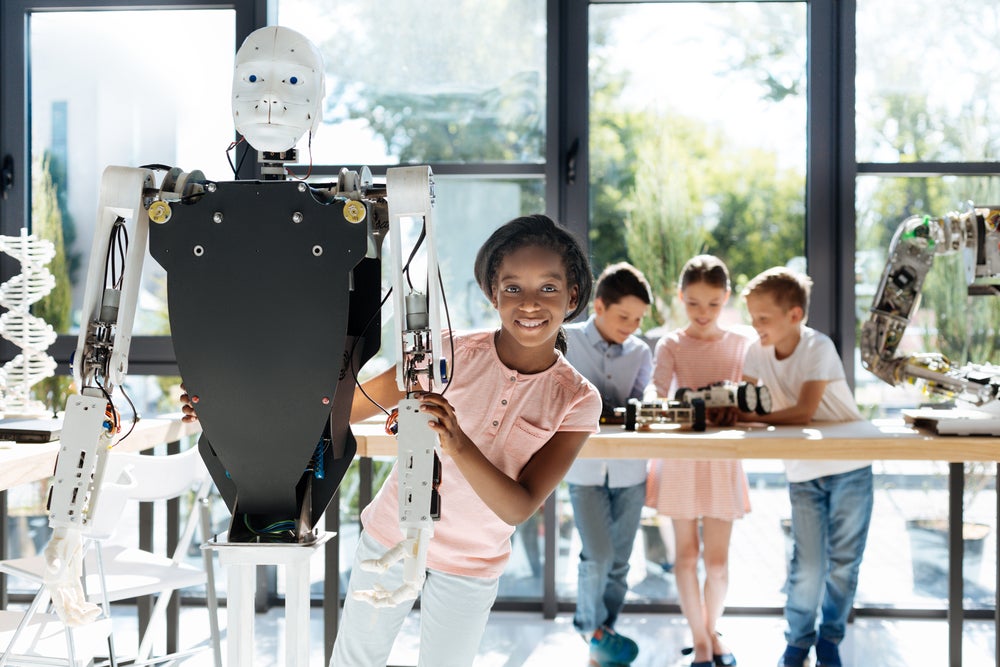
Children with conditions such as autism spectrum disorder (ASD) or attention deficit hyperactivity disorder (ADHD) are more likely to have low school attendance in comparison to neurotypical children. For them, practicing interactions with robots may make certain elements of classroom learning easier, and could encourage phased reintegration.
Communication difficulties can be eased through practice in a low-stakes scenario with a robot. Elsewhere, teachers could use robots to create structured role-play scenarios for greetings or expressing needs, which can eventually be transferred to real life, making the prospect of classroom participation less daunting.
Alongside robots offering practice interactions with children, the technology could provide a solution to remote learning. Children who find the physical act of entering school or the classroom too challenging, whether this is due to mental or physical health problems, can use a robot in their place. Robots featuring microphones and cameras can allow pupils to participate in lessons and become accustomed to the school environment in a low-pressure way, allowing for a phased reintegration. This means that children can be absent without missing out on learning, making their eventual return less intimidating.
Robots are starting to make their mark in school
In recent years, some schools have begun trialling robots to tackle attendance issues. Oslo-based start-up No Isolation created a telepresence robot, AV1, with the intent to provide a physical presence for children who cannot be in school. AV1 has a camera, a microphone, and a variety of lights and emoji expressions for absent students to indicate how they are feeling.
AV1 was used in The Wirral in Merseyside from April to July 2024, as part of a scheme to improve low attendance. Some 12 robots were adopted to support children experiencing EBSA in the borough. Official attendance scores of pupils who used the robot improved on average by 21%, with hours that pupils engaged with lessons improving by 42%.
The AV1 was also used successfully in a Twickenham school in 2024 to help a student undergoing chemotherapy. The robot could sit in the classroom with lessons livestreamed. It was carried from class to class by other students, who would interact with the student through the AV1’s microphone. Teachers and students underwent “Robot training” to ensure that their interaction with the robot was sound. Feedback for the AV1 in this instance was overwhelmingly positive, from both school staff, pupils, and the absent student.
The humanoid robot, Pepper, developed by Softbank Robotics, was also designed to improve attendance. Pepper was designed to interact with children naturally and intuitively, built with an ability to recognise emotions and adapt its behavior accordingly. After trialling Pepper, a school in Somerset gave feedback that the robot gave autistic children a new confidence to interact with others. Eventually, children who usually would not interact with peers were choosing to socialize more, having practiced with the robot, Pepper.
The future looks bright
With successful trials of robots in schools, the future seems hopeful. There are hopes that the tumultuous years for education that followed the pandemic could be placated using this technological solution.
With emerging technologies like AI painted as a looming threat to education and society, schools and governments must not overlook the potential benefits of technologies, as has evidently been found with robotics. Innovations like AV1 and Pepper could be a crucial step forward in ensuring a better education and future for struggling children.