
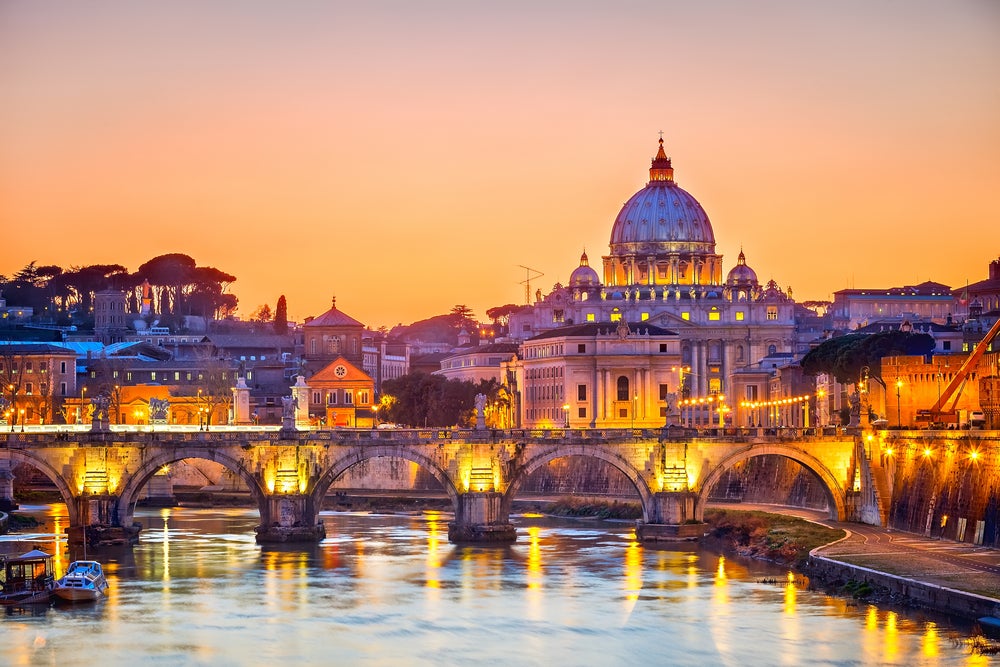
The idioms that mention a city are a measure of its fame and stature, as well as providing comment and advice on everyday life – take Rome, for example.
The city’s history and influence can be summed up by the recollection that: “Rome wasn’t built in a day”; “All roads lead to Rome; “When in Rome….”; “Fiddling while Rome burns”; and “Crossing the Rubicon”, the latter taken from Julius Caesar’s 49 BC act of leading his army across the Rubicon River (a small river in Italy) into Roman territory, which was forbidden and sparked a civil war, forever changing Rome. In other words, making an irrevocable decision or taking a fateful step that commits you to a course of action with no turning back. A point of no return.
Rome’s new idiom: smart city
Increasingly, these days, we might not only think of a city in terms of its idioms, but also in terms of how “smart” it is. And that certainly applies to Rome, because last month, Rome was named the “Smart City of 2025” at the Smart City Expo World Congress in Barcelona.
Its recognition was based on its strategy of using data, 5G, and digital twins to improve governance, services, and resilience, particularly in preparation for the Jubilee. This award highlights Rome’s commitment to transforming itself into an innovative, citizen-focused, and sustainable metropolis by using technology for urban development.
The Rome Jubilee is a major Catholic event occurring every 25 years, focused on spiritual renewal, forgiveness, and pilgrimage, running from December 24, 2024, to January 6, 2026, which was expected to attract millions of pilgrims to Rome to pass through the Holy Doors of four major basilicas, including St. Peter’s, for indulgences and special religious events. The Jubilee would mean large crowds, potential construction disruptions, and increased security. A good reason, then, to step up the city’s ‘smartness’ to cope with such an influx of people.
Reimagining the Eternal City
Rome’s vision was to reimagine the Eternal City to meet the evolving needs of its people and its future. Making use of data and adopting technologies such as 5G and digital twins would help it build resilience ahead of the major logistical and planning challenges it faced to manage the 2025 Jubilee across the city.
With the Jubilee’s impact in mind, in April 2025, Rome inaugurated its first 5G-equipped metro stations. From Vittorio Emanuele to Cipro, passing through Barberini, Flaminio, Lepanto, Ottaviano, Repubblica, Spagna and Termini, the “Roma 5G” project meant residents, visitors and pilgrims arriving for the Jubilee could enjoy faster and more reliable 4G and 5G mobile connections from all the city’s telecoms carriers: Fastweb-Vodafone, Iliad, TIM and WINDTRE, across the nine Jubilee stations on Metro Line A, spanning seven kilometers.
The development marks the first phase of a collaboration between Roma Capitale and Smart City Roma, a company owned by Italian wireless tower and network infrastructure operator INWIT, and which is responsible for leading the Roma 5G project. The operators’ 4G and 5G signals are now available not only in the stations but also throughout the tunnels connecting them, thanks to a multi-operator Distributed Antenna System (DAS) digital infrastructure for indoor locations. There are further plans to extend 5G coverage using DAS technology to all 75 stations across Metro Lines A, B, B1, and C by 2026.
Special anniversaries build smart city resilience
Global city rankings by the IESE Business School at the University of Navarra in Spain show how cities are approaching social, economic, and geopolitical challenges.
The top three in the 2025 rankings are London, New York, and Paris. Rome languishes in 77th place, with its rankings against other cities for specific ‘dimensions’ nothing to write home about: economy (100), human capital (54), social cohesion (106), environment (81), governance (24), urban planning (76), international profile (23), technology (91), and mobility and transportation (38). The rankings for international profile, governance, and mobility and transportation are strong. But some of the others perhaps less so.
However; when major events like Rome’s Jubilee come along, just like the Paris Olympics in 2024, they act as major spurs for smart city investment. You would expect Rome’s IESE rankings to jump markedly as a result of the city’s readiness for its Jubilee.
To return to those idioms, you could argue that winning the 2025 award means Rome has crossed a Rubicon. But smart city or not, as everyone knows, Rome wasn’t built in a day.