Samsung is sharpening its premium hardware strategy with the Galaxy Z TriFold, a triple-panel foldable that sits at the apex of its expanding foldable portfolio.
The device is launching first in South Korea similar to its Galaxy XR headset launch in October 2025, underlining Samsung’s intent to test and refine the concept at home before scaling globally. The phone will reach the US in Q1 2026 as well as China, Singapore, Taiwan, and the UAE.
Go deeper with GlobalData


Access deeper industry intelligence
Experience unmatched clarity with a single platform that combines unique data, AI, and human expertise.
The Korean-first, Korea‑daytime launch timing is no accident. It targets a domestic base of highly design and spec-sensitive early adopters, while giving Samsung a controlled environment to stress-test retail processes, support, and software update pipelines for a fundamentally more complex form factor.
Z Trifold tech
Technically, the Galaxy Z TriFold (below) is Samsung’s boldest foldable yet. Despite its name, it folds twice using two hinges, effectively combining three approximate 6.5-inch panels into a device that is 12.9mm thick when closed and opens into a 10‑inch tablet-class display.
At just 3.9mm at its thinnest point, it undercuts the unfolded Galaxy Z Fold 7, Apple’s iPhone Air, and Samsung’s own Galaxy S25 Edge on thickness, emphasising the company’s drive for a slimmer, more portable large-screen device.
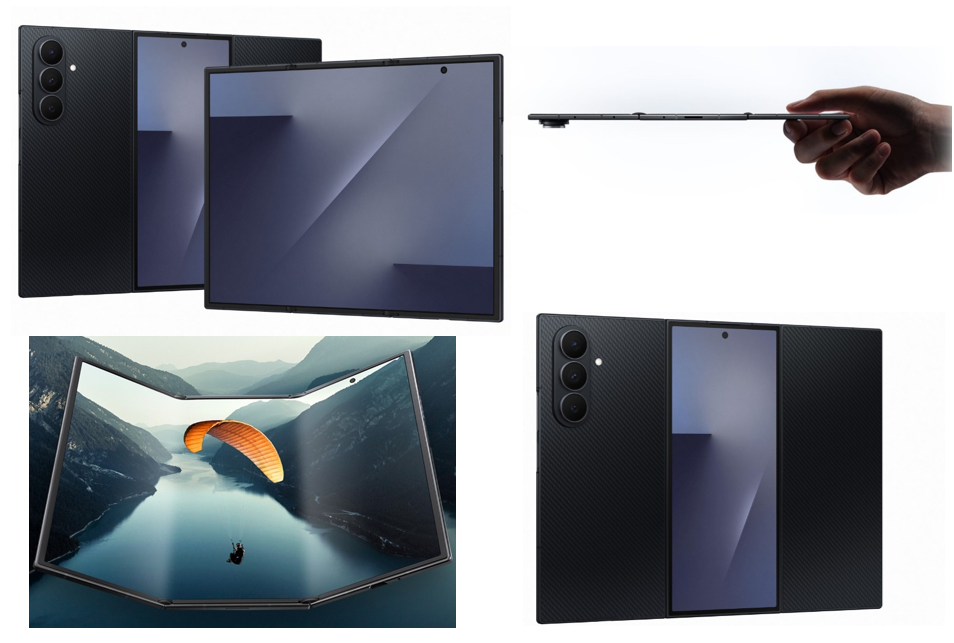
A new display stack, shock‑absorbing layer, and reinforced topcoat address durability across both folds, while the updated Armor FlexHinge—with differently sized hinges and a dual‑rail structure—reduces gaps and improves stability. The hardware runs on a customised Snapdragon 8 Elite Mobile Platform for Samsung Galaxy, a previous-generation chipset but still positioned as sufficient for demanding productivity and gaming.
AI and multitasking
Samsung is leaning heavily on AI and multitasking as key differentiators. Core apps are optimised for the full 10‑inch canvas, while Samsung Galaxy AI and Google Gemini Live enable contextual, on-screen, voice-driven workflows.
A 5,600 mAh three‑cell battery with 45W wired and 15W wireless charging supports the power demands of the larger display, and a 200MP main camera anchors a high-end imaging setup. The IP48 rating matches the Galaxy Z Fold7 but lags IP68 rivals.
Samsung signalling
Strategically, the tri-fold’s role is less about volume and more about brand signalling. Priced at around Won 3.59m in Korea (roughly $2,446), it is likely to approach $3,000 in the US, creating a three-tier foldable ladder at roughly $1,000, $2,000, and $3,000.
This structure allows Samsung to span mainstream premium through to ultra-premium, reinforcing its lead as the only major vendor with a complete, multi-tier foldable range.
Competitively, Huawei’s Mate XT Ultimate has already proven that ultra-premium tri-folds can generate strong demand in China, even above $3,000, albeit at constrained volumes. Samsung’s move is therefore as much defensive as offensive: pre-empting Apple’s entry into foldables and cementing its innovation credentials before rival Android OS brands such as Xiaomi and Oppo can scale similar concepts. For the near term, tri-folds will remain showcase products—but ones that increasingly define the high end of the mobile market.