
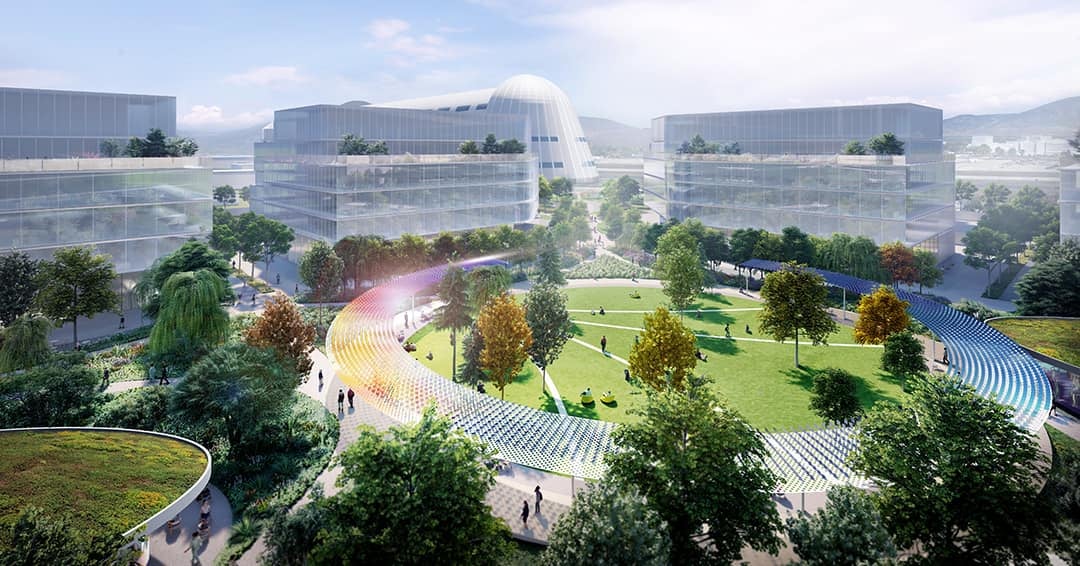
The University of California Berkeley has announced plans to develop a $2 billion aerospace education and research complex at a NASA space campus in Silicon Valley.
The Berkeley Space Center, located at NASA Ames Research Park, will encompass a 35-acre site within NASA’s existing research campus in Silicon Valley.
The complex will include offices, laboratories, classrooms, residences, and retail spaces. Future phases of the project are expected to incorporate short-stay facilities and housing for students and faculty.
Similar models for off-campus research centres at universities include Cornell University’s tech-focused complex on Roosevelt Island in New York City and the Jet Propulsion Laboratory in Pasadena, California, managed by the California Institute of Technology.
GlobalData’s Thematic Intelligence: The Space Economy report puts the value of the space industry in 2022 at $450bn and suggests that it will see a compound annual growth rate of between 6% and 10% between 2022 until 2030.
Construction on the Berkeley Space Center is expected to begin around 2026, pending approvals, with the first buildings opening two years later. The project will be managed by SKS Partners and overseen by CBRE Group.
Potential tenants at the centre are expected to include firms involved in vertical take-off and landing aircraft development and startups in fields like astrobiology, which explores growing organisms in space and the effects of zero gravity on the human body.
The new research hub is expected to facilitate public-private partnerships and collaborations between UC Berkeley, NASA, and the public sector, advancing scientific, engineering, and technical fields while pushing the global university model forward.
Go deeper with GlobalData


Access deeper industry intelligence
Experience unmatched clarity with a single platform that combines unique data, AI, and human expertise.
In July 2023, NASA unveiled spacecraft and mission hardware developed using generative artificial intelligence.
These specialised components, known as evolved structures, are used in equipment such as astrophysics balloon observatories, earth-atmosphere scanners, planetary instruments, and space telescopes.