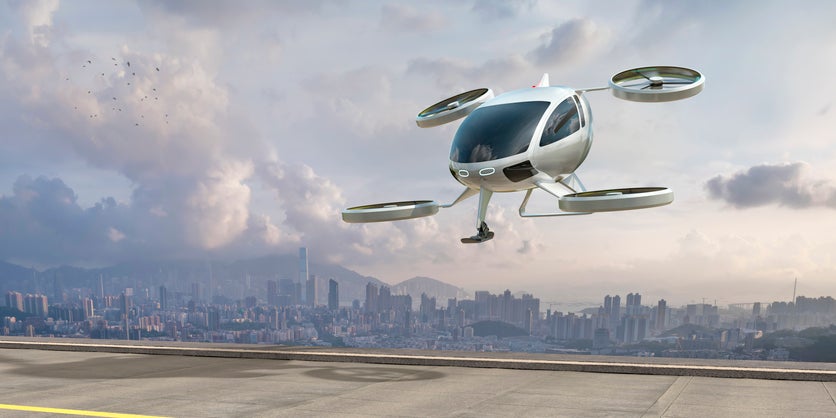
A flying car has just completed a successful wind tunnel test, which demonstrates that flying cars may soon become a reality as a number of companies race to launch their flying vehicle first.
Eve Holding, a Brazilian electric plane maker, said it wants to launch commercial operations of its electric vertical take-off and landing vehicle (eVTOL) by 2026.
Go deeper with GlobalData


Access deeper industry intelligence
Experience unmatched clarity with a single platform that combines unique data, AI, and human expertise.
Regulators see the wind tunnel test as an important part of certification – meaning the eVTOL has made a big step towards being released.
Luiz Valentini, a technology officer at Eve, said: “The information we obtained during this phase of development has helped us further refine the technical solutions of our eVTOL, before committing to production tooling and conforming prototypes.”
Being referred to as a flying taxi, eVTOL’s development is being backed by industry heavyweights Rolls Royce and United Airlines.
Eve has already received a backlog of just under 3,000 pre-orders for its flying car.
The Brazillian company says it plans to start building its first full-to-scale prototype in the latter half of 2023, with further testing planned for next year.
Eve’s successful test comes shortly after Calfornia-based Archer Aviation’s announcement that its eVTOL air taxi was ready for testing.
The United Airlines-backed manufacturer previously said it was planning to launch in Chicago in 2025.
However, with several different companies developing eVTOL vehicles, it’s unclear who will be the first to market.
Experts remain sceptical
Despite the eVTOL’s futuristic and environmentally conscious vision, some experts have questioned the economics of using it commercially.
“The concept of using electric vertical take-off and landing (eVTOL) vehicles as regional air taxis is an interesting possibility that could be realized in the near term,” Lee Sykes, commercial director at Drive System Design UK, told Verdict.
“However, the current economics of using them for such short journeys may be a barrier,” he added.
According to Sykes, the future of electrification in the aviation industry “is not simply a case of choosing between electrification or not” but instead required a “nuanced approach”.
“For heavier aircraft, main propulsion electrification is not the answer, given the battery power density required for such a large and long-range application,” Sykes said.
GlobalData is the parent company of Verdict and its sister publications.