Art forgery has shadowed the art market for centuries, but in the last few decades it has escalated into a global industry.
Estimates from the Art Legacy Institute suggest the trade in counterfeit art may generate between $4 and $6bn annually, with high-profile networks exposed in Europe and beyond. In 2023, Italian police dismantled a ring selling fake works in the style of Picasso, Warhol, and Banksy, valued at more than $200m.
For the estate of Indigenous Canadian artist Norval Morrisseau, who died in 2007, this problem is especially acute. His bold, pictographic style has made him one of the most copied artists in North America. The Morrisseau estate estimates that around 4,500 to 6,000 fake works have infiltrated collections, amounting to tens of millions of dollars in fraudulent sales. The sheer volume has left the estate in a constant struggle to expose and discredit forgeries while protecting the artist’s reputation.
Traditionally, identifying fakes has relied on a handful of highly trained experts capable of spotting anomalies in brushstrokes, pigment use, or compositional choices. But as forgers adopt more sophisticated techniques, the process has become slow, subjective, and prone to error.
Robots are new anti forgery allies
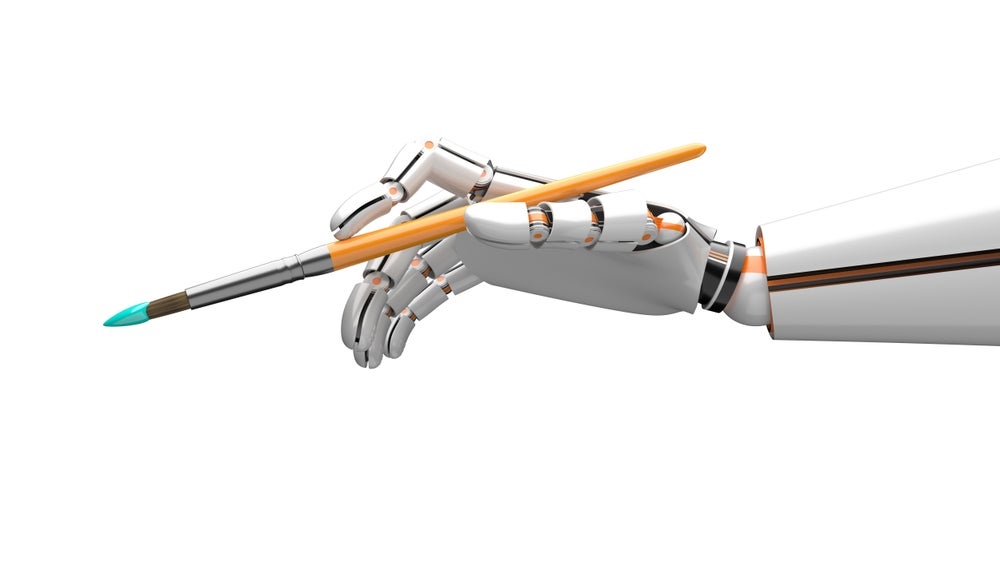
Canadian startup Acrylic Robotics, founded by artist and engineer Chloe Ryan, offers an unconventional solution. Its robotic painting system was originally designed to help artists create authorized, high-quality reproductions of their own work. Unlike flat prints, these robot-made copies use real brushes and paint, capturing the texture and “handmade” feel of the original.
In July 2024, the Morrisseau estate announced it was collaborating with Acrylic to develop its in-house detection system, known as “Norval AI”. Here, the technology is being used for a different purpose: to generate training data for AI authentication. The estate’s in-house system studies the replicas produced by the robot and learns to recognize extremely subtle differences between authentic Morrisseau works and imitations. As the robots improve at mimicking the original paintings, the AI becomes sharper at spotting frauds, a feedback loop that strengthens both tools. This approach represents a shift from art authentication as “an art” toward art authentication as a science of precision and data.
From flaws to fine detail
Early trials with Acrylic’s robotic painter revealed obvious shortcomings. For example, the robot arm initially paused mid-stroke to reload paint, a telltale sign of inauthenticity, since Morrisseau himself never painted this way. But as engineers refined the system, the copies became more convincing.
Today, the estate describes the results as visually compelling, with clear brushstroke lines and a vibrancy resembling Morrisseau’s originals. As the technology improves, so too does the AI authenticator, which now trains on each successive generation of robotic replicas.
As Chloe Ryan explained earlier in 2025, “The better our work gets, the better the model has to get to detect the copies. This also allows us to refine our robotic techniques.”
Extending legacy and accessibility
The Morrisseau estate also plans to sell clearly labelled robot-made replicas, with prices ranging from $2,354 to $32,688. Proceeds will fund both technological development and art restoration projects. Importantly, these replicas are deliberately different in size from Morrisseau’s originals to avoid confusion with authentic works.
Acrylic also sees potential beyond fraud detection. The company envisions a future where its robots, paired with AI, could help restore damaged works or even complete unfinished pieces, extending artistic legacies with technological support.
The approach is not without risks. By perfecting robotic replicas, there is always the danger that the same technology could be misused to create even more convincing forgeries outside of controlled environments. At the same time, questions remain about the ethics of using machines to “extend” an artist’s body of work. For some, allowing robots to finish or replicate paintings blurs the line between preservation and invention, potentially complicating how we define authenticity.
The project touches on the broader debate of accessibility. Fine art has long been tied to scarcity, with originals confined to galleries, collectors, and investors. By producing high-quality painted reproductions at lower costs, Acrylic suggests it might help make art more available without undermining the value of originals.
This collaboration between the Morrisseau estate and Acrylic Robotics illustrates how technology can shift from being a threat to a safeguard in the art world. While forgery thrives on deception, here imitation becomes a tool for truth, helping secure one artist’s legacy while laying groundwork for wider applications across the art market. As estate director Cory Dingle put it: “We want to explore the opportunity to continue his legacy with the aid of technology.”