
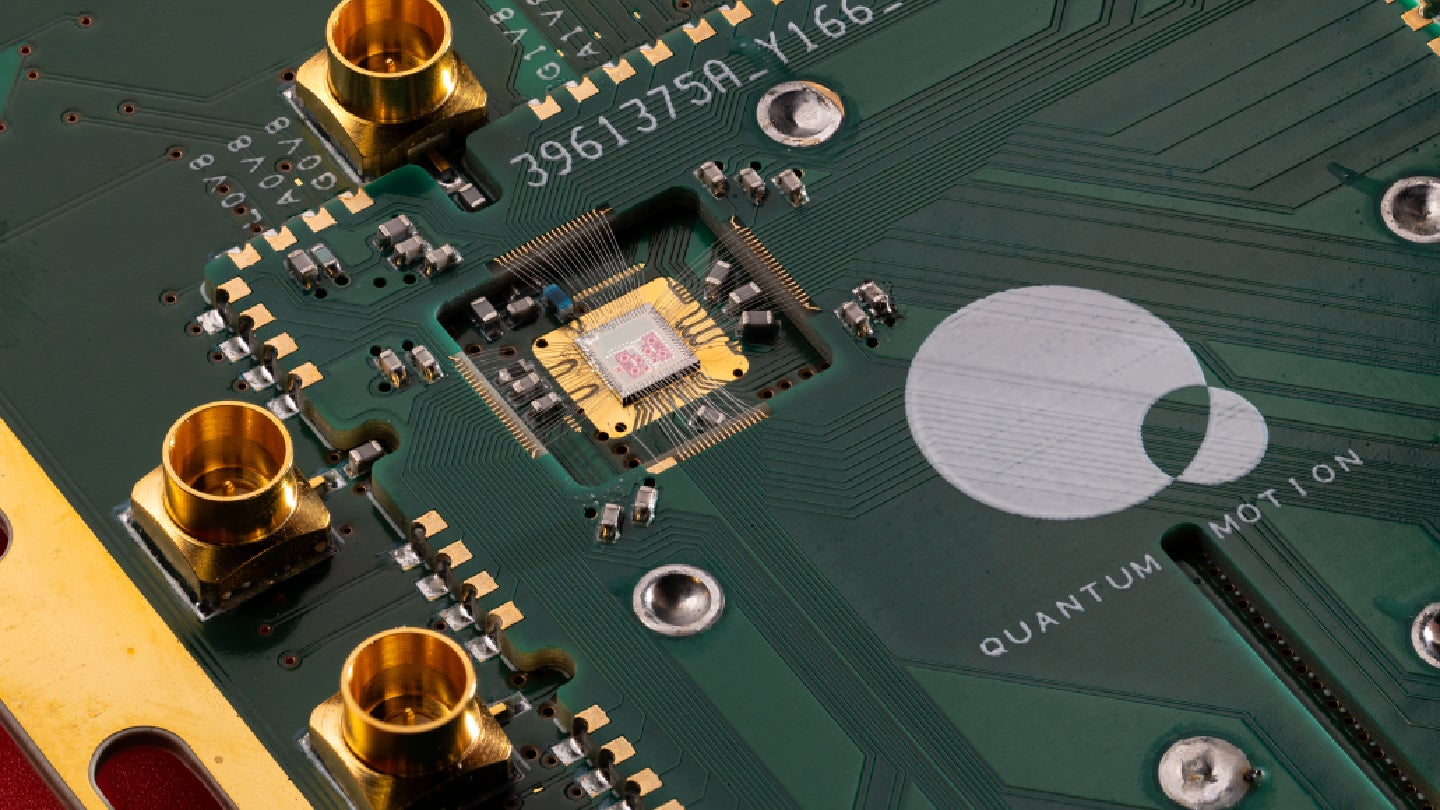
London-based quantum computing company Quantum Motion has announced a Series C funding round totalling $160m, with the investment aimed at developing quantum computers based on silicon transistor technology.
DCVC and Kembara co-led the funding, joined by participants such as the British Business Bank, Oxford Science Enterprises, Bosch Ventures, Firgun, Porsche Automobil Holding, Inkef, and Parkwalk Advisors.
Go deeper with GlobalData


Access deeper industry intelligence
Experience unmatched clarity with a single platform that combines unique data, AI, and human expertise.
The company intends to use this capital to commercialise quantum computing systems that can operate within the infrastructure of current data centres, addressing challenges associated with scaling and power consumption in quantum technologies.
The firm’s approach employs silicon technology that also features in conventional smartphone and laptop chips.
Quantum Motion reports that its architecture can reduce operational costs and space by a factor of 100 and lower energy usage by a factor of 1,000 compared to other quantum computing methods.
This design facilitates the direct integration of quantum computers into standard data-centre racks, removing the need for custom installations and substantial energy demands seen elsewhere in the industry.
Quantum Motion has expanded its operations internationally since its 2023 funding round, launching new offices and laboratories in Spain and Australia and strengthening its manufacturing partnership with GlobalFoundries.
The company continues to prioritise mass deployment and industrial scalability over laboratory-scale demonstrations or increases in qubit counts.
It has scheduled the first commercial rollout of a full-stack silicon CMOS quantum system at the UK National Quantum Computing Centre in 2025 and has moved forward into Stage B of the DARPA Quantum Benchmarking Initiative.
The fundraising comes as the computing sector invests in high-performance computing and AI, both of which increase energy and infrastructure requirements.
Quantum Motion CEO Dr James Palles-Dimmock said: “Quantum computing will only achieve its full potential if it can be built on a platform that scales, and we believe silicon is the strongest route to achieving that.
“We are pleased to be joined by investors who share our vision and understand what it takes to build a foundational company in this field.”
With industry and governments anticipating greater demand on electricity grids, Quantum Motion positions its low-power consumption systems as an alternative to existing quantum computers that may require industrial-scale facilities and high power usage.