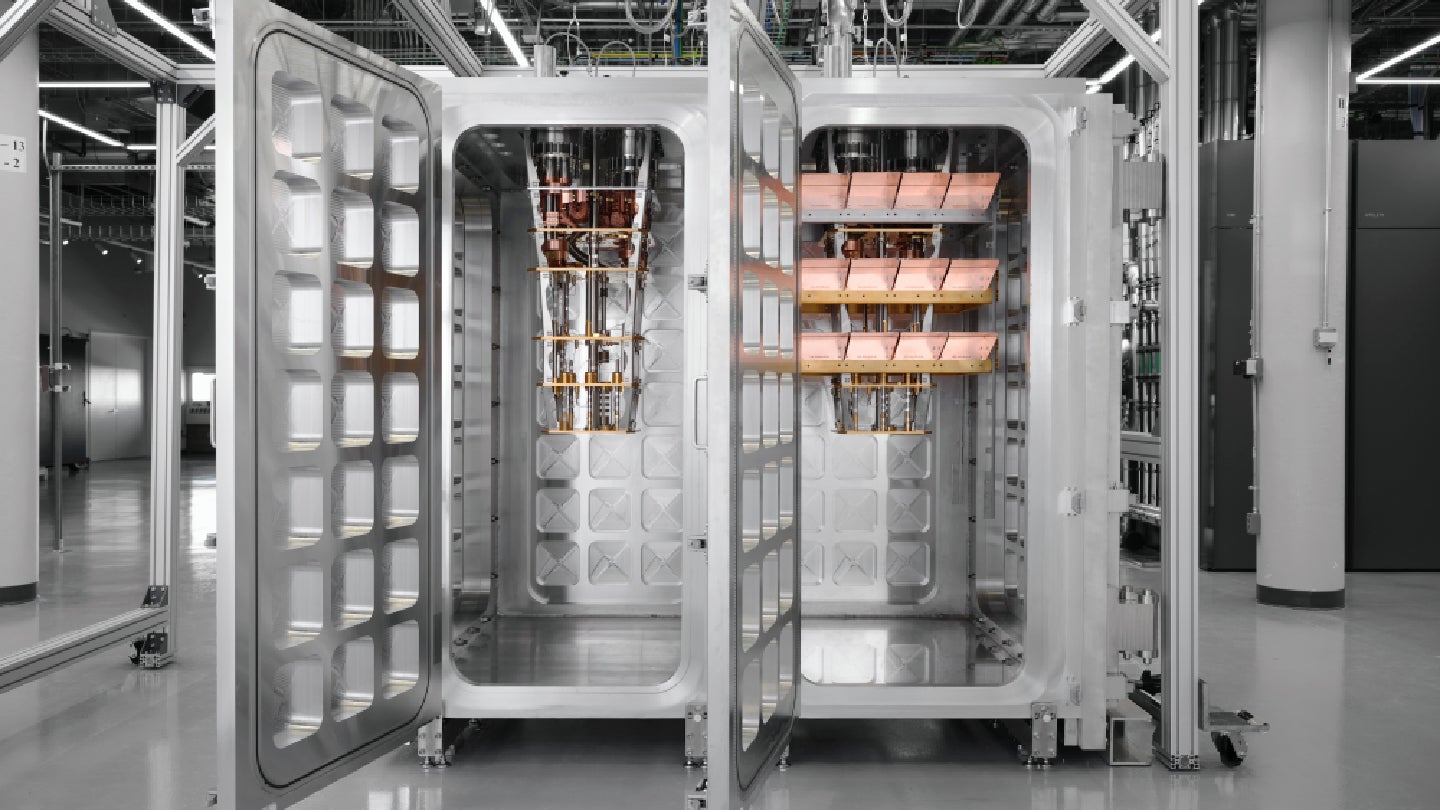
IBM has connected and cooled a pair of cryogenic modules as a single unit, in an architecture the company says is designed to scale to hundreds of linked quantum chips.
The design is intended to grow into a shared, ultra-cold environment in which those chips operate together as one more powerful machine capable of tackling large problems.
Go deeper with GlobalData


Access deeper industry intelligence
Experience unmatched clarity with a single platform that combines unique data, AI, and human expertise.
Standing together, the two units measure upwards of 8ft in both height and width.
Early testing took the pair down to 4 Kelvin, which IBM identifies as the temperature of liquid helium, in fewer than five days. Temperatures fell below 15 millikelvin shortly afterwards.
IBM said that figure is more than 180 times colder than deep space.
Wiring capacity inside each module’s vacuum enclosure runs to as much as 12 times that of IBM’s most widely used quantum systems. The additional room permits a greater number of chip-to-chip connections, both inside individual modules and across them.
A box-shaped format lets the units sit flush against one another in a row. That proximity, together with the extra internal space, makes it possible to join processors directly through IBM’s “L-coupler” technology.
The couplers act as a bridge between discrete chips, letting them exchange information and function collectively within one machine.
Under its roadmap, IBM intends to have L-couplers binding several processors into a single system of no fewer than 1,000 programmable qubits by 2027. Programmable qubits are those available directly for computation.
Nighthawk processors are due to go into the modules later this year, broadening the scope of operational performance testing.
The work feeds into Starling, scheduled for 2029, which IBM expects will be the first fault-tolerant quantum computer built anywhere.
Error correction, processor design, decoding and systems engineering are all to be folded into that machine. Each module is expected to hold thousands of qubits by the time it arrives.
IBM set out its Starling plans last year, alongside a new error-correction code that it said cuts the physical resources fault tolerance demands.
Since then the company has stayed on schedule, pointing to demonstrations of core hardware components and to progress on efficient decoding for error correction.
IBM research director and IBM fellow Jay Gambetta said: “Bringing fault-tolerant quantum computers to industries depends on several fundamental advances.
“The successful connection and operation of these cryogenic modules signals a leap forward in that direction and will accelerate our progress alongside continued innovation in quantum hardware, software, and algorithms.”
Three components essential to the IBM Quantum System Two environment have been carried into the new architecture, though in a form that lets each one be tested, refined and rapidly iterated on its own. IBM said the modular approach should quicken its pace of innovation.
The company disclosed in July 2026 that it had reached a definitive agreement to buy HRL Laboratories, a privately held research and development institution owned jointly by Boeing and General Motors.
IBM said the two owners will remain involved after the transaction, continuing joint work on quantum applications and advanced technology development.
HRL’s silicon-spin qubit engineering will, according to IBM, add to and broaden its longer-term effort to build ever more powerful quantum machines.