
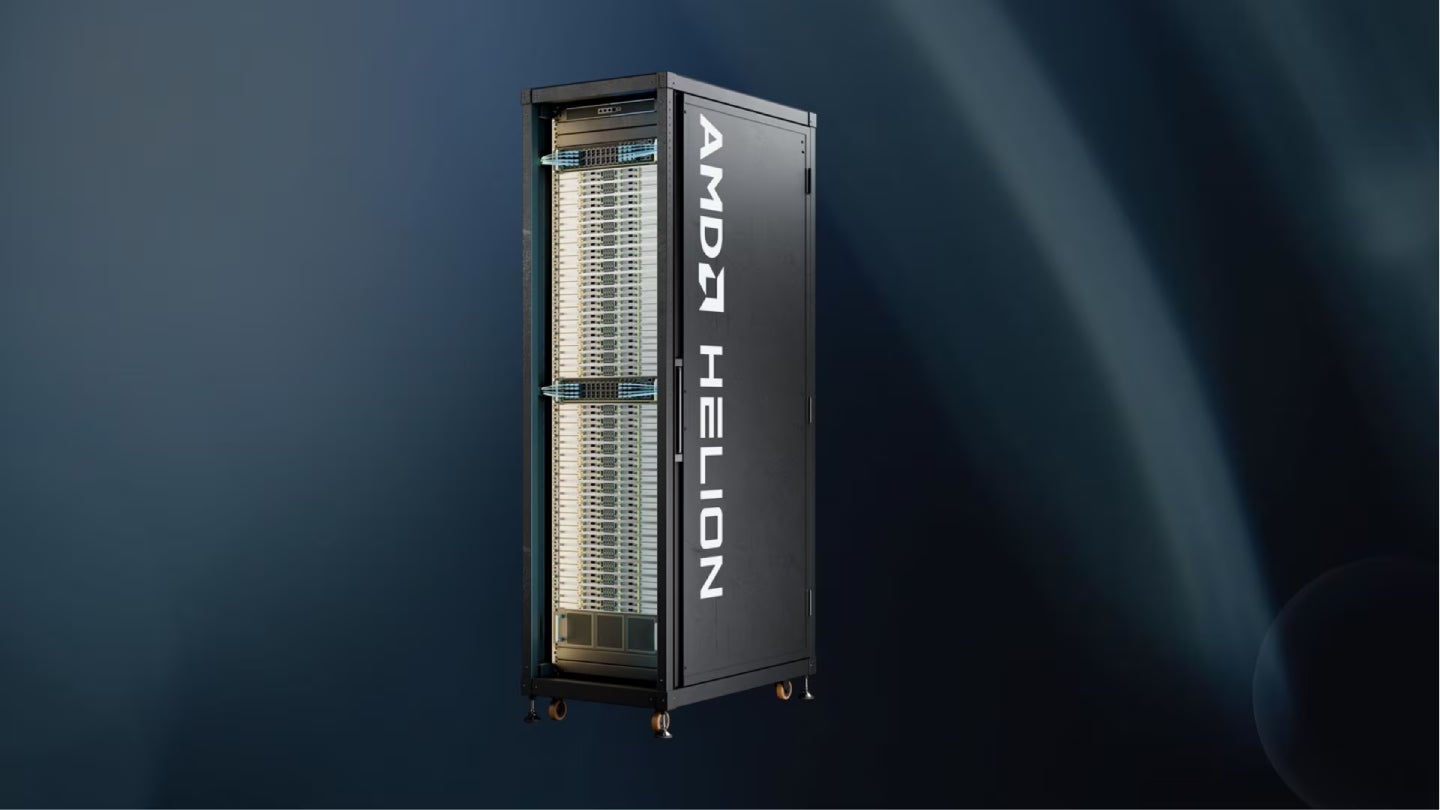
AMD has introduced AMD Helion, an open rack-scale blueprint for agentic AI infrastructure designed around an Open Compute Project (OCP) specification and driven by the company’s processor and accelerator portfolio.
The platform follows the open-design philosophy established by the AMD Helios rack-scale solution, providing partners and customers with configurable systems that pair central processing unit (CPU) core density and power with graphics processing unit (GPU) acceleration across a range of agentic AI workloads.
Go deeper with GlobalData


Access deeper industry intelligence
Experience unmatched clarity with a single platform that combines unique data, AI, and human expertise.
AMD compute and enterprise AI senior vice president and general manager Dan McNamara said: “Agentic AI is not a single workload. It spans personal agents, enterprise applications, code execution and complex workflows, each with different compute requirements.
“With AMD Helion, we are bringing AMD EPYC performance, open software and flexible rack designs together so our partners can build systems around customer needs and make efficient use of available power.”
AMD detailed two reference configurations for the platform. The first is a CPU-only rack built on 6th Gen AMD EPYC processors, capable of housing up to 32,768 CPU cores. This variant is intended for hyperscale customers who need dedicated agent execution capacity alongside connections to external model inference infrastructure.
The second is an integrated rack that pairs AMD EPYC CPU nodes with AMD Instinct MI350P GPU nodes and general-purpose compute resources, offering enterprise organisations a unified platform for agentic AI deployment.
The OCP-based blueprint accommodates both liquid- and air-cooled designs, allowing organisations to incorporate the technology within their current data centre environments and repurpose existing infrastructure for AI workloads.
System integrator partners have the ability to customise the balance of CPU and GPU resources so that agent execution, model inference and auxiliary compute are each matched to the specific performance, power and cost profile of a given deployment.
AMD said it intends to submit the Helion specification to OCP, opening the design to wider community development. Rack configurations are being developed in collaboration with ecosystem partners, with availability planned for November 2026.
In a separate development, last month, AMD signed an all-stock deal worth around $8.2bn to acquire AI research laboratory World Labs.