Heatwaves are currently sweeping Europe, with temperatures in parts of the continent reaching more than 40oC.
The extreme heat has also led to depleted water levels and drought threats. In the UK, Yorkshire Water announced a hosepipe ban in July 2025 after the county experienced its driest spring in 132 years.
Elsewhere, the heat and droughts are impacting farmers. In the UK, surveys from the Energy and Climate Intelligence Unit found that more than 80% of farmers have been negatively impacted by extreme weather, citing reduced productivity and failing crop yields. Climate change will continually exacerbate these extreme heat conditions, so farming is inevitably going to adapt.
It’s about the verticals
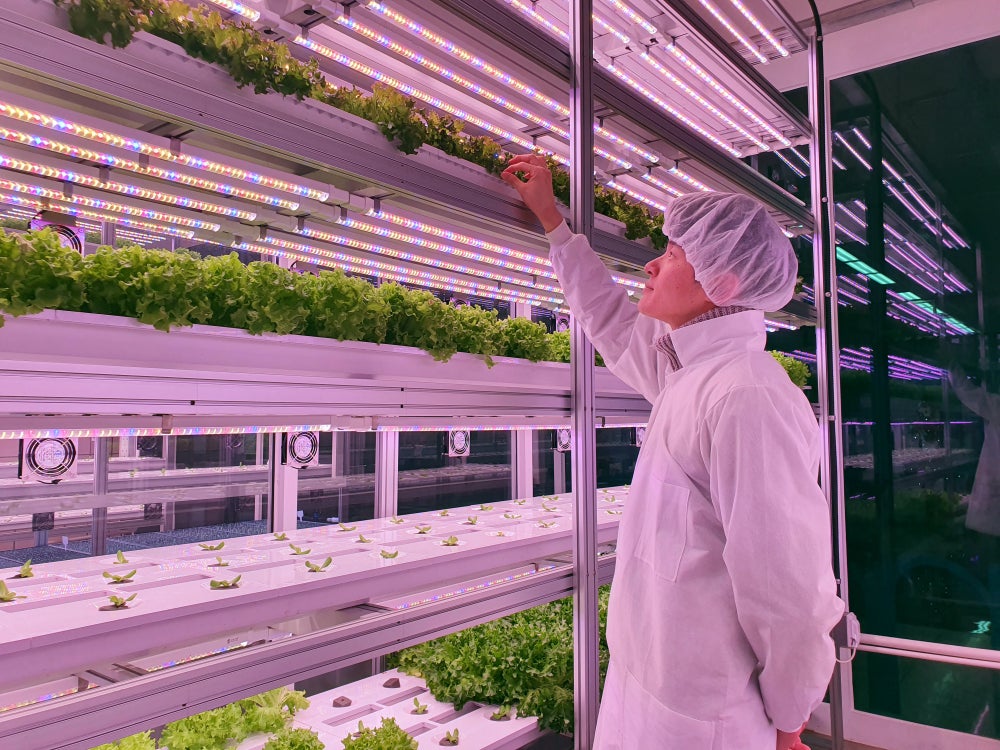
Vertical farming is a method of growing crops in stacked layers, typically in greenhouses or warehouses. It is one solution that could help continue to support food supplies, as climate change continues to negatively impact traditional farming.
With vertical farming, farmers can produce more food on less land. Vertical farms can be in warehouses or shipping containers, as well as being integrated into city-based buildings like skyscrapers. The farms are input-controlled using artificial temperature, light, water, and humidity to best support and stimulate plant growth. They also require fewer inputs than traditional farms.
Vertical farms typically use hydroponics rather than soil. This means that plants are grown in water-based nutrient solutions. Urban farm company Agripolis estimates that its hydroponic system uses 80% less water and produces 62% less carbon emissions than traditional farming.
Vertical farming also has the additional benefit of being localised. The growth of urban farming involves growing food in and around cities. This reduces food miles and therefore reduces the emissions associated with food production. The UN Food and Agriculture Organisation estimates that 79% of all food is consumed in urban areas. By incorporating vertical farms into city life, urban food security can be better secured.
From leafy greens to grains
Most commonly, vertical farms are best used to grow leafy greens like spinach and lettuce. There is a year-round demand for salad greens, making them an attractive crop to grow. This type of farming allows for year-round production of leafy greens, where the traditional growing season will be depleted over the winter months. Furthermore, leafy greens are quick to grow, and vertical farms can complete a harvest cycle in as little as 28 days. This allows vertical farms to complete around 12 harvests a year, where traditional farms complete around six annually.
Around half of the world’s diet consists of grains like wheat and rice. In 2023, UK vertical farming company Fischer Farms extended its crop offering from leafy greens and began trialing the growing of wheat. It became the first vertical farm in the UK to successfully cultivate the grain. According to Fischer Farms, it can grow the equivalent of 273 acres worth of wheat in a 10-acre vertical farm.
Expanding vertical farming into grains like wheat and rice will further help support future food supplies for the world’s growing population and make vertical farming a more viable option for the future of farming.
Culinary professionals love vertical farming
Recently featured as part of Stanley Tucci’s Italian travels, Da Vittorio is a three-Michelin-star restaurant located in Bergamo. Its menu uses local ingredients, and it wanted to find a sustainable solution to optimising food production and limiting the wastage associated with its operations.
It has partnered with vertical farm company Planet Farms to construct a vertical farm in the restaurant’s garden. The Da Vittorio team primarily grows leafy greens, vegetables, and herbs, using on-site basil for pesto. The Planet Farms operations on site use 95% less water than traditional grows.
Vertical farms are taking off
Vertical farming is a growing business, with tech leaders like James Dyson investing. Dyson recently unveiled a vertical strawberry farm in the UK. To combat the increased imports of the fruit that are seen when the berry is out of season, Dyson has invested £110m ($149m) into the high-tech farm
Located in a greenhouse in Lincolnshire and powered by renewable energy, the climate-controlled farm is home to over a million strawberry plants. Dyson’s farm is tended by robots and uses minimum inputs. Robotic arms pick ripe fruit and can harvest on average 200,000 strawberries per month.
Dyson engineers have made a 5 metre tall rig that spins. The wheel is spun by gas produced from grains, and the excess heat from the turbines is used to keep the greenhouse warm. Meanwhile, excess products from the gas production are used as organic fertiliser, while rainwater is collected on the roof and used to help grow the 1,250 tonnes of strawberries annually. Dyson strawberries are already making their way to a local Marks and Spencer supermarket.