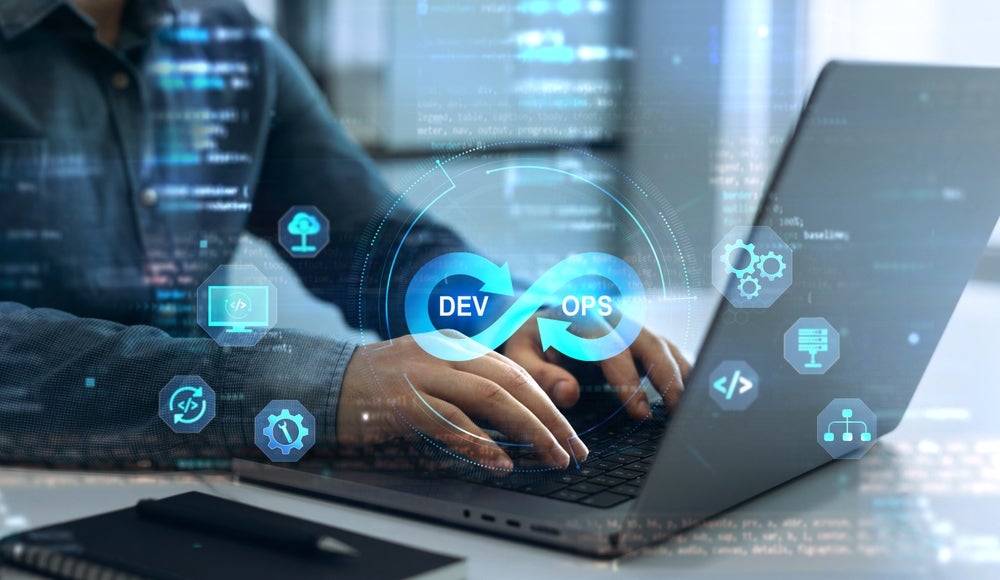
DevOps—the close collaboration between software development and operations functions within an enterprise—is a perennial headache for CIOs. The work required to take automated processes from development to full operation often has to follow executive directives that don’t always account for the complexities of enterprise IT modernisation.
When successful, a highly functioning and effective DevOps function has the potential to significantly cut costs, increase productivity and streamline tasks by creating new workflow automation processes.
Go deeper with GlobalData


Access deeper industry intelligence
Experience unmatched clarity with a single platform that combines unique data, AI, and human expertise.
But despite advances in intelligent process automation (IPA), enterprises continue to struggle with defining, creating and managing the modernisation of existing IT infrastructure and applications, according to GlobalData Technology research director Charlotte Dunlap. IPA and robotic process automation (RPA) have gone a long way in streamlining operational provisioning. “But they haven’t done enough,” says Dunlap.
Platform services advancements over the years, including low-code interfaces, intelligent automation, and microservices containerisation have helped, but business transformations are often still costly, slow, and laborious. Problems include a lack of executive support and internal expertise within an enterprise, as well as access to adequate consultants and integrators.
And while IT modernisation projects are fraught with risk, simply doing nothing is not an option as maintaining legacy IT systems becomes increasingly costly and carries regulatory and operational risk.
“AI agents represent the most promising technology available to enterprise developers since intelligent process automation began addressing cumbersome digital transformation deployments in past years,” says Dunlap.
While IPA automates repetitive, rule-based business processes, AI agents support goal-driven applications capable of adapting and reasoning in an autonomous fashion, she explains.
GenAI adoption over the last three years by application platform providers has made machine learning and natural language processing accessible to developers through APIs, pre-built data models, algorithms, and frameworks—important technologies underpinning agentic AI.
This enabled customisation of GenAI-injected code and integrations between development environments and repositories like GitHub, eventually leading to the enhancement of intelligent workflows through autonomous capabilities, says Dunlap.
And Agentic AI promises even greater automation to a range of complex tasks transforming business processes. “They are designed to solve problems, approach tasks with minimal human input, all the while learning to become more effective over time,” she adds.
Paul Scott Murphy, Cirata CTO agrees with the premise that DevOps will become easier over time as agentic AI is deployed. He says that standards that promote interoperability (Model Context Protocol, open table formats, standardised APIs and data representations) become tools and resources that AI technologies can use to overcome the limitations of siloed systems and information.
“In an Agentic DevOps world where assistance for almost any information task is abundant and cheap, the flow of information between systems can become simpler,” he adds.
Scott Murphy advises large enterprises struggling with wholesale transformation to focus, as a first step, on establishing a data platform in order to expose, secure, control and orchestrate their data and their resources.
Board directives within enterprises are often the primary drivers for IT modernisation. But equally, user expectations are also driving this demand, notes Scott Murphy, as AgenticAI driven automated workflows result in better customer service. “Increased exposure to chat interfaces has fuelled user expectations, and businesses will either respond or fall behind,” he says.
In-house or outsourced agentic DevOps?
CIOs often face the decision of how to outsource Agentic DevOps. Engaging a third party vendor is costly, even prohibitive for smaller businesses, and accessibility of good skills is poor. Even professional integrators and consultants are just coming to grips with some of the issues around modernising IT environments such as cost and availability of skills.
For many smaller companies, the skills required to complete a modernisation project are simply not accessible in-house, despite ambitious directives from their executive team. And most companies not been investing in upskilling and reskilling to the extent that wholesale digital transformation is possible without vendor assistance.
While AI-driven DevOps sounds frictionless in theory, enterprise environments are rarely that simple, says Kai Wombacher, founding product manager at IBM-acquired startup Kubecost. The biggest mistake he sees clients making is overestimating what AI can automate and underestimating how complex their infrastructure really is. Wombacher makes the case for outsourcing agentic DevOps.
“Early on, working with vendors or consultants can help jumpstart progress, especially around tooling or automation. But long-term success depends on your team understanding how these systems behave in your environment.
“Otherwise, you’re layering AI over black boxes you don’t fully control, which limits flexibility and slows innovation when edge cases inevitably show up,” says Wombacher.
Dael Williamson, EMEA CTO at AI driven data analytics platform Databricks, concurs on this approach. “A hybrid model works best; embed external specialists alongside in-house teams to build Eval expertise while retaining critical IP,” he says with the caveat that “outsourcing agentic DevOps too early can undermine quality and domain-specific insight. Success depends on rigorous agent evaluation, which is hard to get right without deep context.”
A new era of Agentic DevOps
Systems integrators are releasing a raft of AI agent offerings targeting developers. In May, Big four consultant, Deloitte, launched a new global Agentic network to help accelerate the development and deployment of AI-driven workforce solutions at scale. Deloitte’s Global Agentic Network is part of a broader market trend for consultancies and integrators building agent toolkits and frameworks.
This shift helps developers by increasingly automating the app development processes to help abstract operational complexities. All of which means moving modernised apps quickly into production during the deployment cycle. This is the phase of app modernisation which DevOps teams have struggled with for years, and the primary barrier of adoption of digital transformations, says Dunlap, adding: “Overcoming those barriers, that is the promise of AI agents.”