Nvidia has announced the release of its Alpamayo 2 Super vision language action (VLA) model, designed to accelerate level 4 robotaxi and autonomous vehicle (AV) development.
The model, now scaling the number of parameters from 10bn to 32bn, is the latest advancement in the company’s Alpamayo family of open AI models, frameworks, and datasets.
Go deeper with GlobalData


Access deeper industry intelligence
Experience unmatched clarity with a single platform that combines unique data, AI, and human expertise.
Nvidia states the Alpamayo suite aims to support safety and operational requirements for AV deployment without requiring companies to construct core autonomy infrastructure independently.
Nvidia founder and CEO Jensen Huang said: “Alpamayo is the moment cars begin to safely reason, not just drive.
“Only Nvidia makes available open models, simulation, real-world data and agent skills so the entire global robotaxi ecosystem can develop level 4 capabilities that understand edge cases, explain decisions, earn trust and scale safely to millions of vehicles.”
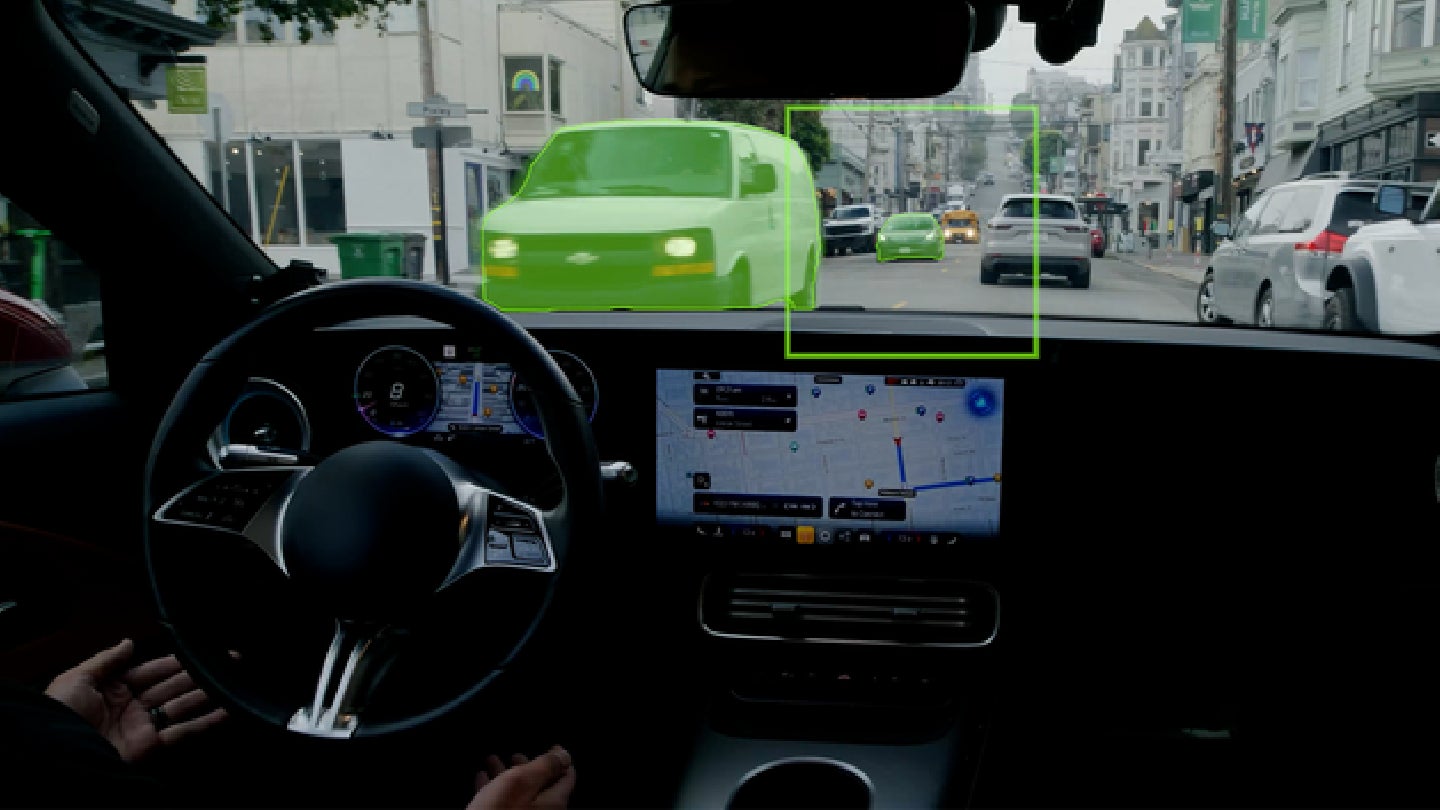
Alpamayo 2 Super operates across the full driving stack, enabling functions such as perception, reasoning, planning, and action. The model incorporates full-surround situational awareness, expanding its scope from front-facing sensors to encompass 360-degree assessments.
Additionally, the model includes high-level decision capabilities, referred to as Meta-Actions, covering macro manoeuvres such as yielding, lane changes, and stopping. Downstream planners can access both trajectory paths and chain-of-causation traces.
A significant increase in model scale enables Alpamayo 2 Super to enhance spatial reasoning, 3D environment understanding, and navigation in unusual, long-tail driving situations. It is intended to address challenges where standard imitation-learning stacks have limitations.
The model introduces reasoning auto-labelling with 2D grounding, compressing dataset annotation timelines from months to days by generating high-quality reasoning labels. This is intended to optimise the economics of AV data pipelines and support AV stack scalability.
The AI agent can be distilled into compressed models suited for in-vehicle deployment on the Nvidia DRIVE Hyperion and DRIVE AGX Thor platforms. This distillation enables manufacturers to build AV stacks that benefit from the same reasoning and perception capabilities, using an open-source base, without requiring separate, ground-up model creation.
To support dataset creation and on-road model training, Nvidia has released a set of additional tools alongside Alpamayo 2 Super. The AlpaGym framework offers an open-source, high-throughput reinforcement learning (RL) environment for closed-loop training, where every driving decision affects the evolving simulation, in contrast to conventional open-loop systems.
AlpaGym is built on the AlpaSim microservice simulation stack. It integrates with the Nvidia Omniverse NuRec libraries, facilitating simulation of scenarios and generation of synthetic training data at scale from real-world fleet driving.
The Nvidia OmniDreams generative world model allows for photorealistic, closed-loop scenario creation, supporting the simulation and training of AV systems to manage rare and complex edge cases.
The company has also released an open-source CoC Auto-Labeling Pipeline, which automatically generates causally linked and decision-grounded labels from raw driving data without human annotation.
Skill sets bundled under Nvidia Agent Toolkit aim to assist developers in simulation, data generation, and closed-loop model refinement. These include Neural Reconstruction skills, OmniDreams scenario tools, and AlpaGym RL skills, all designed to support embodied reasoning and simulation-based AV system development.
Alpamayo 2 Super will be available this summer via GitHub for inference code and on Hugging Face for model weights.
In a separate development, a Reuters report noted that the US Department of Commerce recently moved to address a potential loophole allowing exports of advanced AI chips, such as Nvidia’s Blackwell processors, to subsidiaries of Chinese technology firms outside of China.
The report said this may have included subsidiaries based in places such as Malaysia. This action forms part of ongoing US efforts to limit Chinese access to high-performance semiconductors used in AI system development.