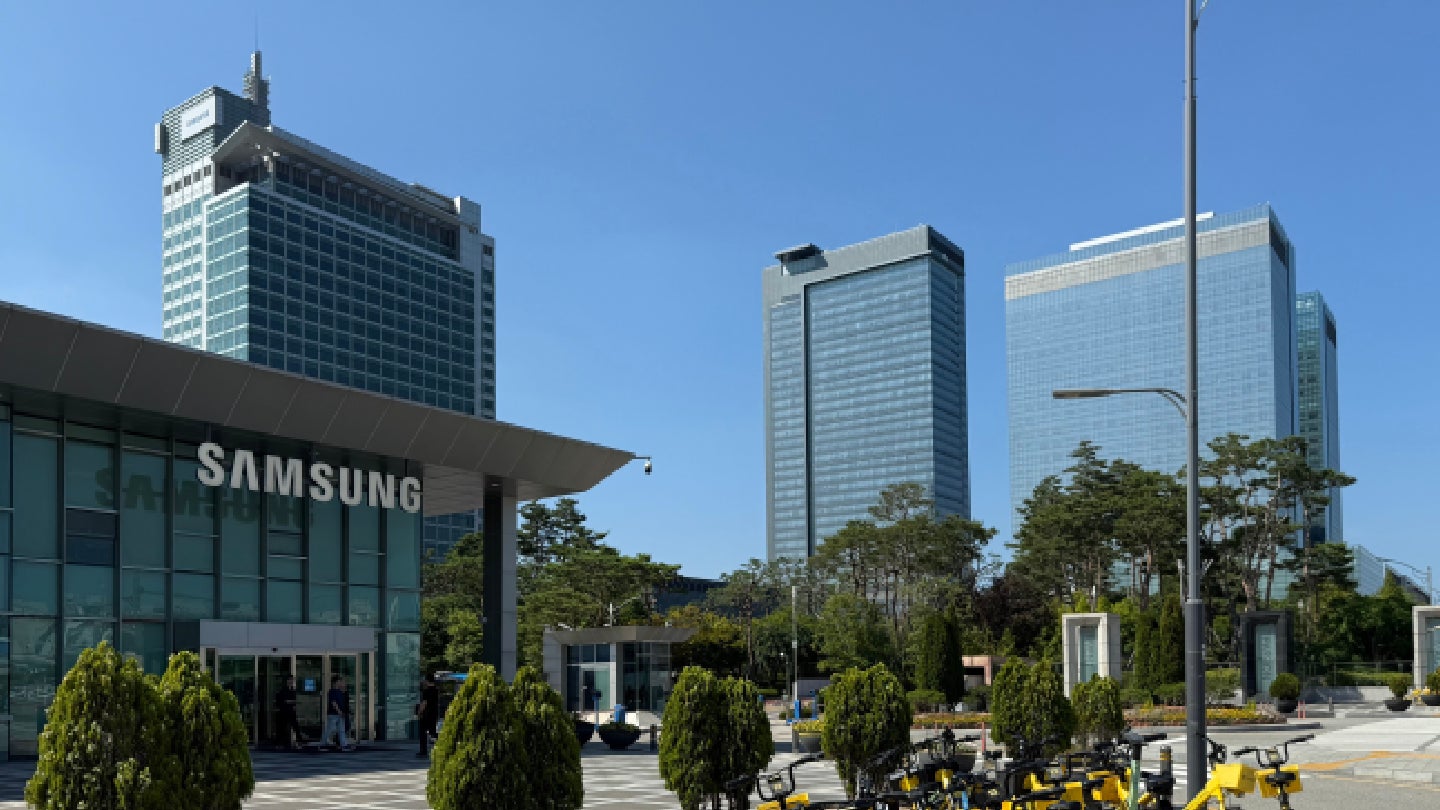
Samsung Electronics has set up a new Robotics eXperience (RX) Business Office, forming a central part of its plan to make robotics a core driver of its future business strategy.
The division will operate at the company’s Seoul research and development (R&D) Campus in South Korea and report directly to chief executive officer Roh Tae-moon.
Go deeper with GlobalData


Access deeper industry intelligence
Experience unmatched clarity with a single platform that combines unique data, AI, and human expertise.
The RX Business Office will integrate Samsung’s various robotics activities and oversee long-term planning, technology development, and commercialisation. Samsung stated this structure is intended to reduce barriers between teams and speed up both decision-making and deployment across the company’s robotics projects.
A major element of this effort involves strengthening the company’s use of data. Samsung will build a Data Factory at its Gumi site in North Gyeongsang Province.
The Data Factory will collect and analyse information from industrial environments. Its purpose is to help refine robotics systems and support rapid deployment in real-world settings.
Engineers and researchers at the Seoul campus will work jointly with the Gumi site to increase the intelligence of Samsung’s robotics platforms.
Samsung also plans to expand its global research presence by opening robotics centres in the US, China, and Japan. These centres are expected to allow Samsung to access local expertise, technologies, and broader innovation ecosystems in major international technology markets.
The company has named executive vice president Lee Dong-kun to head the robotics strategy team, which will operate under the RX Business Office.
Lee formerly led robotics strategy at Hyundai Motor Group and Boston Dynamics. In his new role, he will shape Samsung’s longer-term robotics business direction.
Two academic experts have been recruited to join the RX Business Office. Kim Hyoun-jin, a professor at Seoul National University, brings experience in autonomous robotic systems and control.
Kim Ui-kyum, an Ajou University professor, specialises in robotic hands and manipulation technologies.
Samsung indicated it will continue bringing in further expertise to support technology and product commercialisation.
The RX Business Office will have oversight over strategy, technical development, and commercial initiatives for Samsung’s robotics products. It will act as a hub for the company’s robotics research, infrastructure, and project deployment as Samsung expands facilities and development capacity within the sector.
This move forms part of Samsung’s broader plan to integrate advanced robotics and AI into its business operations.
Earlier this month, Samsung started mass production of its PM1763 enterprise SSD, based on the PCIe 6.0 interface and targeting AI and high-performance computing server environments. The device is designed to handle large data volumes and support applications requiring high bandwidth and low latency.
In March 2026, the company announced plans to transition all its manufacturing sites into ‘AI-Driven Factories’ by 2030. This initiative will see AI integrated into all areas of production, including logistics, manufacturing, quality inspection, and shipment using digital twin-based simulations and intelligent AI agents.
At that time, Samsung also outlined plans to deploy specialised robots for production, logistics, assembly, and environmental safety across its global manufacturing footprint. These include operating robots, logistics robots, assembly robots, and environmental safety robots fitted with digital twin integration.
The stated objective is to improve efficiency, quality standards, and safety through automation and robotics.