
The US is planning potential cloud computing regulations that would curb China’s access to the technology, according to US under secretary of commerce for industry and security Alan Estevez.
Speaking at Japan’s Mount Fuji Dialogue forum, first reported by Japanese newspaper Nikkei, Estevez stated that US controls over cloud computing could be likely as the country seeks to deter China from developing military-use AI.
Go deeper with GlobalData


Access deeper industry intelligence
Experience unmatched clarity with a single platform that combines unique data, AI, and human expertise.
“Cloud-based technologies are fairly ubiquitous… Now, AI itself it is ubiquitous,” he stated, “The concern is … that AI in the future will probably command and control military logistics… So, we want to make sure that we’re controlling the use.”
In GlobalData’s 2022 report into cloud computing, China appeared to have a significant dominance over the US and other countries in terms of cloud related patents, accounting for over 80% of the total tracked patent applications between 2020 and 2022.
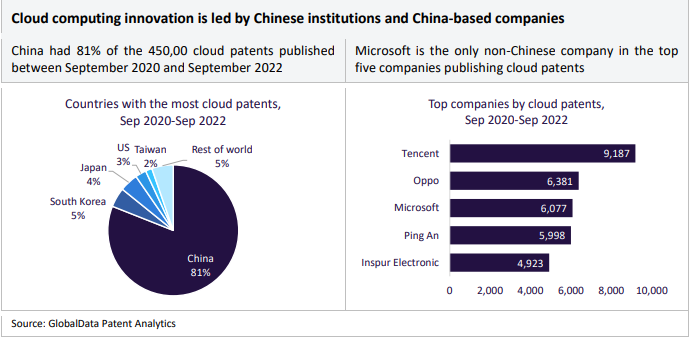
Microsoft was the only non-Chinese company to make it into the top five companies with the highest number of patents, still had 3,000 fewer patents than Tencent. Considering this well-established lead, could the US ever successfully inhibit China’s access to cloud computing?
GlobalData analyst Michael Orme gave a broader perspective on US motives.
“China has been both smuggling AI chips and legally accessing them via AWS, Azure and Google Cloud services,” he stated, “There’s precious little that Washington can do about the former, but it’s now poised to block the latter.”
However, in Orme’s opinion curbs on Chinese access to cloud computing would not simply be about hobbling Chinese AI development. Instead, the US’ aim is broader. Citing recent research by Australia’s Strategic Policy Institute, Orme stated that China leads research in 37 out of 46 key technologies including biotech, space, energy and defence.
“Just how effective in wounding China the weaponization of US tech IP will prove to be is indeterminate given grey markets, workarounds and China’s ability to transmit its treasure trove of high-quality data,” Orme stated.
US actions against China are not without counteraction either, pointed out Orme.
China has already placed import restrictions on critical minerals such as gallium and graphite, now causing shortages and a monopolisation of the global battery supply chain.
“Relations are icy and tech, including AI chips, is front and centre,” concluded Orme.