Announced June 16 by Donald Trump Jr. and Eric Trump to coincide with the 10th anniversary of their father’s 2016 campaign launch, Trump Mobile ties its new wireless service tightly to presidential branding.
Its lone smartphone, the $499 T1, is scheduled for a potential August 2025 release, although some reports mention a Fall 2025 launch. However, a scrutiny of images, specs, and marketing copy reveals a product that looks more like a concept wrapped in rhetoric than a finished smartphone ready for consumers.
No real prototype for Trump mobile
Public-facing materials for the T1 phone are inconsistent and, in several cases, implausible. The company’s website uses a gold smartphone rendering with odd design details (misplaced buttons, a peculiar home key, strange camera placement) and no photographed prototype.
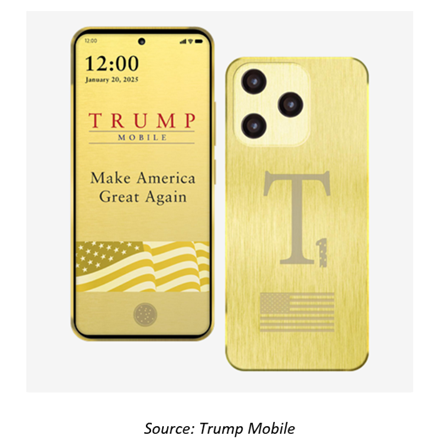
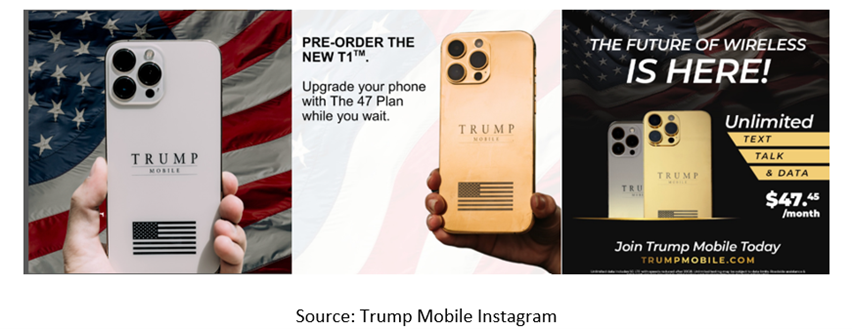
Social media posts instead recycle what appear to be iPhones with Trump insignia layered on top. Crucially, specs changed within days, for example, screen size was trimmed from 6.78 to 6.25 inches, and key details such as the processor are omitted.
That pattern suggests the T1 phone is still in negotiation with manufacturers or being conceptualised, not a finished consumer product.
Trump mobile “Made in the USA” claims don’t add up
A central marketing pillar — American manufacturing — erodes under inspection. Initial “Proudly Made in the USA” claims have been quickly softened to vague language like “brought to life right here in the USA” and “American hands behind every device.” There’s no evidence components or final assembly will be domestic. The only US-made smartphone on the market, the Purism Librem 5 USA, sells for $799 and carries markedly different and low-end specs, underscoring how expensive domestic production is.
Smartphone supply chains are globally complex: displays, chips, and dozens of materials come from suppliers worldwide. The T1’s own listed components include items not produced in the US — for example, AMOLED displays — making a true “Made in USA” phone at $499 implausible.
The device’s listed specs also resemble existing models. Industry comparisons suggest the T1 could simply be a rebranded Chinese handset. Names like the $249 Revvl 7 Pro 5G, built by Wingtech, a company partially owned by the Chinese government, have been floated. If indeed the case, Trump Mobile will be selling a Chinese government-affiliated phone at a $250 markup. Ultimately, the only American aspect of the T1 phone is that it will be sold in America.
Advertising and consumer protections
The marketing narrative diverges sharply from the company’s legal disclaimers. While customer-facing scripts reportedly say, “Trump is making the phone,” the press release explicitly states Trump Organisation affiliates were not involved in design, development, or manufacturing.
That disconnect raises questions about truth-in-advertising enforcement and consumer confusion. Trump Mobile’s strict “all sales final” policy, with refunds only at the company’s discretion, further shifts risk to buyers who may be swayed by patriotic branding rather than verifiable product facts.
Privacy and monetisation concerns
Reports that the T1 could include a crypto wallet tied to Trump-associated tokens, plus potential preloaded apps, raise additional issues: monetisation through transaction fees, unwanted bloatware, and privacy risks. In an era of heightened scrutiny over device security and data collection, those are salient factors for prospective buyers.
Bottom line
Trump Mobile is a high-profile branding exercise wrapped in political symbolism. But until there are photographed prototypes, named manufacturing partners, and stable technical specifications, it remains a marketing promise more than a transparent consumer offering.
Buyers should treat patriotic branding with scepticism and demand concrete evidence before spending $499 on what may turn out to be a rebadged device with limited claims to US manufacture or unique value.