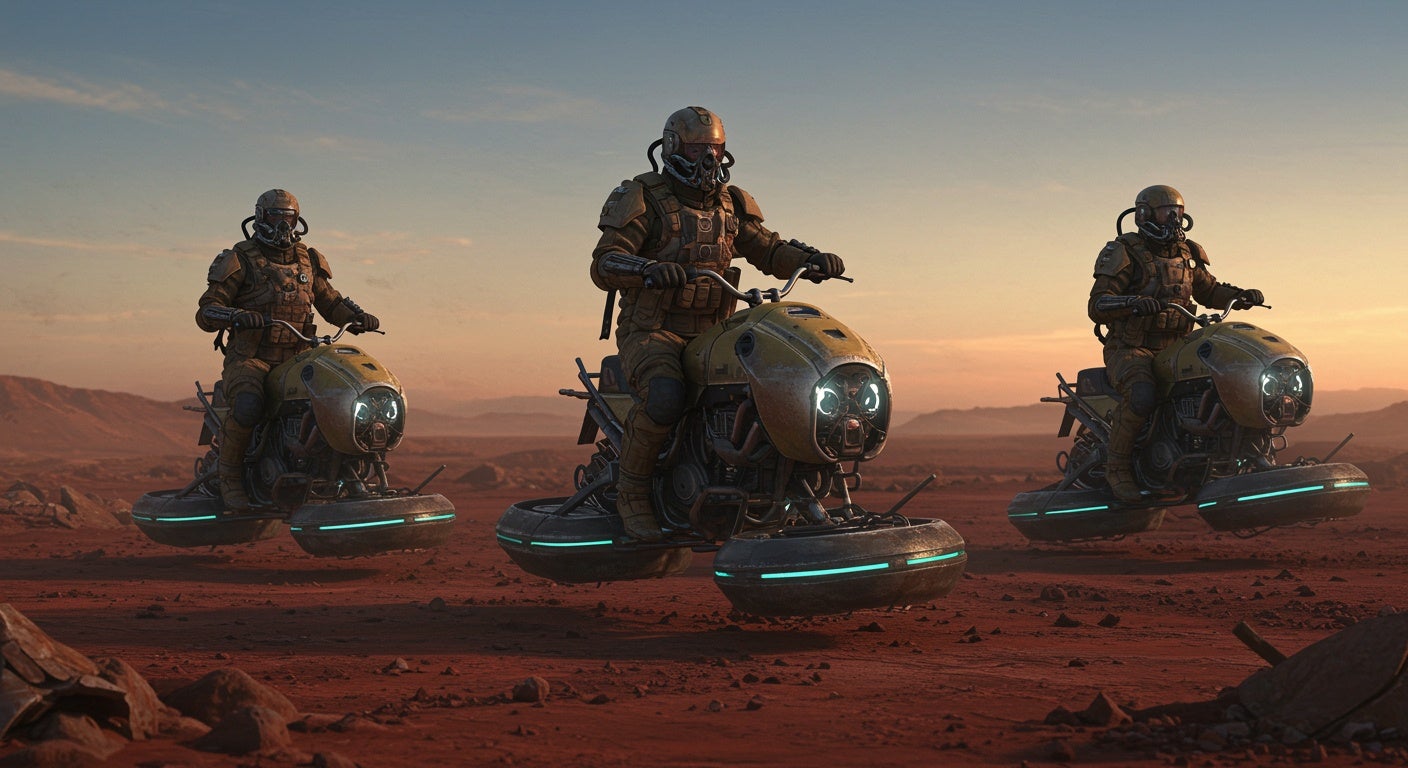
Volonaut’s newly released Airbike is a lightweight, single-rider aerial vehicle designed to hover and fly short distances at low altitudes.
It is visually reminiscent of a motorcycle fused with a drone, with many hailing it to be a “Star Wars-style flying bike.” It uses a compact jet propulsion system, enabling the vehicle to achieve vertical takeoff and landing (VTOL).
Onboard stabilisation software, enhanced by a flight computer, allows the rider to easily manoeuvre while flying, with the handlebars serving as the main form of steering, like a traditional bike.
Additionally, the system also integrates obstacle sensors, GPS routing, and altitude governors for safety and semi-autonomous balance. While not considered to be a regular street vehicle, the Airbike does offer a possible solution for short-range urban mobility.
The benefits of the Airbike
The Airbike taps into a long-standing vision of personal flight. It is compact, manoeuvrable, and user-operated without needing a full pilot’s license (in some jurisdictions). For short-range commutes over gridlocked cities, it offers the possibility of bypassing congested infrastructure entirely. With it having zero ground footprint during flight, it avoids the spatial limits of cars, bikes, and larger ground vehicles, potentially leading to less congested roads. And while the Airbike may seem difficult to ride, its onboard flight computer assists the rider to allow for an easier flying experience.
Finally, being constructed with 3D printing techniques and advanced carbon fiber material, the Airbike is a lot lighter than existing VTOL alternatives, coming in at 66lb (30kg). With this lightweight design, the Airbike can also reach a top speed of 102 km/h (63mph), which complies with the US Federal Aviation Administration rules.
The downsides
The Airbike is in the early stages of its lifecycle. Several issues limit practicality in its current form. Fuel and battery life are the main constraints, only allowing the vehicle to fly for a maximum of ten minutes, massively restricting its range.
Safety is another significant concern. While it is equipped with safety measures, the lack of enclosure or crash mitigation makes any malfunction potentially catastrophic. Weather limitations like harsh winds, heavy rain, and low visibility can ground the Airbike more often than not, raising questions of whether it is worth investing in.
Also, legal implications are a grey area for Airbikes, with no established framework for public use. Insurance, liability, registration, and flight permissions are pending issues that are unresolved. Ultimately, the Airbike comes at a steep price of reportedly around $880,000, meaning it is not a mass-market product.
The potential of the Airbike
Despite limitations, the Airbike represents an evolving frontier of aerial micro-mobility. As battery tech improves and noise-reducing propulsion systems mature, future models could significantly expand in range and safety. In low-traffic or emergency contexts, such as rural rescue, infrastructure inspection, or military scouting, the Airbike already shows tactical advantages.
Longer term, if regulations catch up and manufacturing scales, personal VTOLs might fill niche transportation roles between bikes and helicopters. However, that future hinges on critical advancements in autonomy and airspace.
For now, the Airbike is less a replacement for cars and more a signal that daily travel and commuting may one day leave the ground.