
Supply chains for frontier technologies are complex. Energy, materials and infrastructure are becoming increasingly subject to geopolitical turbulence, as well as central to global policy making strategies. If the US Iran war that started on 28 February causes helium shortages to the quantum computing industry, it only highlights further how the wider geopolitical backdrop has become a central constraint to deep technology advancements—one that will only become more important.
Over a third of world’s helium supply originates from the Gulf state of Quatar where it is primarily produced as a by-product of natural gas and oil extraction. On 4 March, reports emerged that state owned energy company, Qatar Energy, had declared it can no longer fulfil existing contracts. The announcement followed the shutdown of its key LNG processing plant, Ras Laffan, following an Iranian drone attack on 2 March. Qatar Energy manages all LNG production in the country.
Go deeper with GlobalData

Access deeper industry intelligence
Experience unmatched clarity with a single platform that combines unique data, AI, and human expertise.
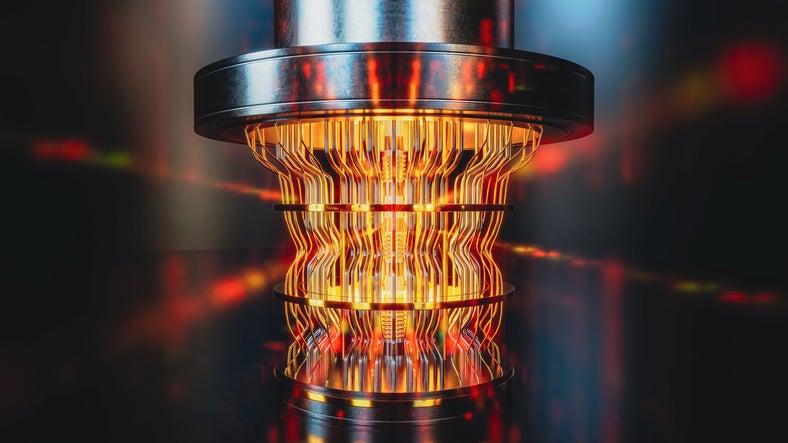
Quantum computing that operates using superconducting qubits—a method used by companies like IBM and Google—requires dilution refrigerators that use helium-3 and helium-4 to reach temperatures near 10–20 millikelvin. Without helium, these systems cannot operate.
Dr Ilana Wisby, quantum computing and deep tech serial entrepreneur, former CEO of Oxford Quantum Circuits, says helium shortages linked to geopolitical disruption are unlikely to fundamentally change the trajectory of quantum computing development in the near term.
“Most modern superconducting quantum systems already run on closed-cycle ‘dry’ dilution refrigerators, which significantly reduce the need for liquid helium compared with older cryogenic systems,” explains Wisby.
In Wisby’s view the nearer-term effects are more likely to be felt across the wider scientific ecosystem that relies heavily on cryogenic infrastructure. Helium is widely used in superconducting magnets, cryogenic detectors and quantum sensing systems that support applications ranging from medical imaging to advanced physics research.
Helium-3 and helium-4
It is also important to distinguish between helium isotopes. Much of the geopolitical discussion centres on disruptions to helium-4, which is widely used in industrial cryogenic infrastructure. The extremely low temperatures required for quantum computing dilution refrigeration rely on helium-3, a much rarer isotope typically sourced through tritium decay and specialised production streams, notes Wisby.
“These supply chains are distinct, meaning the immediate impact on quantum computing infrastructure may be more limited than headlines suggest,” she says.
In recent years, as helium has increased in strategic value, the scarcity of Helium-3 for quantum hardware has prompted ongoing efforts to improve supply chains, including lunar mining and advanced separation technologies.
The race for quantum supremacy—the point at which quantum computing surpasses classical computing—has played out among competing geographies and companies. And within this competitive field, different modes of development have emerged with superconducting qubits, trapped ion qubits and photonic qubits the three leading architectures.
Instead of classic computing’s binary processing, quantum computing uses the properties of quantum physics: the counterintuitive behaviour of subatomic particles that results in the quantum states of superposition and entanglement. Quantum computing bits are called qubits and represent both 0 and 1 simultaneously. By increasing qubits, the computational power grows exponentially, not linearly. This is the basis of the massive compute power potential of quantum computing.
How critical is helium to quantum computing?
Current timelines put quantum supremacy at five to ten years away. But if helium shortages continue, could this alter the way the race plays out going forward with the most helium dependent quantum computing companies risking greater disruption from the current geopolitical conflict?
“Helium shortages alone are unlikely to drive a shift between quantum computing architectures. Platform choices are primarily determined by performance and engineering trade-offs, and every approach has its own infrastructure dependencies,” says Wisby.
“For example, many photonic quantum systems rely on superconducting photon detectors that themselves operate at cryogenic temperatures. Over the longer term, the key challenge will be ensuring that the industrial supply chains underpinning these technologies can scale alongside the science. Continued investment in materials, components and engineering solutions that reduce cryogenic requirements will be an important part of that effort,” she adds.
Alternative geographies for helium supply
The three largest producers of helium in the world are the US, Qatar, and Russia. And global helium supplies are already stretched. Isabel Al-Dhahir, principal analyst, at GlobalData Strategic Intelligence notes that Russia’s helium production facilities have been the target of Ukrainian attacks, yet exports have continued, primarily to China and the wider Asian market.
Nevertheless, no matter the extent to which Qatar becomes embroiled in the US Iran conflict, it will, and already has, suffered supply chain disruption to both its imports and export activity.
“As a major supplier to Europe and the US, any disruption to Qatari helium exports could tighten availability for quantum computing and other technologies. Algeria, Canada, and Poland also produce helium, but scaling their output to compensate for disruptions would require substantial new investment and capacity expansion,” says Al-Dhahir.
In addition to its cooling properties, helium is critical to semiconductor manufacturing, used to cool silicon wafers and stabilise fabrication equipment during chip production.
Quantum processors (superconducting chips, control electronics, cryogenic amplifiers) rely on these same semiconductor fabs. The end result is that helium shortages will impact both the manufacture and operation of quantum computing systems if supply chains continue to be disrupted by the Iran US war.