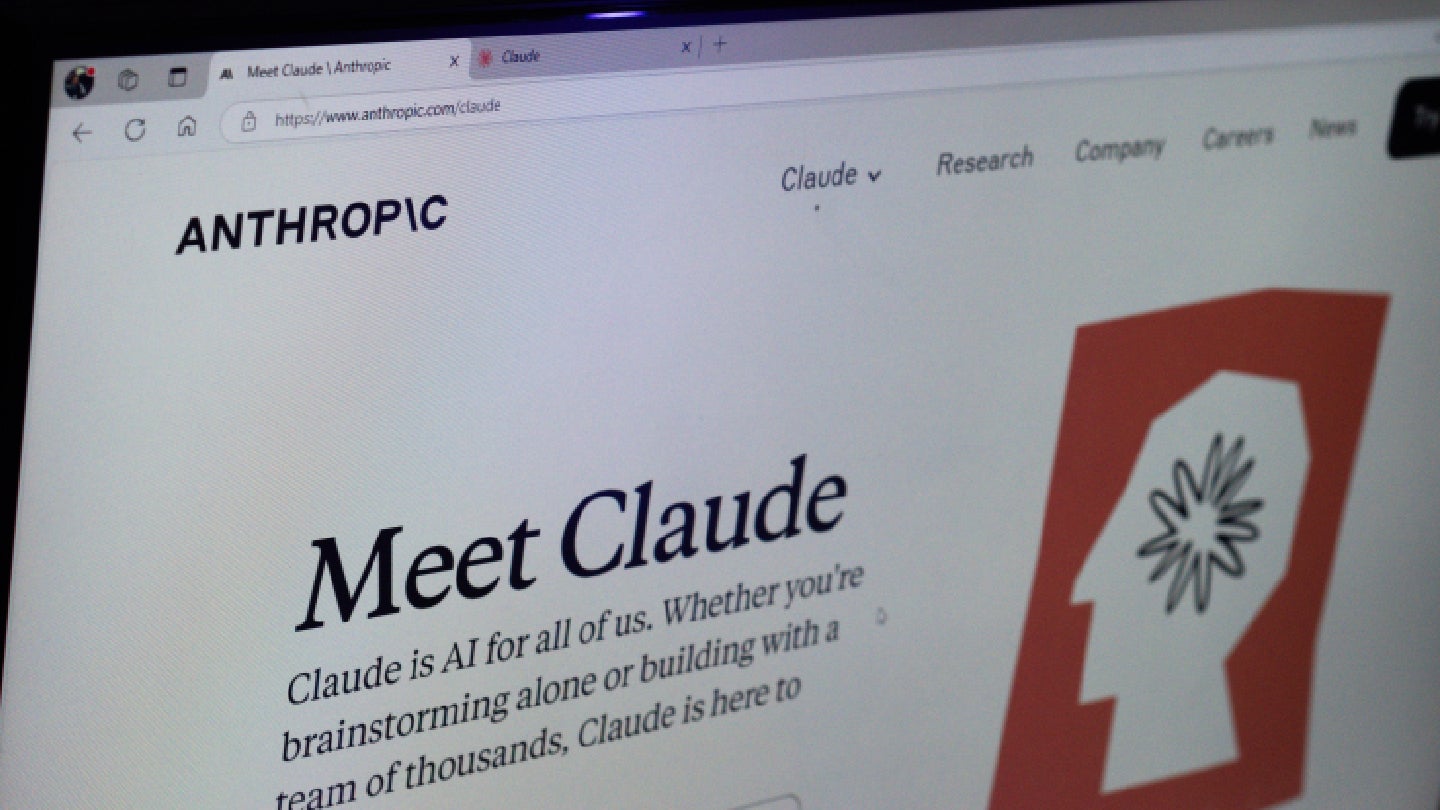
Anthropic has released Claude Opus 4.6, updating its Opus-class model with changes aimed at coding workflows and long-context use, including a 1M token context window in beta.
The San Francisco-based AI company said this is the first Opus-class model to support 1M tokens of context.
Go deeper with GlobalData


Access deeper industry intelligence
Experience unmatched clarity with a single platform that combines unique data, AI, and human expertise.
Anthropic said Claude Opus 4.6 is available currently on claude.ai, through its API and on major cloud platforms. Developers can access it as claude-opus-4-6 via the Claude API, the company said.
Pricing remains $5/$25 per million tokens, according to Anthropic. For prompts exceeding 200,000 tokens, the company said premium pricing applies at $10/$37.50 per million input/output tokens.
Anthropic also said US-only inference is available at 1.1× token pricing for workloads that must run in the United States.
On model capabilities, Anthropic said Opus 4.6 improves on Claude Opus 4.5 in coding, with more careful planning, longer-running agentic task execution, more reliable operation in larger codebases, and stronger code review and debugging intended to help the model catch its own mistakes.
The company said the same improvements can support other knowledge work, including running financial analyses, performing research, and using or creating documents, spreadsheets and presentations. Furthermore, these workflows can run within Cowork, where Claude can multitask autonomously.
Anthropic reported benchmark results across several evaluations. It said Opus 4.6 achieves the highest score on Terminal-Bench 2.0, which it described as an agentic coding evaluation. The Claude developer also said the model leads other frontier models on Humanity’s Last Exam, which it described as a multidisciplinary reasoning test.
On GDPval-AA, which it described as measuring performance on economically valuable knowledge work tasks across finance, legal and other domains, Anthropic said Opus 4.6 outperforms OpenAI’s GPT-5.2 by around 144 Elo points and Claude Opus 4.5 by 190 points.
The company also claimed that Opus 4.6 performs better than any other model on BrowseComp, which it said measures the ability to locate hard-to-find information online.
Anthropic said its system card shows Opus 4.6 has an overall safety profile as good as, or better than, other frontier models, with low rates of misaligned behaviour across safety evaluations.
GitHub chief product officer Mario Rodriguez said: “Early testing shows Claude Opus 4.6 delivering on the complex, multi-step coding work developers face every day—especially agentic workflows that demand planning and tool calling. This starts unlocking long-horizon tasks at the frontier.”
The release of Claude Opus 4.6 also includes product and platform updates intended to support longer and more complex tasks. In Claude Code, Anthropic said users can assemble agent teams to work on tasks together.
On the Claude Developer Platform, the company introduced adaptive thinking, which it described as enabling the model to decide when extended reasoning would help, rather than forcing developers to choose between enabling or disabling extended thinking.
Anthropic also added effort controls with four settings, low, medium, high (default) and max, which are intended to let developers balance intelligence, speed and cost.
To address context limits in longer sessions, Anthropic introduced context compaction in beta on the API. The company said compaction summarises and replaces older context as a conversation approaches a configurable threshold, allowing longer-running conversations and agentic tasks.
Anthropic also said Opus 4.6 supports outputs of up to 128,000 tokens.
Outside developer tooling, Anthropic has made substantial upgrades to Claude in Excel and is releasing Claude in PowerPoint in a research preview.
The company said the PowerPoint integration works inside the application by reading layouts, fonts and slide masters so edits stay aligned to existing templates, and can build slides from a corporate template, restructure a storyline, convert bullets into diagrams, or generate a full deck from a description.
The PowerPoint research preview is in beta for Max, Team and Enterprise plan customers, said the company.
Last month, reports surfaced that Anthropic was planning to raise $10bn in new funding, potentially valuing the firm at $350bn. The company aims to substantially boost its annualised revenue run rate this year due to increased adoption of its enterprise products.