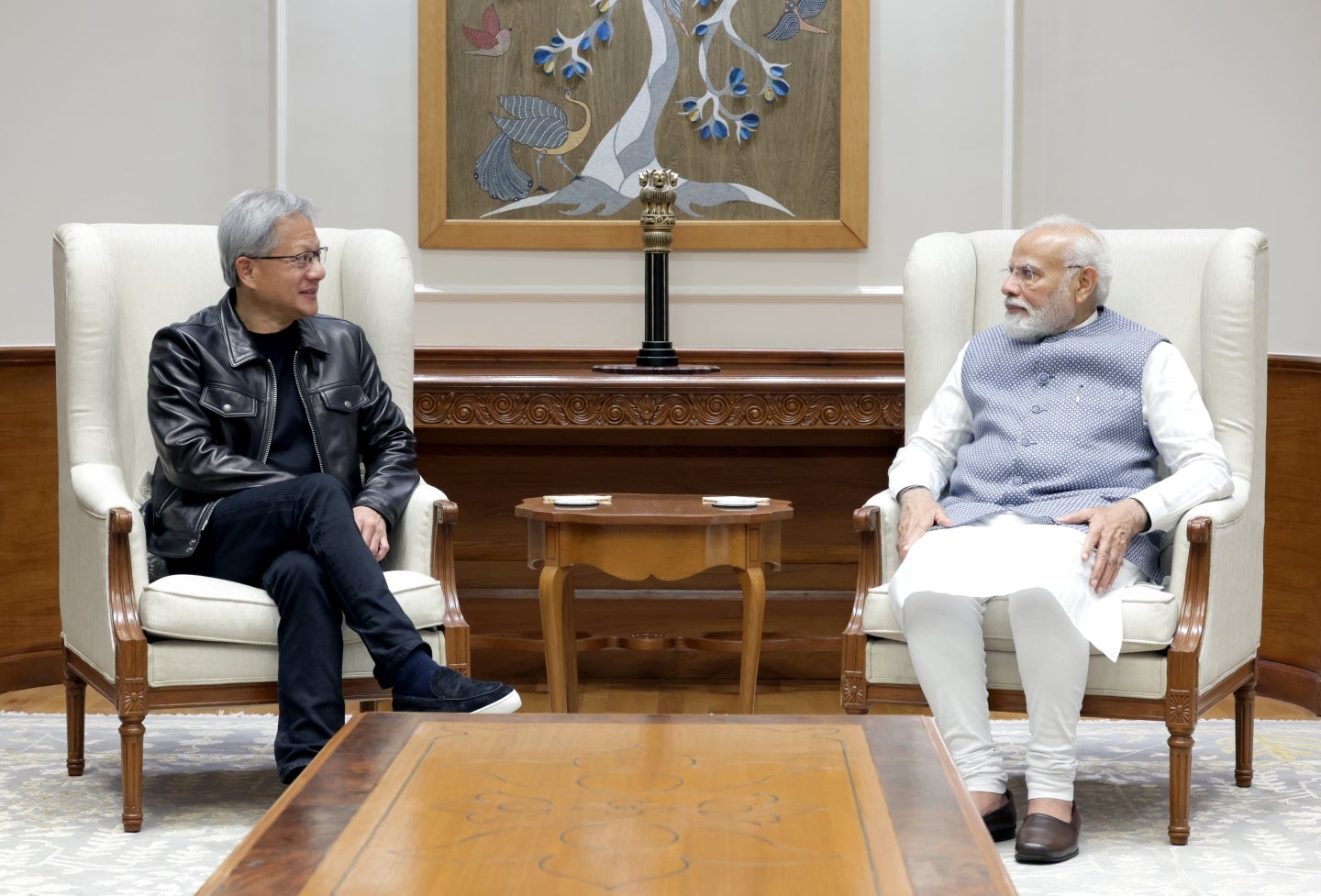
Nvidia CEO Jensen Huang visited India at the beginning of September, seemingly optimistic about India’s potential as the next big chip manufacturing market.
In a visit where Huang was treated, as described by Bloomberg, as a “head of state” the CEO met India’s Prime Minister Narendra Modi.
Go deeper with GlobalData


Access deeper industry intelligence
Experience unmatched clarity with a single platform that combines unique data, AI, and human expertise.
In a post to X (formerly Twitter), Modi described his “excellent meeting” with Huang and stated that their discussions centred around India’s potential as an AI hub, as well as the “talented” workforce within India.
India’s efforts to boost its local manufacturing and tech sector have not gone unnoticed.
Earlier this year, India placed import restrictions on foreign-manufactured laptops and computers in an effort to boost its local tech. The largest iPhone manufacturer in the world, Foxconn, also planned to double its India investment this month.
India makes efforts to boost its tech sector
Research and forecast data from analyst GlobalData demonstrates that while India’s AI market is half the size of China’s, India’s market is likely to grow at a faster rate.
Global Data predicts that India’s AI market will grow at a compound annual growth rate (CAGR) of 44.72% from 2022 to 2027 compared to China’s AI market which the analyst predicts will grow at at CAGR of 33.45% for the same period.
India’s government, the analyst noted, had been extremely proactive in promoting Indian manufacturing. However, GlobalData noted that India’s R&D expenditure was significantly lower than peers such as Brazil or China, which will have an impact on India’s high-tech exports.
High-end technology exports, such as Nvidia’s leading chip technology, would greatly benefit India, according to the analyst.
Higher-end technology exports would allow India to be less vulnerable to price competition from China.
This lack of R&D spending may also explain GlobalData’s findings that India is lagging behind in technological patents.
In 2021 India only received 6114 patents, whilst China received 29,469.
However, multiple players in Big Tech have subsequently pledged billions in funding towards India’s tech sector and Nvidia recently announced a partnership with India’s Reliance Industries to build supercomputing infrastructure and create a foundation for India’s own large language model.
With this in mind, alongside India’s positive advancements in space recently, it is likely that R&D expenditure could increase soon thereby improving the country’s competitiveness.