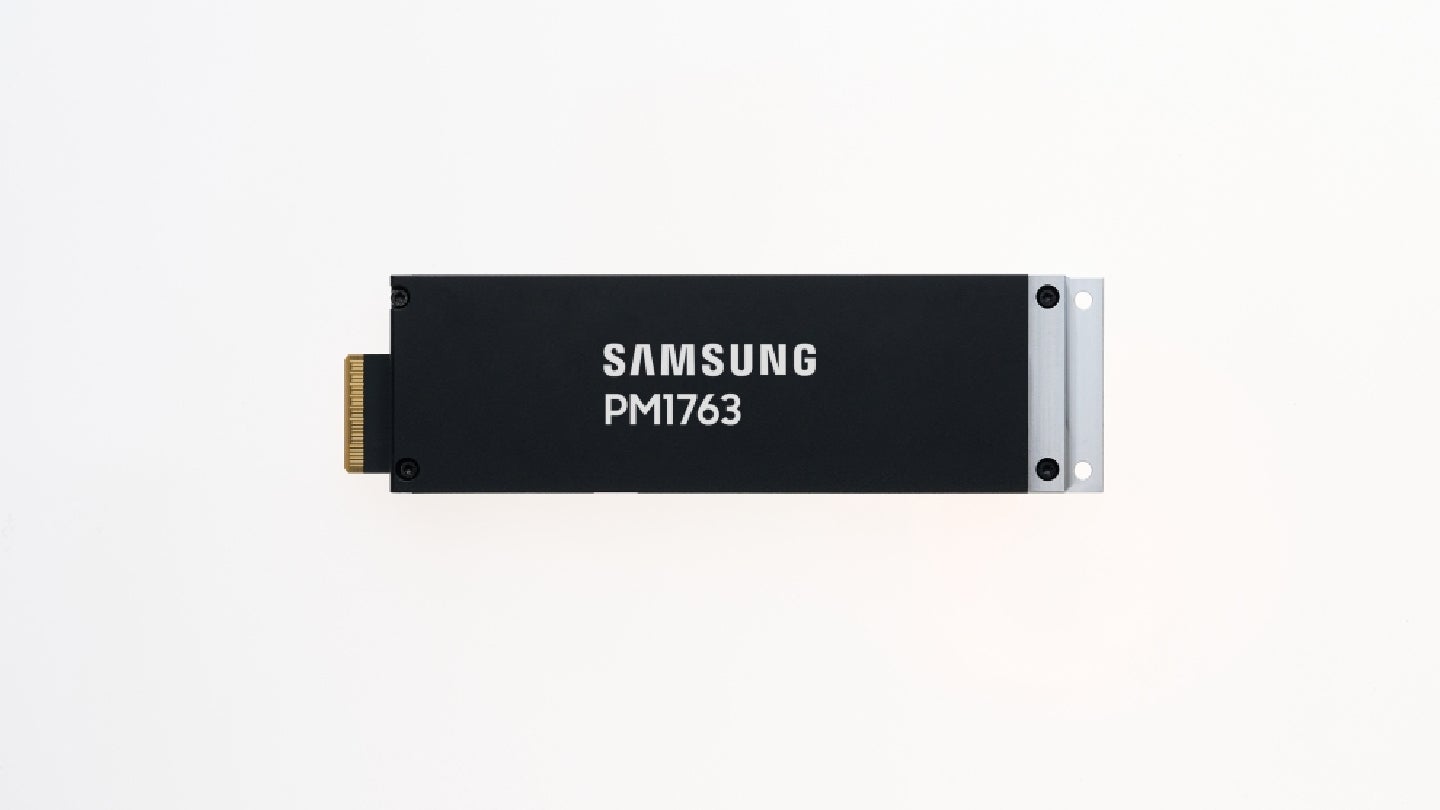
South Korean memory chipmaker Samsung Electronics has commenced mass production of its PM1763 enterprise solid state drive (SSD), utilising the PCIe 6.0 interface.
The storage device is designed for emerging AI and high-performance computing (HPC) server environments, where rapid data growth is creating new demands for high-bandwidth, low-latency solutions.
Go deeper with GlobalData


Access deeper industry intelligence
Experience unmatched clarity with a single platform that combines unique data, AI, and human expertise.
Samsung reports that as AI training and inference workloads increase, the need for enterprise SSDs that can deliver data quickly and reliably has become more significant for infrastructure development.
The PM1763 incorporates Samsung’s 9th-generation V-NAND and employs a controller manufactured on a 4-nanometre process.
The SSD is offered in capacities of 4TB, 8TB, and 16TB. Samsung states that the 16TB model achieves sequential read speeds of up to 28,400 megabytes per second (MB/s) and sequential write speeds of up to 21,900MB/s, which is more than twice the level of performance compared to its previous PM1753 model.
For AI workloads, Samsung highlights that the PM1763 can transfer a 40-gigabyte large language model in around 1.4 seconds. This speed is aimed at minimising data latency during processing and improving overall efficiency for AI platforms.
The drive supports operation in liquid-cooled server environments via direct-to-chip cooling technology. According to Samsung, this enables the SSD to maintain peak performance during intensive and prolonged workloads common to modern data centre configurations.
Power efficiency is another reported improvement, with the PM1763 claimed to be over 1.8 times more power efficient than its predecessor. Samsung states that this enhancement can help reduce operating costs in large-scale data centres where storage energy use is a key consideration.
The device also includes security features, supporting post-quantum cryptography algorithms and the TEE Device Interface Security Protocol (TDISP). These additions are intended to provide protection against future quantum computing threats and secure data pathways in virtualised environments.
Samsung vice president and memory product planning head Jangseok Choi said: “Built on industry-leading performance, PM1763 has successfully completed validation for next-generation AI platforms and is well positioned to support evolving AI infrastructure requirements. As AI models continue to grow in size and complexity, PM1763 will serve as a key solution that enables customers to efficiently scale memory capacity and optimise AI operations.”
In a separate update, Samsung Electronics has announced earnings guidance for the second quarter of 2026. The company forecasts consolidated sales of approximately Won171tn ($113bn) and an operating profit of roughly Won89.4tn ($58.4bn).
Comparatively, Samsung reported sales of Won133.87tn and operating profit of Won57.23tn for the first quarter of 2026. For the second quarter of 2025, the figures were Won74.57tn in sales and Won4.68tn in operating profit.
Last month, Samsung reported it had developed a Universal Flash Storage (UFS) 5.0 solution.
The device is claimed to deliver sequential read speeds of up to 10.8 gigabytes per second (GB/s) and write speeds up to 9.5GB/s, which, according to the company, is more than twice the speed of the UFS 4.1 standard. This storage solution is intended to support AI-based data processing and handling on future mobile devices.
Earlier in the year, Samsung began mass production of HBM4 high-bandwidth memory and has shipped commercial products to customers. Production uses the company’s sixth-generation 10 nanometre-class DRAM process, referred to as 1c.
Samsung reported that stable yields were achieved from the outset of production without requiring any additional process redesigns.