
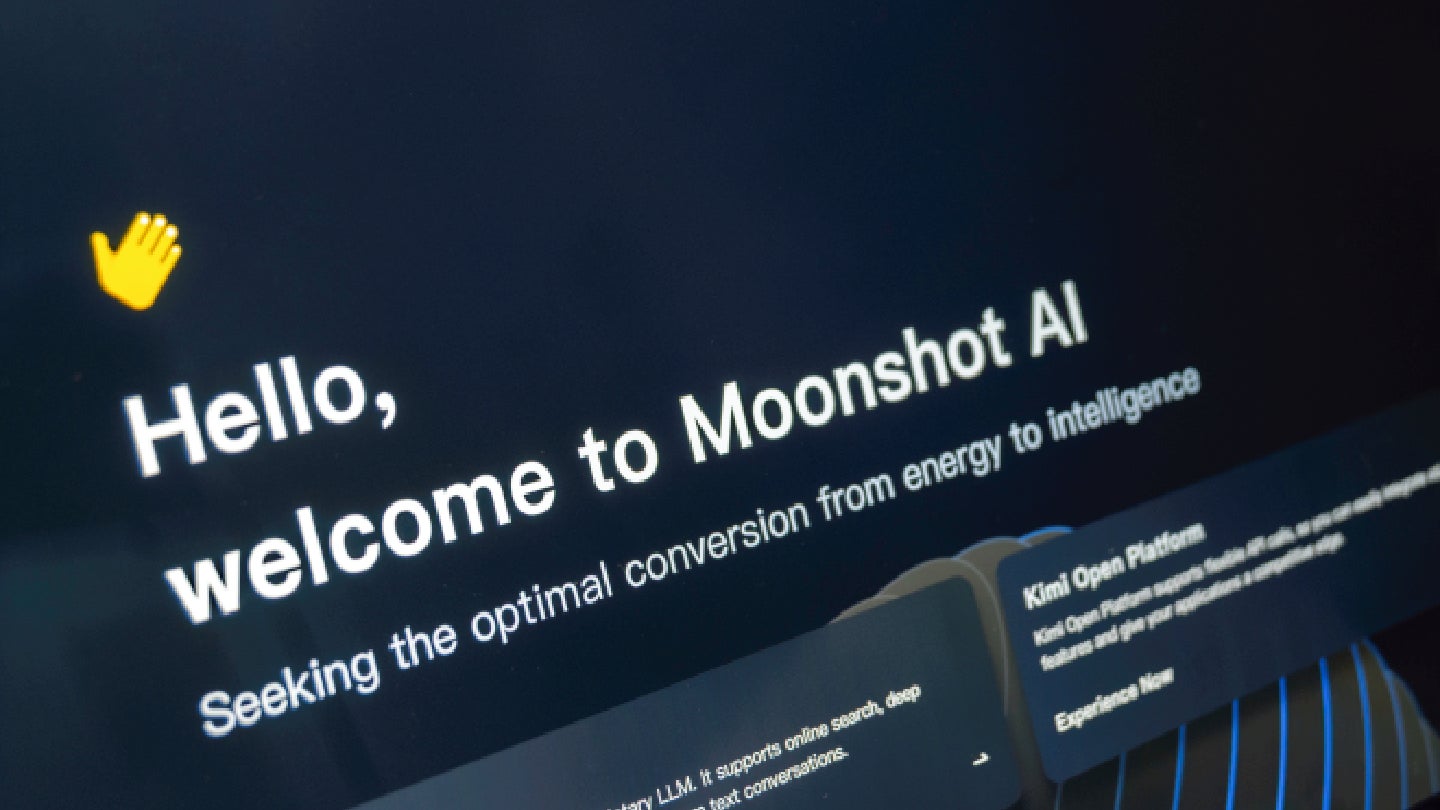
Chinese AI startup Moonshot AI has secured approximately $2bn in a new financing round, raising its valuation to over $20bn, reported Bloomberg News.
The round was led by Long-Z Investments, the venture arm of Chinese food delivery firm Meituan, according to HF Capital, which provided financial advice to some participants.
Go deeper with GlobalData


Access deeper industry intelligence
Experience unmatched clarity with a single platform that combines unique data, AI, and human expertise.
The Beijing-based company’s revenue reached more than $200m in April, due to growth in subscriptions for its Kimi chatbot and AI model services.
The funding round reflects a significant increase in Moonshot AI’s valuation. This follows a $500m raise in a Series C round at a $4.3bn valuation late last year.
Earlier this year, Moonshot AI raked in an additional $700m at a $10bn valuation. The Chinese firm then targeted a further $1bn expansion in funding.
Meituan’s Long-Z Investments confirmed its role in the latest round to the publication, while Moonshot AI representatives did not comment on the development.
Moonshot AI was founded by Yang Zhilin, a former professor at Tsinghua University who had also worked at Meta Platforms and Google. The company focuses on subscription-based chatbot products and enterprise AI solutions.
The latest fundraising round comes as investors continue to show interest in Chinese AI start-ups seeking to compete with firms such as OpenAI and Anthropic.
Other Chinese companies in the sector, including DeepSeek, MiniMax, and Zhipu AI, have also attracted significant external investment and achieved high valuations. MiniMax and Zhipu AI surpassed $30bn following their public market launches in Hong Kong earlier this year.
Moonshot AI became one of the more closely watched Chinese AI firms in 2025 after introducing K2, a large language model that runs the Kimi chatbot and is designed for demanding uses, including software development and financial research.
Kimi had previously been offered under a closed model, with details of how it was trained kept confidential. That approach shifted after DeepSeek attracted attention for open-source systems developed at relatively low cost.
In response, Moonshot AI modified Kimi and started publishing its own models openly. When K2 arrived in July 2025, the company went further by releasing the underlying architecture for others to use.