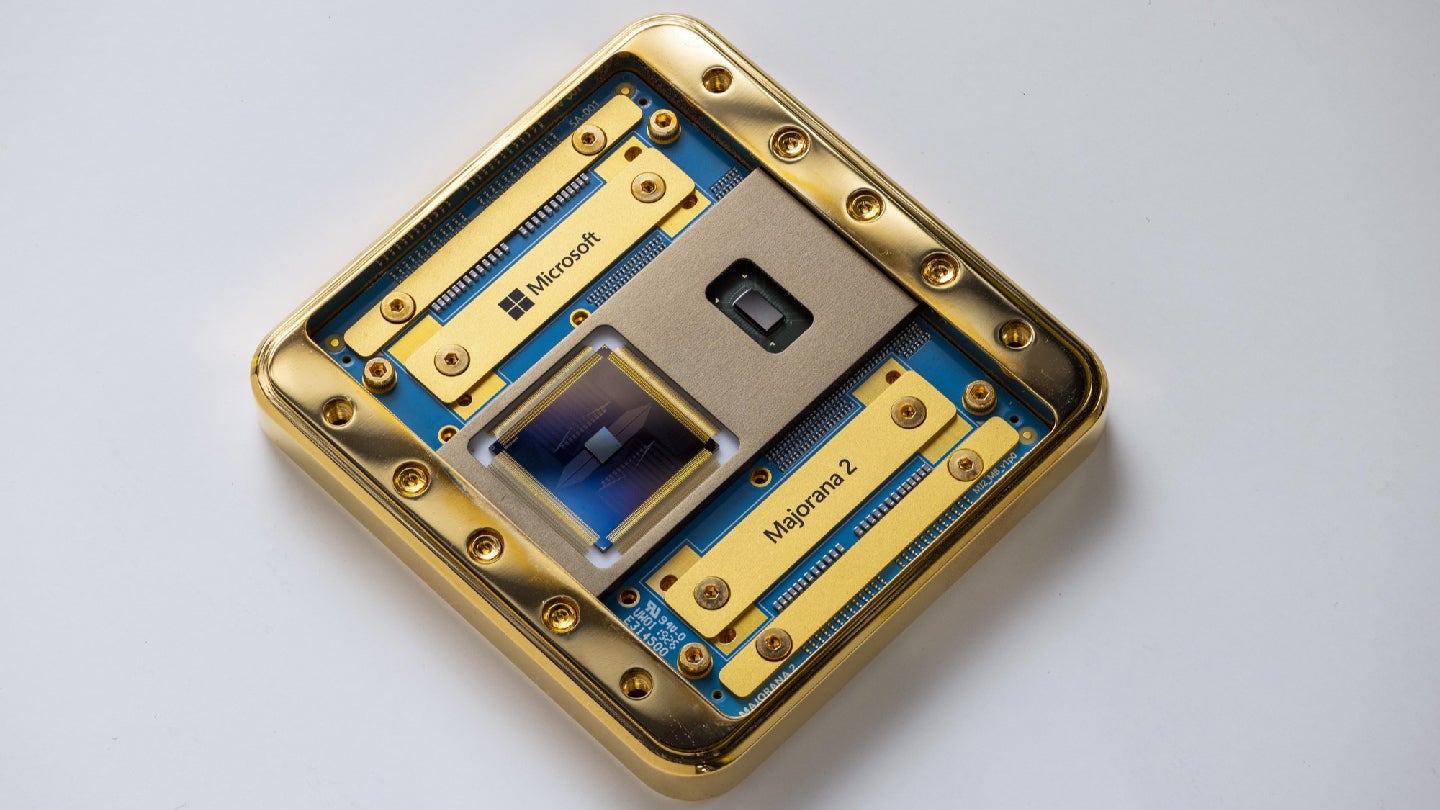
Microsoft has introduced Majorana 2, its latest topological quantum chip that features a new materials stack and qubits that are reported to be 1,000 times more reliable than those in its previous model.
The company now expects to achieve a scalable quantum computer by 2029, a revised target that moves the timeline forward by several years.
Go deeper with GlobalData


Access deeper industry intelligence
Experience unmatched clarity with a single platform that combines unique data, AI, and human expertise.
According to the company, this development is supported by advances in agentic AI engineered to boost the pace of scientific progress and foster collaboration. Microsoft said that its quantum team applies this technology to address challenges in reliability, speed and size that have limited the practical use of quantum computing.
The Majorana 2 chip differentiates itself through its ability to keep qubits in their quantum state for much longer than before. The next-generation quantum chip has been built using Microsoft Discovery’s agentic AI.
The mean lifetime for a qubit in Majorana 2 is 20 seconds, with some cases reaching up to one minute. This contrasts with the microsecond-scale qubit lifetimes often seen with other approaches and represents a substantial increase from Majorana 1, which had lifetimes between one and 12 milliseconds.
The updated chip uses lead instead of aluminium for its superconducting layer and introduces a new semiconductor region based on indium arsenide and indium arsenide antimonide.
Microsoft states that these modifications have resulted in greater robustness of the chip’s topological phase, with the protective topological gap more than doubled compared to the previous version. A larger gap offers increased protection against environmental noise and errors, contributing to the enhanced stability of the qubits.
Microsoft technical fellow and quantum hardware corporate vice president Chetan Nayak said: “We need to make improvements each year that will get us closer to delivering a computer that we believe will have massive commercial and societal value.
“We’ve got to keep marching to that roadmap to accomplish that, but where are we relative to last year? We’re 1,000 times better.”
Microsoft first launched Majorana 1 in February 2025, which it described as the first quantum processor using topological qubits. The company positions this architecture as an important step towards building large-scale quantum computers with lower error rates compared to other designs.
In addition, Microsoft announced the general availability of Microsoft Discovery, a platform designed for organisations to support frontier research and development. It includes AI agents for scientific research, a Discovery Engine to structure research workflows, and features for security and governance.
The company also released an early preview of Microsoft Discovery app for individual researchers, which allows certain core features to be accessed for free on personal devices with a GitHub Copilot account.
The Discovery platform enables researchers to deploy autonomous agent teams for tasks such as hypothesis generation, experimental optimisation, and theory validation, while built-in controls support alignment with compliance and safety standards.